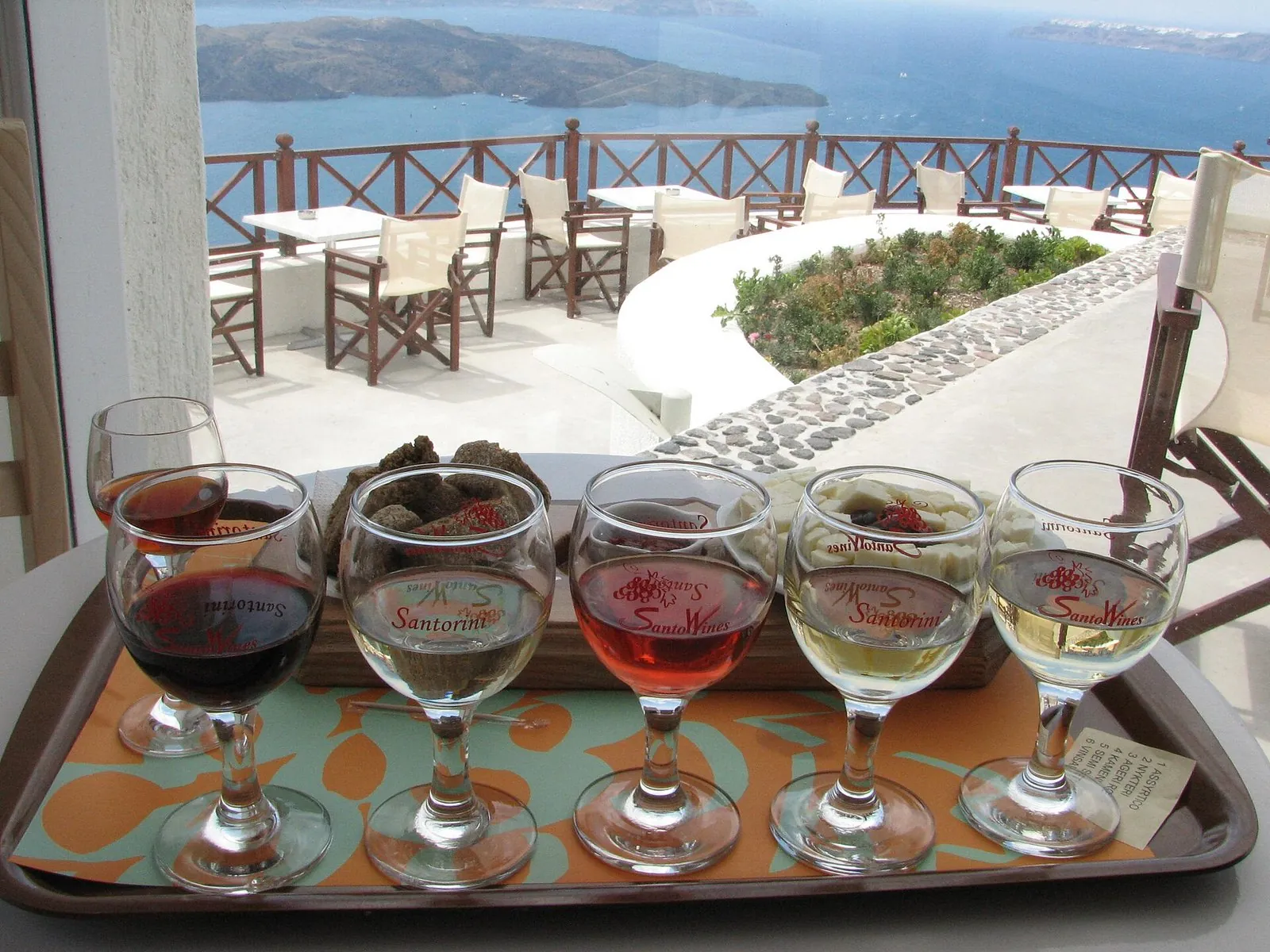
Visiting Santorini wineries is one of the best things you can do on the island, and not only for wine lovers. The wines are unusual, made mostly from Assyrtiko, a white grape that grows on volcanic soil with almost no rain, and the vines themselves look like nothing you’ve seen before: trained into low baskets on the ground to protect them from the wind. Many wineries pour their tastings on terraces above the caldera or in old cave cellars, and a winery afternoon is the most relaxed way to spend the hottest part of the day. The choice is less about which winery is “best” and more about the kind of visit you want: a big view, a serious tasting with the winemaker, or a small family estate in the vineyards.
Quick answer: For a first visit, combine one caldera-view winery for the setting with one smaller estate for the wine, and taste Assyrtiko, a Nykteri if it’s poured, and a Vinsanto to finish. Book ahead in summer, visit two or three wineries at most in a day, and don’t drive: take a tour, a taxi or the bus to Pyrgos or Megalochori (EUR 2.20 from Fira on the 2026 table).
Last updated October 4, 2026. We checked the wineries’ tastings, prices and seasons on their own websites, the Santorini and Vinsanto PDO rules on producers’ sites, and bus fares on the KTEL table in September 2026. Prices and opening hours change from season to season; confirm yours with the winery.
- Two protected wines: Santorini PDO, the dry white made mainly from Assyrtiko, and Vinsanto PDO, the sweet wine from sun-dried grapes, are both EU-protected designations.
- The basket vines: Santorini’s vines are trained in the traditional kouloura basket shape to protect them from wind and drought on the volcanic soil.
- The cooperative: Santo Wines, the Union of Santorini Cooperatives founded in 1947, represents about 1,200 grower-members.
- Harvest: the grape harvest, vedema in the local dialect, starts around mid-August; in 2026 the Vedema harvest festival at Santo Wines was held on August 2, with free admission.
- Getting there: buses from Fira to Pyrgos and Megalochori, the heart of wine country, cost EUR 2.20 (KTEL table updated May 19, 2026). Don’t drive after a tasting.
On this page: Wineries at a glance | Santorini wine in five minutes | Grapes and styles | History | The best wineries | Cave cellars | How tastings work | Day plans | Tours or DIY | Planning a winery day | Which winery suits you | Wineries map | Harvest and seasons | What to skip | FAQ
Santorini Wineries at a Glance
Our shortlist, with details from each winery’s own site as of September 2026. Where no price is shown, the winery doesn’t publish one online; book through its site for current rates.
| Winery | Village | Known for | Visiting (as published, 2026) |
|---|---|---|---|
| Santo Wines | Pyrgos | The island’s cooperative; caldera terrace | Open all year; wine flights bookable online |
| Venetsanos Winery | Megalochori | Terraces on the caldera cliff | Tasting and light lunch; book online |
| Domaine Sigalas | Near Oia | Pioneer estate, food pairing | Daily 11:00-21:00; tastings by reservation |
| Estate Argyros | Episkopi Gonia | Very old vines, since 1903 | EUR 25 or EUR 40 per adult; by appointment |
| Gaia Wines | Kamari-Monolithos coast | Seafront former tomato factory | April 29-October 31, daily 12:00-20:00 |
| Koutsoyannopoulos Wine Museum | Vothonas | Cave museum and tastings | From EUR 30 with museum entry |
| Hatzidakis Winery | Pyrgos | Underground family winery | Check its visit page |
| Artemis Karamolegos | Exo Gonia | Assyrtiko and an on-site restaurant | Book online |
| Gavalas Winery | Megalochori | Rare Katsano and Voudomato grapes | Book online |
| Art Space Winery | Exo Gonia | Art gallery in 1861 cellars | Daily 11:00 to sunset, by appointment |
| Domaine Vassaltis | Vourvoulos | Modern estate, ten labels | Book online |
Wineries rank high on any list of things to do in Santorini, and they fit neatly into a day around the villages of Pyrgos and Megalochori.
Santorini Wine in Five Minutes
You’ll enjoy the tastings far more if you know what makes Santorini wine different. Here’s the short course.
Assyrtiko, the island’s grape. Most Santorini wine is white, and most of it is Assyrtiko: a grape that keeps high acidity even in the island’s heat, giving bone-dry, mineral, often salty-tasting wines that age surprisingly well. The island’s other native white grapes, Athiri and Aidani, are often blended with it. Among the reds, look for Mavrotragano, a rare local variety, and Mandilaria.
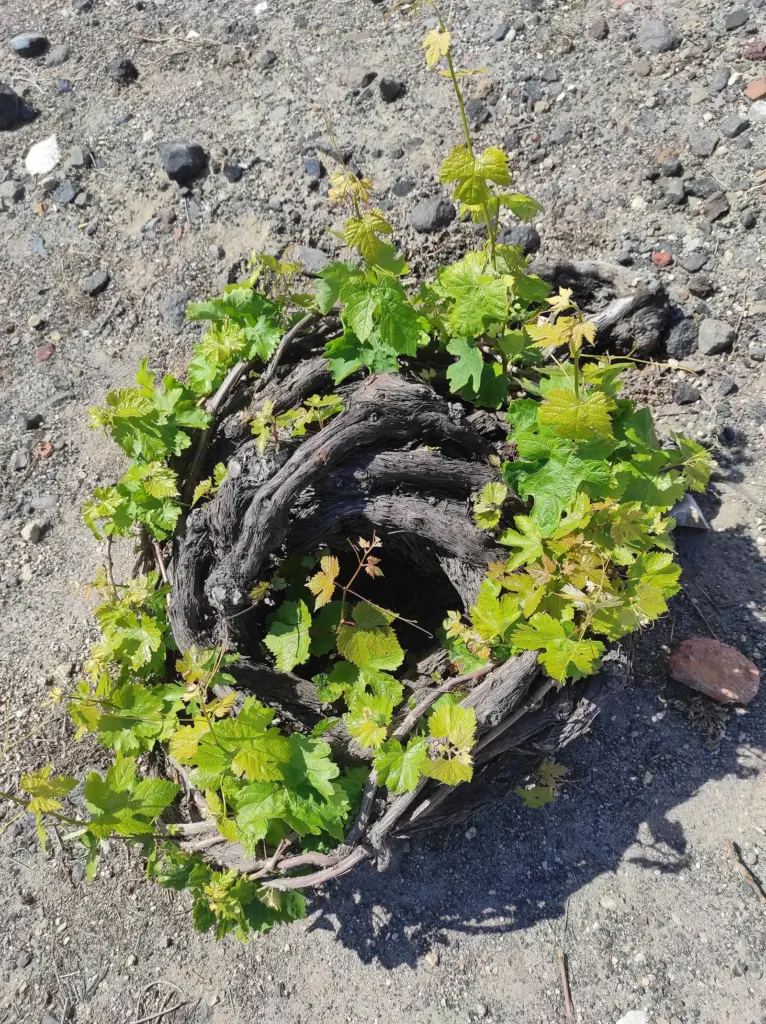
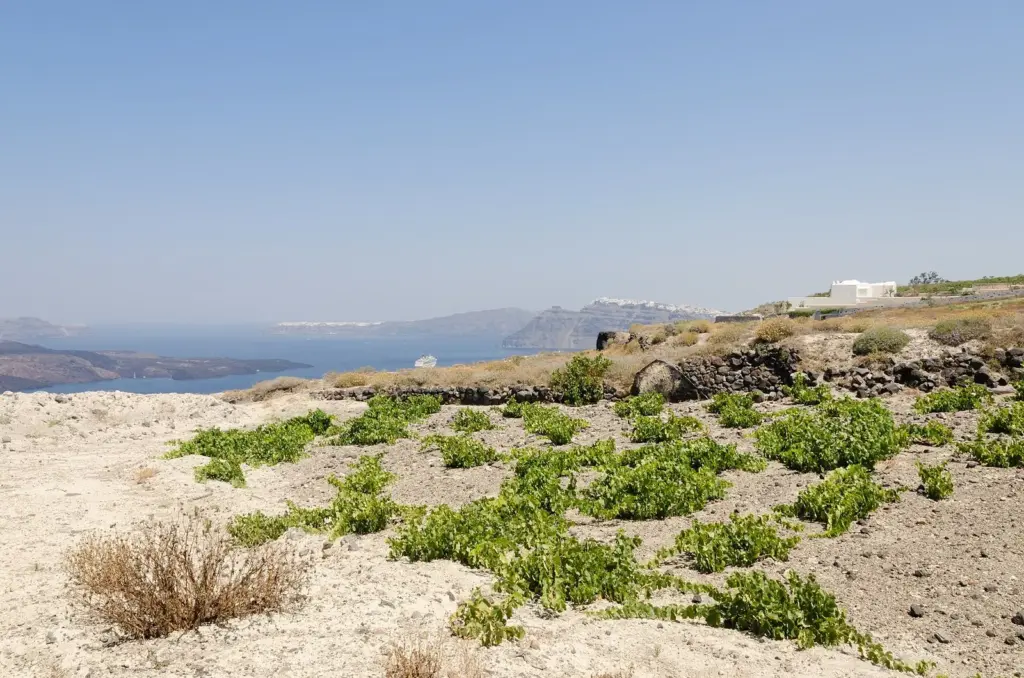
The kouloura, the basket vine. Walk past any vineyard and you’ll see vines woven into round baskets on the ground instead of on wires. The kouloura shape protects the grapes from the strong wind and the fierce sun, and helps them catch the moisture from the night air, which matters on an island that gets almost no rain in summer. It’s one of the most distinctive sights on the island.
Old, ungrafted vines. Santorini’s volcanic soil is said to have kept out phylloxera, the pest that devastated Europe’s vineyards in the 19th century, so many vines here grow on their own roots, with root systems that growers describe as centuries old. The baskets are renewed from time to time, but the roots below keep going.
Santorini PDO. The island’s dry white wine carries the protected designation Santorini PDO, which requires it to be made mainly from Assyrtiko grown on the island. You’ll also see wines labeled Nykteri, a traditional, usually oak-aged style whose name is generally explained by the old practice of pressing the grapes through the night; many wineries pour it as a richer counterpoint to their fresh Assyrtiko.
Vinsanto, the sweet one. Vinsanto is a naturally sweet wine made from grapes dried in the sun after harvest, typically about 85% Assyrtiko and 15% Aidani, and then aged, often for many years, in oak. It’s deep amber, rich and full of dried fruit and caramel, and it has its own protected designation, Vinsanto PDO. Aging periods vary from label to label, so ask the winery how long each one has been matured.
Santorini’s Grapes and Wines at a Glance
Santorini wine is mostly white, but not only white, and a good tasting takes you through several styles. This is what you’ll meet, with a few places where each is poured or made.
| Wine or grape | Style | What to expect | Poured or made at (confirmed examples) |
|---|---|---|---|
| Assyrtiko | Dry white; the heart of Santorini PDO | High acidity, citrus, a mineral and often salty edge; ages well | Every winery on this page |
| Nykteri | Oak-aged dry white | Rounder and richer than young Assyrtiko, with toasty notes | Koutsoyannopoulos Wine Museum (Silver tasting) |
| Aidani | Aromatic white; also part of Vinsanto | Floral and softer than Assyrtiko | Domaine Vassaltis, Koutsoyannopoulos Wine Museum |
| Athiri | White, often blended with Assyrtiko | Lighter and gentler | Blends at several wineries |
| Katsano and Voudomato | Rare indigenous whites | Grapes you’ll find almost nowhere else | Gavalas Winery, which says it’s the only one vinifying them |
| Mavrotragano | Dry red, rare and local | Deep color, firm structure, dark fruit | Domaine Vassaltis, Koutsoyannopoulos Wine Museum |
| Vinsanto | Naturally sweet, from sun-dried grapes; Vinsanto PDO | Amber, dried fruit, caramel, long finish | Estate Argyros, Venetsanos, Vassaltis, Koutsoyannopoulos Wine Museum |
A Short History of Santorini Wine
Wine has been made on Santorini for a very long time, and the island’s history explains much of what you’ll taste. The volcanic soil and the lack of water made grapes, along with tomatoes and fava, one of the few crops that could thrive here, and for centuries wine was one of the island’s main exports. Its sweet wine traveled across the Mediterranean and beyond; the name Vinsanto is usually explained as a contraction linked to “wine of Santorini”, and local histories tell of it being shipped far afield, including for use as a church wine.
The 20th century brought upheaval. The cooperative that became Santo Wines was founded in 1947 to give the island’s growers a common winery, and it still represents about 1,200 of them. The 1956 earthquake emptied villages and damaged cellars, and as tourism grew, vineyards were lost to building. From the 1990s, a new generation of producers helped turn Santorini into one of the most talked-about wine regions in Greece: Domaine Sigalas traces its first Santorini PDO wine under its own label to 1991, Hatzidakis was founded in 1997, and in 1999 the old Art Space winery, built in 1861, reopened as an art center with its cellars intact. Older family names such as Argyros, established in 1903, and Gavalas, with five generations behind it, carried the tradition through.
Today the pressures are different, from tourism competing for land to changes in the climate, and the old basket vines and the ungrafted roots below them are what the island’s winemakers work hardest to protect.
Why Santorini’s Landscape Makes Its Wine
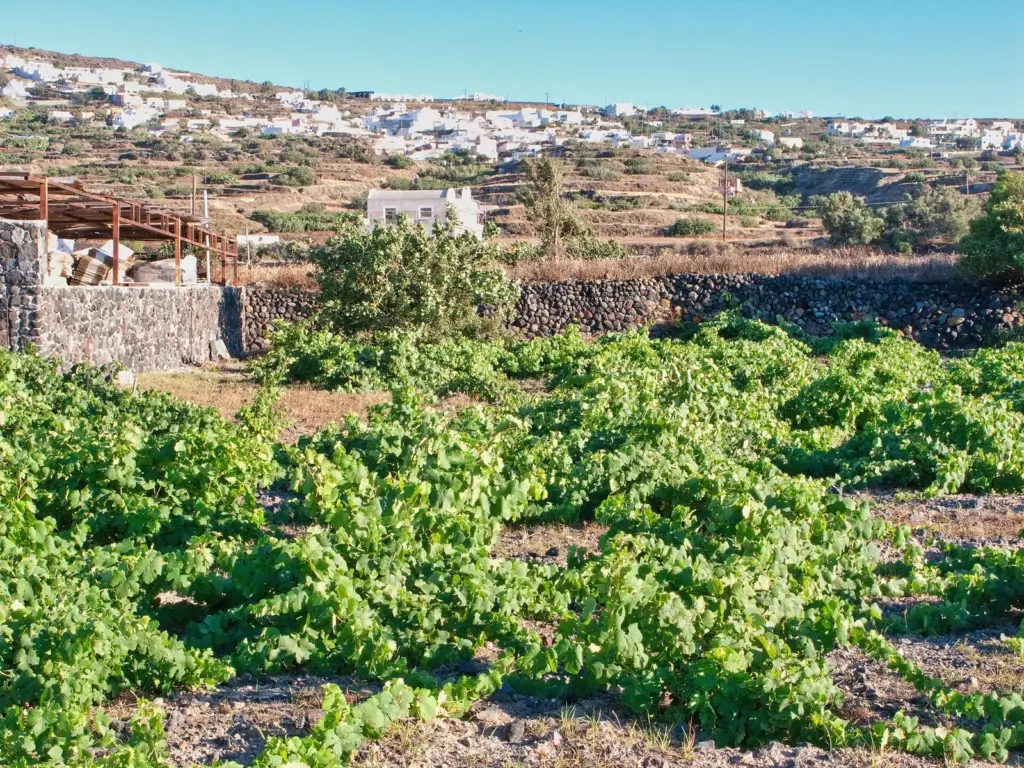
Everything about Santorini wine comes back to the volcano. The vineyards grow in layers of pumice, ash and lava left by eruptions over thousands of years, a light, sandy, porous soil with very little organic matter. It drains fast and holds little water, and in summer it barely rains, so the vines push their roots deep and give small crops of small, concentrated grapes. That stress is part of why Assyrtiko here keeps such high acidity and intensity.
The wind is the other half of the story. Santorini is exposed to strong winds for much of the year, especially the north wind in summer, which would strip young shoots and dry the grapes on a trellis. Hence the kouloura: the vine is woven into a low basket on the ground, the grapes hang inside it out of the wind and the direct sun, and the leaves trap the moisture that condenses from the sea air at night. Walk into any vineyard and you’ll see how completely the landscape has shaped the way wine is grown here.
The Best Wineries in Santorini
These are the Santorini wineries to visit, grouped roughly by what they do best. Each entry says where the winery is, what makes it worth the trip and what its own website says about visiting as of September 2026. Where a winery doesn’t publish its tasting prices online, the entry says so; book through its site for current prices.
1. Santo Wines
The cooperative with the caldera terrace. Santo Wines, in Pyrgos, is the Union of Santorini Cooperatives, founded in 1947, and it represents about 1,200 grape-growing members, so a glass here is a taste of the whole island’s vineyards. Its terrace looks out over the caldera and the volcano, which makes it the island’s most popular sunset tasting; the winery says it’s open all year and that Wine Enthusiast magazine has recommended it as the best place on Santorini to taste wine. It also hosts the island’s harvest festival, held on August 2 in 2026.
Beyond the flights, the winery has a shop stocked with the whole range from the cooperative’s growers, and a visit fits easily with an evening in Pyrgos village, a few minutes away, for dinner below the castle.
Plan it: tastings come as curated wine flights, bookable online; the winery publishes its flights menu as a PDF, so check current prices there. Book sunset slots well ahead in summer. It’s a short ride from Fira by the Pyrgos bus. Best for: first-timers who want a big view with a broad introduction to Santorini wine.
2. Venetsanos Winery
Terraces on the caldera cliff at Megalochori. Venetsanos Winery sits on the caldera edge at Megalochori and describes itself as the first industrial winery on the island. Its tastings and light lunches are served on a Main Hall Terrace and a separate Sunset Terrace, both overlooking the caldera, and its Vinsanto is made from grapes left to dry naturally in the sun. The setting on the cliff edge is part of the experience.
Combine it with Gavalas Winery and a walk through Megalochori’s lanes, or with the walk out to the caldera rim by the chapel of Saint Marina for sunset.
Plan it: book through the winery’s own site, which doesn’t list current prices on its main pages; sunset slots go first. Megalochori is EUR 2.20 by bus from Fira. Best for: a caldera-view tasting with lunch, and a Venetsanos winery visit combined with a walk through Megalochori.
3. Domaine Sigalas
A pioneer estate in the north, with serious food pairing. Domaine Sigalas stands in the vineyards on the old plain near Oia, and it’s one of the estates that put modern Santorini wine on the map; it traces its first Santorini PDO wine under the Sigalas label to the 1991 vintage. Its “Sigalas Experience” pairs five limited-edition wines with a chef-prepared dish, and there’s an a la carte menu too, with the vineyards and their basket vines around you.
What to taste: the limited-edition wines in the Sigalas Experience, and an older Assyrtiko if one is poured, to see how the estate’s whites develop.
Plan it: the winery lists its hours as Monday to Sunday, 11:00-21:00, and tastings are by reservation; it doesn’t publish prices online. It’s close to Oia, which makes Domaine Sigalas an easy stop on the way to or from a sunset there. Best for: wine lovers who want depth, food and a vineyard setting.
4. Estate Argyros
Old vines and a family history going back to 1903. Estate Argyros, in Episkopi Gonia, was established in 1903 and describes itself as the largest private owner of vineyards on Santorini, with more than 120 hectares, an average vine age of over 70 years and some parcels more than two centuries old. That age is the point: these are some of the most concentrated Assyrtikos and Vinsantos on the island.
What to taste: the old-vine Assyrtiko and the Vinsanto, which the ‘Taste the real Santorini’ experience includes. Episkopi Gonia’s Byzantine church is a few minutes away.
Plan it: on its own tour pages, the “Estate Argyros Welcome” tasting costs EUR 25 per adult and “Taste the real Santorini”, which includes Assyrtiko and the estate’s Vinsanto, EUR 40 per adult; experiences are by appointment. Best for: serious wine lovers and anyone curious about very old vines.
5. Gaia Wines
A seafront winery in an old tomato factory. The Gaia Wines Santorini winery sits on the east coast between Kamari and Monolithos, in a building the winery says served as a tomato paste factory in the early 20th century. Besides its Assyrtiko-based wines, it makes an Assyrtiko vinegar aged for five years in oak barrels, in very small quantities of about 1,500 liters a year.
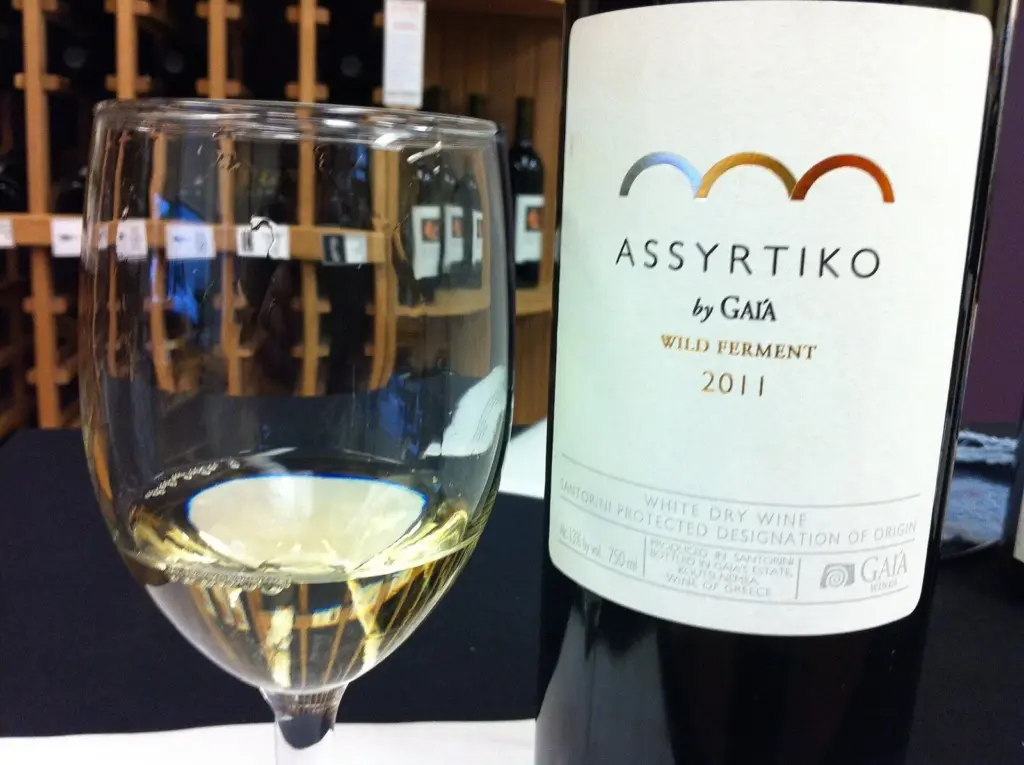
What to taste: the estate’s Assyrtikos side by side, and ask about the aged Assyrtiko vinegar, one of the island’s more unusual products.
Plan it: the winery says it’s open for visits from April 29 to October 31, daily 12:00-20:00; tastings are booked through its site, which doesn’t list prices on the Santorini page. It pairs well with a swim at Kamari or Monolithos, a few minutes away. Best for: travelers staying on the east coast and anyone who wants a seaside tasting.
6. Koutsoyannopoulos Wine Museum
A wine museum in a cave, with tastings. The Koutsoyannopoulos Wine Museum, in Vothonas, is built into a cave eight meters underground and 300 meters long, which the family says took twenty-one years of work to complete. Exhibits trace the history of winemaking on the island, and the visit ends with a tasting of the family winery’s wines. The old domain, Volcan Wines, now redirects to the museum’s own site.
What to taste: the Silver package includes a range that runs from Aidani and Assyrtiko through a rose, a Nykteri and Mavrotragano to Vinsanto and Kamaritis, a sweet red, which makes it one of the broadest introductions to the island’s styles in a single sitting.
Plan it: its booking page lists packages that include museum entry with an audio guide in 15 languages: Bronze at EUR 30 per person (75 minutes, four wines), Silver at EUR 55 (120 minutes, seven wines including Nykteri, Mavrotragano and Vinsanto), and larger packages at EUR 90, EUR 250 and EUR 450. Best for: a rainy or very hot day, families with older kids and anyone who wants the history behind the glass.
7. Hatzidakis Winery
A small underground family winery near Pyrgos. Hatzidakis Winery, in Pyrgos Kallistis, was founded in 1997 by Charidimos Hatzidakis and Konstantina Chrysou and describes itself as an underground family winery making volcanic Santorini wines.
Pyrgos village is on the doorstep, so it pairs naturally with a walk up to the Kasteli and dinner in the village.
Plan it: check the “Visit Us” page on its site for current hours and tastings; small wineries often work by appointment. Best for: enthusiasts looking for a small, personal visit.
8. Artemis Karamolegos Winery
Assyrtiko, plus a proper restaurant. Artemis Karamolegos Winery, in Exo Gonia, takes a minimalist approach to winemaking focused on Assyrtiko, and runs an on-site restaurant, Aroma Avlis Food & Wine, as well as cooking classes. That makes it one of the best places on the island to turn a tasting into a long lunch or dinner.
Plan to arrive hungry: the restaurant makes this the easiest place on the island to combine a serious tasting with a full meal.
Plan it: tastings, tours and food-and-wine pairings are booked through the winery’s site, which doesn’t show prices on the tasting page. Best for: food lovers who want a tasting with a meal.
9. Gavalas Winery
Five generations and two rare grapes. Gavalas Winery, in Megalochori, describes a history of five generations of winemaking spanning about three centuries, and says it’s the only winery on Santorini that vinifies the rare indigenous grapes Katsano and Voudomato. It’s a traditional family winery in the heart of the village, and an easy walk from the bus stop.
What to taste: the Katsano and Voudomato, if they’re poured on the day, since you’re unlikely to find them anywhere else.
Plan it: tastings are booked online through the winery’s site. Combine it with Venetsanos and a walk through Megalochori. Best for: curious drinkers who want to taste grapes they’ll find nowhere else.
10. Art Space Winery
An old winery turned art gallery. Art Space, in Exo Gonia, occupies the pumice-carved chambers of a winery established in 1861 and restored as an art center in 1999. The old cellars, kanaves in the local word, and the distillery equipment share the space with contemporary art. It’s one of the most atmospheric places on the island to see how wine was made before modern equipment.
Allow time for the galleries as well as the wine; the setting is as much the point as the tasting.
Plan it: the site gives opening hours of daily 11:00 to sunset, with visits only by appointment, and doesn’t publish tasting prices. Best for: art lovers and anyone who wants history with their wine.
11. Domaine Vassaltis
A modern estate in the quiet northeast. Domaine Vassaltis, in Vourvoulos, is a modern estate with a range of ten labels that runs from a PetNat and a pure Aidani to single-vineyard whites, a Mavrotragano and a Vinsanto. It’s a good place to see where Santorini wine is heading, away from the caldera crowds.
What to taste: the PetNat and the Aidani for something different from the usual Assyrtiko, then the Mavrotragano and Vinsanto.
Plan it: book a wine experience on the estate’s site, which doesn’t show current prices or 2026 hours on its homepage. Vourvoulos is a short drive from Fira. Best for: enthusiasts who want a contemporary take on the island’s grapes.
A note on Boutari
Older guides list the Boutari Santorini winery in Megalochori among the places to visit. In September 2026, Boutari’s own visitor page listed only its wineries at Mantineia, Naousa and Goumenissa on the mainland, not Santorini, although its Santorini PDO Assyrtiko is still sold. Check with Boutari directly before planning a visit; if you want a caldera-edge tasting in Megalochori, Venetsanos and Gavalas are in the same village.
The Canavas: Santorini’s Old Cave Cellars
Before modern wineries, Santorini’s wine was made and stored in canavas, cellars dug into the soft pumice and volcanic ash, where the temperature stays cool through the summer. Many survive, and some of the most atmospheric places on the island to drink, eat or even sleep are old canavas:
- Art Space Winery in Exo Gonia keeps its pumice-carved chambers, old cellars and distillery equipment alongside its art gallery.
- The Koutsoyannopoulos Wine Museum in Vothonas is dug eight meters underground, a modern take on the same idea.
- Vedema, the resort in Megalochori, grew out of a 400-year-old winery; its Alati restaurant is in the old canava where the estate began, and its spa sits in a 100-year-old wine cellar.
- The Symposion Cultural Center in Megalochori occupies a turn-of-the-century winery that stood empty for fifty years before it reopened in 2018.
- Caveland, a hostel in Karterados, occupies an 18th-century wine estate, with rooms in caves once used for wine storage.
Look for canavas as you walk through Megalochori, Pyrgos and the Gonia villages: arched doorways cut into the rock, sometimes still with old presses inside.
How Winery Tastings Work in Santorini
Most Santorini wineries run tastings in a similar way, though the formats and prices vary a lot, so it’s worth knowing what you’re choosing between before you book.
- Tasting flights. The standard format: a set number of wines, usually somewhere between three and a dozen, poured in small measures, often with bread, cheese, tomatoes, olives or fava. Bigger flights usually mean older vintages, single-vineyard bottlings and a Vinsanto at the end.
- Guided tours. Some wineries add a walk through the vineyard or the cellar, with an explanation of the kouloura vines, the winemaking and the history of the estate. These are the visits to book if you want to understand what you’re drinking.
- Sunset tastings. Caldera-view wineries fill up in the hour before sunset; book well ahead and arrive early.
- Food. Several wineries serve full meals or larger platters, which turns a tasting into a long lunch and makes the afternoon safer. For dinners with wine pairings, many Santorini restaurants build their lists around the island’s own producers.
- Booking. In July and August, and for any guided tour or sunset slot, book ahead on the winery’s own site. Walk-ins are often fine for simple flights outside the peak season.
- Buying bottles. Wineries sell bottles on site and many will ship. The older Vinsanto and the single-vineyard Assyrtiko are the bottles people most regret not buying.
Three Winery Day Plans
Here are three ways to spend a wine day, each built around one area so you spend your time tasting rather than driving. Book the tastings ahead in summer, and arrange a driver, a tour or the bus.
1. Megalochori and the caldera. Start late morning at Gavalas Winery in the village for its rare Katsano and Voudomato, walk through Megalochori’s lanes and look in at the Symposion Cultural Center, then have a tasting and light lunch on Venetsanos Winery’s caldera terrace. Finish with a walk out to the rim by the chapel of Saint Marina for sunset. Megalochori is EUR 2.20 by bus from Fira, and everything here is walkable.
2. The center: Gonia villages and Pyrgos. Begin with an Estate Argyros experience in Episkopi Gonia (EUR 25 or EUR 40 per adult on its site), then lunch at Artemis Karamolegos in Exo Gonia, where the restaurant makes a long meal easy. In the afternoon, see the old cellars and the galleries at Art Space, by appointment, and end the day with dinner in Pyrgos, below the castle. You’ll want a driver or a taxi for this one.
3. North and east. Book the Sigalas Experience at Domaine Sigalas near Oia for the afternoon, then head into Oia for the sunset. On another day, combine a swim at Kamari or Monolithos with a seaside tasting at Gaia Wines, and keep the Koutsoyannopoulos Wine Museum in Vothonas for a hot or wet morning, when a cave eight meters underground is the most comfortable place on the island.
Guided Wine Tours or Going It Alone?
There are two ways to do Santorini’s wineries, and both work.
A guided Santorini wine tour takes care of the bookings and the driving, usually visits three wineries in half a day, and adds a guide who explains the grapes, the soil and the history as you go. Small-group tours are the most sociable and the best value; private tours let you choose the wineries and the pace; sunset tours end at a caldera-view terrace. Before you book, ask which wineries are included, how many wines you’ll taste at each, whether food is included, and whether hotel pickup is part of the price.
Going it alone gives you more freedom and often more time at each winery. Book tastings directly on the wineries’ own sites, group them by area, and sort out transport first: a taxi for the afternoon, a designated driver, or the bus to Pyrgos or Megalochori (EUR 2.20 from Fira on the 2026 table) and a walk between wineries in the village. The price of the tastings themselves varies widely: on their own sites, for example, Estate Argyros charges EUR 25 or EUR 40 per adult for its two experiences, and the Koutsoyannopoulos Wine Museum’s packages start at EUR 30 with museum entry.
How to Get the Most From a Tasting
- Go from light to rich. Most flights run from fresh, young Assyrtiko through oak-aged whites and reds to Vinsanto. Follow the order, even if you’re tempted to jump to the sweet wine.
- Compare young and old Assyrtiko. Santorini’s white ages unusually well, and tasting a recent vintage beside an older one is the best lesson in what the grape can do.
- Taste the salt. Many people notice a saline edge in Santorini whites; see if you do.
- Eat something. Local fava, tomato fritters, capers and the island’s cheeses are made for these wines, and food slows the pace of an afternoon of tasting.
- Use the spittoon. Nobody minds, and it’s how professionals get through a long tasting.
- Ask about the vines. Winemakers and guides love to talk about old vines, the kouloura baskets and the vineyards behind each wine; it makes the tasting far more interesting.
Planning a Winery Day
Santorini’s wineries are spread across the island, but most cluster in the center and south, around Pyrgos, Megalochori, Exo Gonia and Episkopi Gonia, with a few near Oia and on the east coast. Here’s how to plan a good day.
- Two or three wineries is plenty. Tastings are generous, the sun is strong and every stop takes an hour or more. Quality beats quantity.
- Mix the settings. One caldera-view winery for the scenery, one small estate or cellar for the wine, and perhaps the wine museum in Vothonas for the history.
- Start late morning, eat at a winery. A tasting with food at lunchtime, a second tasting in the afternoon and a sunset tasting or dinner is a full, happy day.
- Don’t drive. Book a small-group or private Santorini wine tour, hire a taxi for the day, choose a designated driver, or take the bus: Pyrgos and Megalochori are EUR 2.20 from Fira on the 2026 table, and several wineries are a walk from the bus stops.
- Combine with the villages. Pyrgos and Megalochori are two of the best Santorini villages to wander between tastings; our guide to Santorini villages covers them.
A sample loop: a late-morning tasting and lunch at a winery near Megalochori, a walk through the village, an afternoon tasting at an estate near Pyrgos or Exo Gonia, then the caldera for sunset. With a car and a designated driver, add the wine museum in Vothonas. If you want everything arranged, a guided Santorini wine tasting tour takes care of the bookings and the driving, and usually visits three wineries in half a day.
Getting to the Wineries by Bus
You can reach most wine areas on the KTEL buses from Fira, all at EUR 2.20 on the price table updated May 19, 2026, then walk or take a short taxi ride to the winery. Check the timetable for the return trip, since buses thin out in the evening.
| Winery or area | Bus from Fira | Notes |
|---|---|---|
| Santo Wines, Hatzidakis (Pyrgos) | Pyrgos line, EUR 2.20 | The line runs via Vothonas |
| Koutsoyannopoulos Wine Museum (Vothonas) | Pyrgos line, EUR 2.20 | Vothonas is on the way to Pyrgos |
| Venetsanos, Gavalas (Megalochori) | Megalochori line, EUR 2.20 | Both are in or next to the village |
| Art Space, Karamolegos (Exo Gonia) | Exo Gonia is on a EUR 2.20 route | A taxi between wineries is easier |
| Estate Argyros (Episkopi Gonia) | Toward Kamari, EUR 2.20 | Best by taxi or with a driver |
| Gaia Wines (between Kamari and Monolithos) | Kamari-Monolithos line, EUR 2.20 | Combine with the beach |
| Domaine Vassaltis (Vourvoulos) | Vourvoulos line, EUR 2.20 | Quiet northeast; check return times |
| Domaine Sigalas (near Oia) | Oia line, EUR 2.20 | The estate is outside the village; a short taxi ride helps |
Santorini Wineries Map
The island’s wineries sit in three main areas: the center, around Pyrgos, Vothonas, Exo Gonia and Episkopi Gonia; the south, around Megalochori on the caldera side; and scattered estates in the north near Oia and on the east coast near Kamari. A Santorini wineries map makes it easy to group them by area, which is the key to a relaxed day.
What to Eat With Santorini Wine
Santorini’s wines are made for its food, and a little pairing makes any tasting or dinner better.
- Young Assyrtiko: grilled fish, octopus, salads with the island’s cherry tomatoes and capers, and fava, the yellow split-pea puree that’s on every menu.
- Oak-aged whites and Nykteri: richer dishes such as slow-cooked vegetables, white eggplant, creamy cheeses and roast chicken.
- Mavrotragano and other reds: grilled and roast meats, lamb and aged cheeses.
- Vinsanto: desserts, dried fruit, nuts and blue or aged cheeses, or simply on its own at the end of the meal.
Tomato fritters, the island’s signature snack, go with almost everything, and so does a bottle of chilled Assyrtiko on a hot evening.
Harvest, Seasons and the Best Time for Wineries
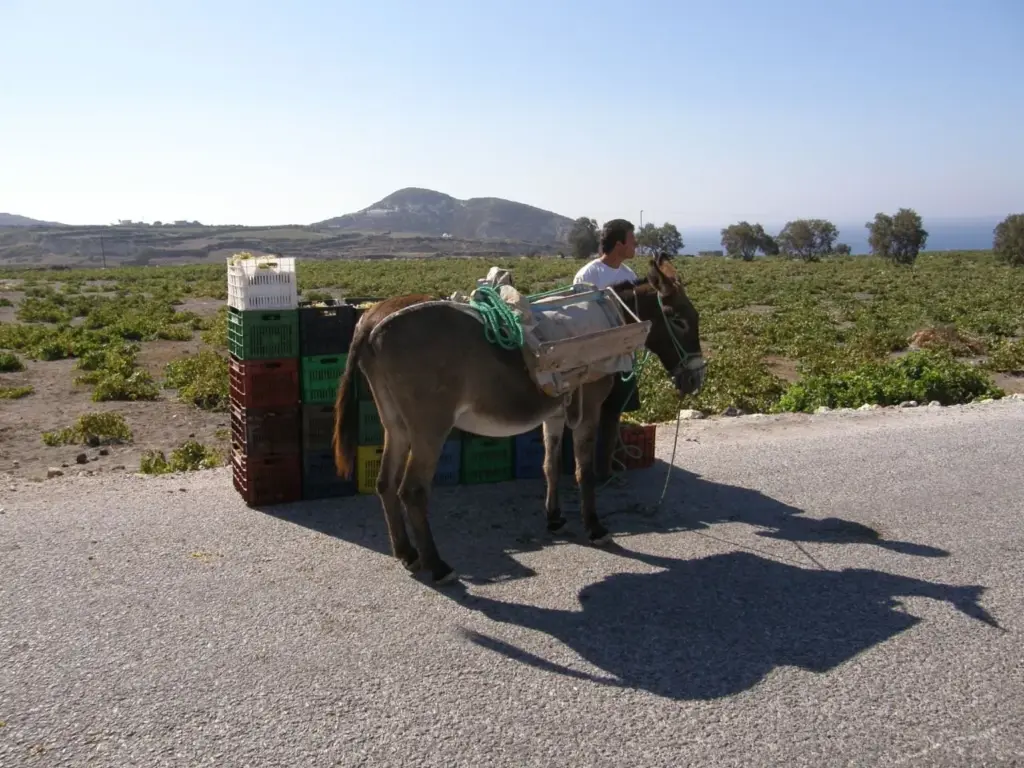
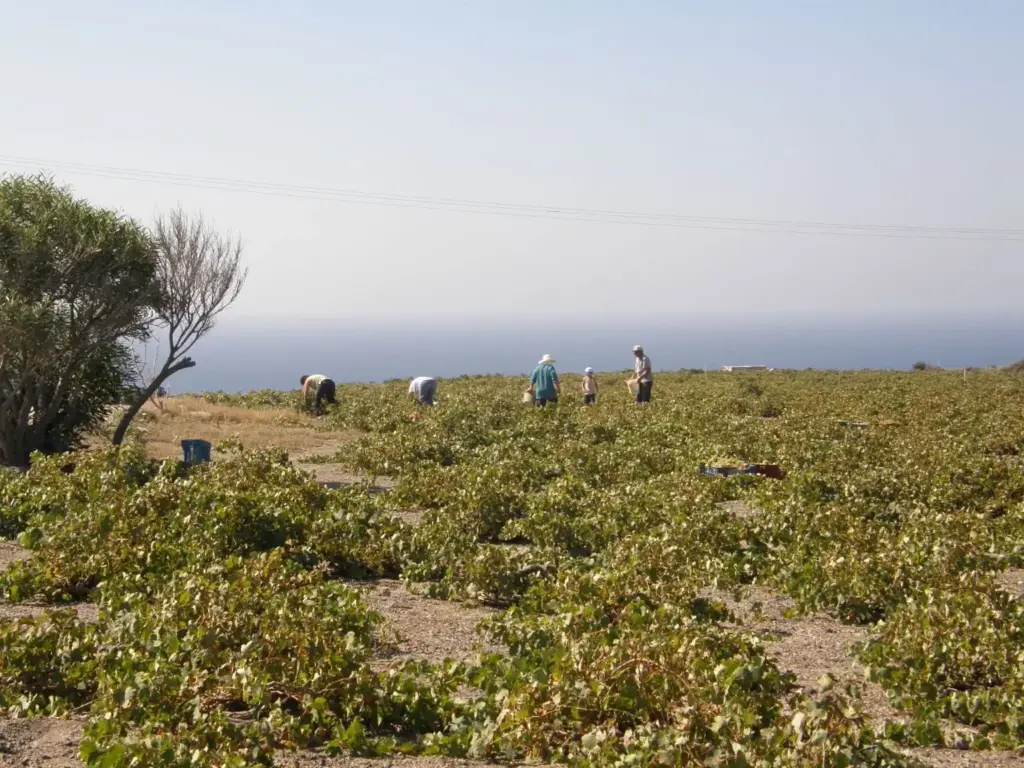
The grape harvest, the vedema, begins around mid-August and runs into September, when the wineries are busiest and the air smells of fermenting grapes. In 2026, Santo Wines hosted the Vedema harvest festival on August 2, with free admission; check Santo Wines’ site for the 2027 date.
- Spring (April-May): the vines are leafing out, the wineries are reopening and tastings are uncrowded.
- Summer (June-August): every winery is open, sunset slots sell out, and midday tastings are a welcome escape from the heat.
- Harvest (mid-August to September): the most atmospheric time, with the vineyards busy and the cellars working.
- Fall (October): quieter and cheaper, with most wineries still open.
- Winter (November-March): many wineries close or open only by appointment; check before you go.
Beer drinkers aren’t forgotten: a Santorini brewery makes craft beer on the island, a refreshing change after a day of tastings.
Buying and Taking Wine Home
Every winery sells its wines on site, and prices for the same bottle are usually no higher, and often lower, than in shops. The most sought-after bottles are the older Vinsantos and the single-vineyard or old-vine Assyrtikos, which can be hard to find abroad. Many wineries will ship for you; ask about costs and delivery times, which vary by destination. If you’re flying home with bottles, pack them in checked luggage, well wrapped, and check your country’s customs allowance for alcohol before you buy a case.
Which Winery Suits You?
| If you want… | Try |
|---|---|
| A sunset tasting over the caldera | Santo Wines, Venetsanos Winery |
| A serious tasting of old-vine wines | Estate Argyros, Domaine Sigalas, Hatzidakis Winery |
| A tasting with a proper meal | Artemis Karamolegos, Domaine Sigalas |
| Something for a hot or rainy day | Koutsoyannopoulos Wine Museum |
| Wine with art and history | Art Space Winery |
| Rare grapes | Gavalas Winery |
| A seaside winery near the beaches | Gaia Wines |
| A modern estate away from the crowds | Domaine Vassaltis |
| No car | Santo Wines, Venetsanos and Gavalas, near the Pyrgos and Megalochori bus stops |
Wine Events and Festivals
The biggest wine event of the year is the harvest festival, held at Santo Wines, which in 2026 took place on August 2 with free admission; check Santo Wines’ site for the 2027 date. The harvest itself, from mid-August into September, brings the vineyards to life, and several wineries run harvest experiences or special tastings in those weeks. The Symposion Cultural Center in Megalochori, in an old winery, hosts performances and workshops through the season. Check the wineries’ own sites and social media a few weeks before your trip for tastings, dinners and events.
Winery Practicalities and Etiquette
- Be on time. Tastings are often scheduled in slots, and guided visits start on the hour.
- Check the cancellation terms. They vary by winery and by experience, especially for prepaid bookings.
- Bring the kids if you like. Many wineries welcome families, and the wine museum’s cave is a hit with older children, but check before you book a long tasting.
- Dress for the sun. Terraces and vineyards can be exposed, so bring a hat and sunscreen for afternoon visits.
- Allow for the heat. Midday tastings are popular for good reason; drink water between wines.
- Ask questions. The staff at most wineries are happy to explain the vines, the soils and the wines, and a good question often earns an extra pour of something special.
What a Winery Day Costs
A wine day can be as simple or as lavish as you like. As a guide from the wineries’ own sites in September 2026: Estate Argyros’s two experiences cost EUR 25 and EUR 40 per adult, and the Koutsoyannopoulos Wine Museum’s packages run from EUR 30 per person with museum entry and four wines to EUR 55 with seven wines, with premium options far above that. Other wineries price their flights on their booking pages. Add transport (EUR 2.20 each way by bus, much more by taxi or with a private driver), lunch at a winery restaurant, and any bottles you take home. Two tastings, lunch and the bus make a comfortable mid-range day; a private tour with three wineries and a sunset tasting costs several times more.
A Short Glossary of Santorini Wine Words
- Assyrtiko: the island’s main white grape and the heart of Santorini PDO wines.
- Aidani and Athiri: Santorini’s other native white grapes, often blended with Assyrtiko; Aidani also goes into Vinsanto.
- Mavrotragano and Mandilaria: the island’s red grapes; Mavrotragano is rare and prized.
- Katsano and Voudomato: rare indigenous white grapes, still made into wine at Gavalas.
- Kouloura: the basket shape the vines are trained into, to shelter the grapes from wind and sun.
- Canava: a traditional wine cellar dug into the volcanic rock.
- Nykteri: a traditional, usually oak-aged style of white wine.
- Vinsanto: the naturally sweet wine made from sun-dried grapes, with its own PDO.
- Vedema: the grape harvest, in the local dialect, and the name of the harvest festival.
- PDO: Protected Designation of Origin, the EU label that protects Santorini and Vinsanto wines.
Visiting Wineries Outside the Summer
Wine is one of the best reasons to visit Santorini in the quieter months, since a tasting doesn’t depend on beach weather. Hours shrink, though. Santo Wines says it’s open all year; Gaia Wines’ Santorini winery gives its visiting season as April 29 to October 31; and Art Space works by appointment. Many smaller wineries cut their hours or open only on request from November to March, so contact them before you go, and expect a quieter, more personal visit when you do.
The Future of Santorini’s Vineyards
Santorini’s vineyards face real pressures: land lost to building as tourism grows, a very dry climate getting drier, and the constant work of keeping old basket vines alive. Wineries are investing to cope. Domaine Sigalas, for example, publishes details of a project under Greece’s national recovery plan to upgrade its equipment and introduce environmental protection and water-saving measures. Visiting, tasting and buying the island’s wines is one of the most direct ways travelers can help keep the vineyards, and the landscape they create, alive.
What to Skip
- Driving between tastings. The roads are narrow and busy, and even small tasting pours add up. Take a tour, a taxi or the bus.
- Five wineries in a day. You’ll remember none of them. Two or three is the sweet spot.
- Sunset tastings without a booking in summer. The best terraces fill days ahead.
- Judging Assyrtiko by one glass. Taste a young one, an older one and a Nykteri side by side; the differences are the point.
- Skipping the Vinsanto. Even people who don’t like sweet wine are often won over.
Santorini Wineries FAQ
What wine is Santorini famous for?
Assyrtiko, a crisp, mineral white grape grown in volcanic soil, which makes the island’s dry Santorini PDO wines, and Vinsanto, a naturally sweet wine from sun-dried grapes (typically about 85% Assyrtiko and 15% Aidani), aged for years in oak. Both carry EU-protected designations. Look out for Nykteri and for the rare red grape Mavrotragano too.
How many wineries should I visit in one day?
Two or three. Tastings are generous, each visit takes an hour or more, and the afternoon sun is strong. Mix one caldera-view winery for the setting with a smaller estate or cellar for the wine, eat at one of them, and let someone else drive: a tour, a taxi or the bus.
Do I need to book winery tastings in Santorini?
In July and August, and for guided tours or sunset slots, yes: book ahead on the winery’s own site. Outside the peak season, simple tasting flights can often be arranged on the day. Many wineries close or work by appointment only from November to March, so check before you go.
Why are Santorini’s vines shaped like baskets?
The kouloura, the traditional basket shape, protects the grapes from the island’s strong winds and fierce sun and helps them catch moisture from the night air, since it barely rains in summer. The vines grow close to the volcanic ground, with the grapes sheltered inside the woven basket.
What is Vinsanto?
Vinsanto is Santorini’s naturally sweet wine, made from grapes dried in the sun after harvest, typically about 85% Assyrtiko and 15% Aidani, then aged in oak, often for many years. It has its own protected designation, Vinsanto PDO. Aging periods differ from label to label, so ask the winery about each bottle.
Can I get to the wineries without a car?
Yes. KTEL buses from Fira to Pyrgos and Megalochori cost EUR 2.20 on the 2026 table, and several wineries are within walking distance of the village stops. Guided wine tours include transport, and a taxi for the afternoon is another option. Driving yourself after tastings is a bad idea on these roads.
When is the grape harvest in Santorini?
The harvest, called vedema in the local dialect, starts around mid-August and runs into September, depending on the year and the grape. It’s the most atmospheric time to visit the wineries. In 2026, Santo Wines hosted the Vedema harvest festival on August 2, with free admission; the 2027 date wasn’t yet announced.
Is Santorini wine expensive?
It’s among the pricier wines in Greece, because yields from the old basket vines are very low and land is scarce. At the wineries, tastings range widely: on their own sites, Estate Argyros charges EUR 25 or EUR 40 per adult, and the Koutsoyannopoulos Wine Museum’s packages start at EUR 30 with museum entry. Bottles bought at the winery are often good value.
Sources and How We Checked
We checked the wineries’ own websites and the producers’ pages on the island’s protected designations in September 2026, and dated every price; we did not visit the wineries for this guide, and no winery paid to be included.
- Santo Wines, Venetsanos Winery, Domaine Sigalas and Estate Argyros: tastings, hours and prices
- Gaia Wines, Koutsoyannopoulos Wine Museum and Hatzidakis Winery
- Artemis Karamolegos, Gavalas Winery, Art Space Winery and Domaine Vassaltis
- Santo Wines: Santorini PDO, for the protected designations and the kouloura vines
- Boutari: visitable wineries (Santorini not listed in September 2026)
- KTEL Santorini price table (updated May 19, 2026): buses to Pyrgos and Megalochori
Santorini Tourism Guide is an independent publication. We are not affiliated with the Municipality of Thira, the Greek National Tourism Organisation, any winery or tour operator listed here, and no one paid to be included.
Photo Credits
- Santorini wine tasting flight: photo by Marcelo Costa, via Wikimedia Commons (CC BY 2.0)
- Kouloura-trained Assyrtiko vine: photo by AkatsukiKuro, via Wikimedia Commons (CC0)
- Old vines at Domaine Sigalas: photo by Treephoto, via Wikimedia Commons (CC BY-SA 4.0)
- A glass of Assyrtiko: photo by Agne27, via Wikimedia Commons (CC BY-SA 3.0)
- Vineyards near Megalochori: photo by Norbert Nagel, via Wikimedia Commons (CC BY-SA 3.0)
- The August grape harvest: photo by Klearchos Kapoutsis from Santorini, Greece, via Wikimedia Commons (CC BY 2.0)
- Harvest crates and donkey: photo by Klearchos Kapoutsis from Santorini, Greece, via Wikimedia Commons (CC BY 2.0)