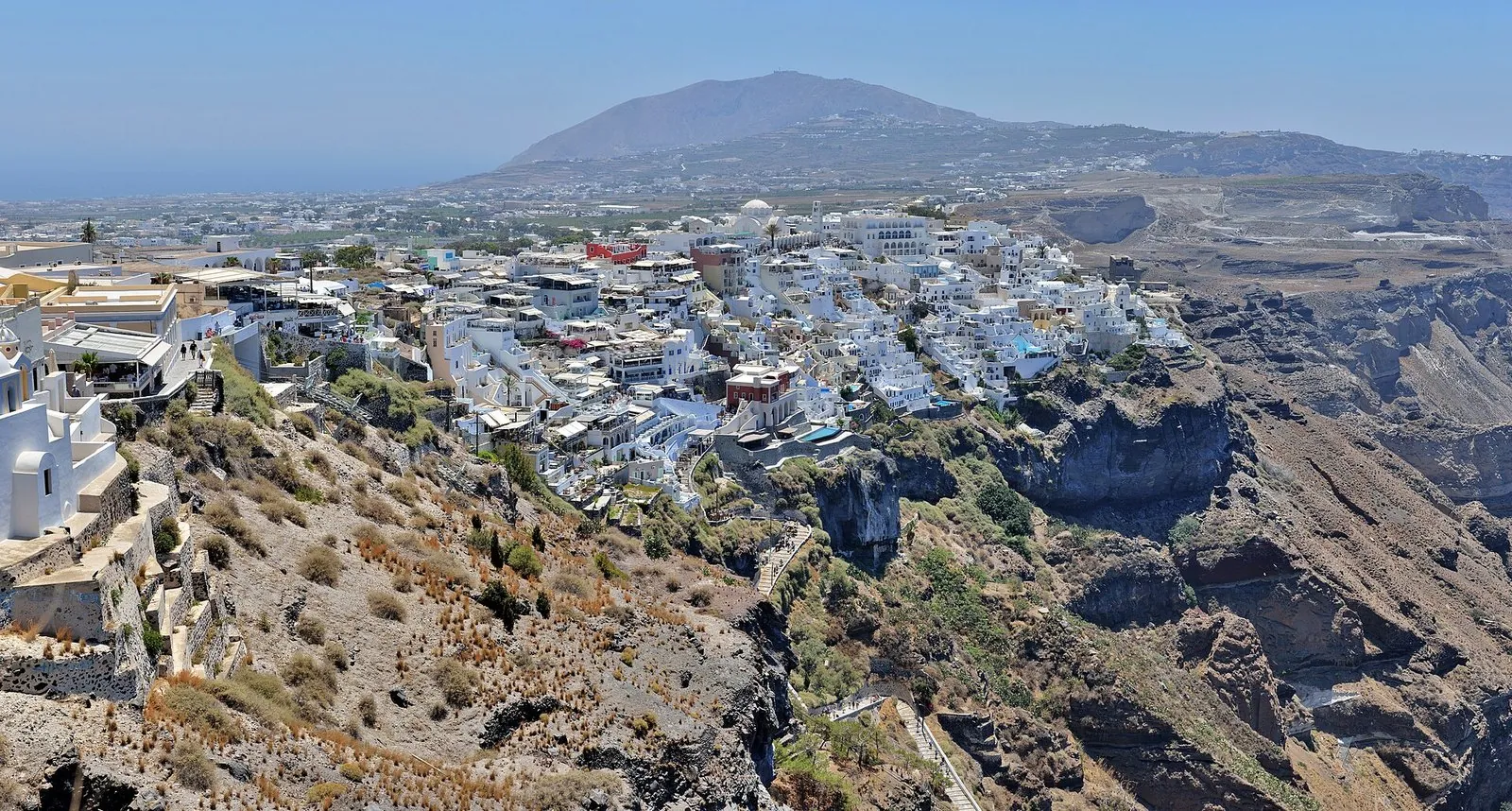
Fira Santorini, or simply Fira, is the island’s capital, its transport hub and its busiest town: a tangle of white lanes, churches and terraces poured over the top of a 200-plus-meter cliff, looking straight across the caldera at the volcano. It’s not the quietest place on Santorini, and it isn’t trying to be. If you want views, museums, restaurants, nightlife and buses to everywhere within a few minutes’ walk, Fira is the best base on the island. If you want silence, stay in Firostefani or Imerovigli and walk in. Either way, give Fira at least a full day.
Quick answer: Fira (Thira) is Santorini’s capital on the caldera rim. The best things to do there are the caldera walk to Firostefani and Imerovigli, the Three Bells of Fira, the two cathedrals, the Museum of Prehistoric Thera (EUR 10, closed Tuesdays) and a ride down to the Old Port by cable car (EUR 10 one way in 2026). Buses run from Fira to Oia every 30 minutes on the summer timetable.
Last updated October 10, 2026. We checked museum hours, cable car and bus fares, and the 2026 Old Port restrictions against official sources and operators’ own sites between September 24 and October 1, 2026. Church histories come from secondary sources and are marked as such.
- What changed: under 2026 Civil Protection measures in force until March 31, 2027, a restricted zone bars visitors from parts of Fira’s Old Port and the slopes above it; the cable car and the Karavolades steps were not restricted. The steps themselves were closed from July 27 to August 3, 2026 after a wall collapse and then reopened by municipal order.
- What it costs: cable car EUR 10 adult, EUR 5 reduced and EUR 5 per bag one way (2026 price list); Museum of Prehistoric Thera and Archaeological Museum of Thera EUR 10 each; KTEL bus from Fira to Oia EUR 2.20 (May 19, 2026 table).
- Season: Fira is the one place on the island that stays busy year-round, but several sights are seasonal: Megaron Gyzi opens May 1 to October 31, Monday to Saturday.
- The trap: the hours when several cruise ships are in. The cable car, the main caldera lanes and the Oia buses all fill at once; walk the caldera path early, and save the shops for the evening.
On this page: Fira at a glance | Is Fira worth visiting? | Map | 12 things to do | Walking tour | The Old Port | Fira sunset | Eating and nightlife | Staying in Fira | Firostefani and Imerovigli | History | Getting there | What’s changed | FAQ
Fira Santorini at a Glance
| Question | Answer |
|---|---|
| Where is it? | On the caldera rim in the middle of Santorini’s west coast, 11.8 km by road from Oia and 18 km from Athinios port |
| Also called | Thira (Θήρα), the island’s official name; Fira (Φηρά) on Greek signs |
| Best for | First-timers, travelers without a car, museums, nightlife, choice of food at every budget |
| Time needed | A full day to see it; a half day for the walk and the main sights |
| Beach? | No. The nearest beach town is Kamari, 7.3 km away, with buses every 30 minutes most of the day |
| Getting there | The KTEL bus hub: Oia, Kamari, Perissa, Akrotiri and the airport for EUR 2.20 to 2.70 |
| Signature sights | The caldera path, the Three Bells of Fira, the two cathedrals, the Old Port |
| Busiest hours | Late morning to late afternoon when cruise ships are in, and the hour before sunset |
Is Fira Worth Visiting?
Yes, and not only because almost every visitor passes through it anyway. Fira has the island’s two archaeological museums, its Orthodox and Catholic cathedrals, the most varied food and nightlife, and the start of the caldera path, the walk that shows Santorini at its most spectacular. It’s also where you’ll catch buses to the rest of the island, so even if you stay in Oia or on the beach, you’ll be here more than once.
It’s honest to name the downsides. On days when several cruise ships anchor below the cliff, the caldera lanes fill with tour groups from late morning, the cable car has long lines, and the town can feel like a shopping mall on a ledge. Some of the main lanes are lined wall to wall with jewelers and souvenir shops. And it’s a working town, with traffic, delivery trucks and a bus station that’s busy rather than pretty.
The fix is timing. Walk the caldera edge before 10:00 or after 17:00, see the museums in the middle of the day when the heat and the crowds are at their worst outside, and come back to the cliff for the evening light. Do that, and Fira is one of the great small towns of the Mediterranean.
Fira Santorini Map
Fira runs along the cliff from south to north. The bus station and the main road sit on the inland side; the caldera edge, with its paths, churches and terraces, is a few minutes’ walk west. The Orthodox cathedral and the Museum of Prehistoric Thera are near the southern center, the cable car station and the Catholic quarter to the north, and the caldera path continues north to Firostefani and Imerovigli. The Old Port lies 200-plus meters below, reached by cable car or the zigzag of the Karavolades steps.
Things to Do in Fira, Santorini: 12 Best
These are the best things to do in Fira, roughly in the order you’d meet them on a walk from the south end of town to Firostefani, with the Old Port and the evening at the end.
1. Walk the Caldera Path to Firostefani and Imerovigli
Free, the essential Fira experience. The paved path along the cliff edge is the reason most people fall for Fira. Walking north, you pass hotel terraces, chapels and viewpoints over the volcano, and in about 15 minutes you’re in Firostefani; carry on and you reach Imerovigli, the highest of the caldera villages, with Skaros rock below. The full Fira to Imerovigli walk is short enough for anyone in reasonable shape and long enough to change how you see the island.
Plan it: go before 10:00 or after 17:00 in summer; there’s little shade. Comfortable shoes, water and a hat. The path continues all the way to Oia, roughly 10 km in total; take the bus back to Fira for EUR 2.20. Best for: everyone, at least once.

2. The Three Bells of Fira
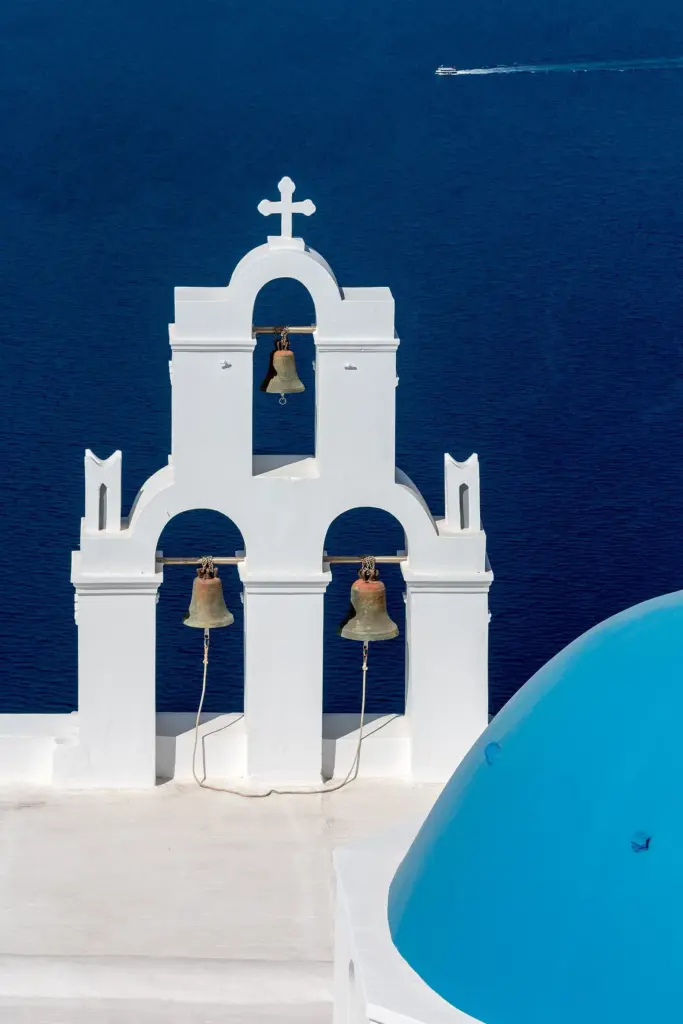
Free, the most photographed belfry in town. The Three Bells of Fira is the Catholic church of the Dormition (Koimisis tis Theotokou), on the caldera edge between Fira and Firostefani. Secondary sources date it to 1757 and say it was badly damaged in the 1956 earthquake and later restored. Its triple bell gable and blue dome against the caldera make one of the island’s most recognizable photographs, which you’ll take from the path just above it.
Plan it: it’s on the caldera path north of the cable car; go early for the photo without a crowd. Respect the church: it’s a place of worship, not a set. Best for: photographers and anyone walking to Firostefani.
3. The Orthodox Metropolitan Cathedral
Free, the heart of the Orthodox town. Fira’s big white cathedral, the Ypapanti (Presentation of Christ), stands on the caldera side of the southern center, next to the Museum of Prehistoric Thera. Sources date it to 1827 and say it was severely damaged in the 1956 earthquake and rebuilt; inside, the frescoes covering the walls are the work of the local artist Christoforos Asimis. Its broad courtyard is one of the few open spaces in central Fira.
Plan it: modest dress (shoulders and knees covered) and quiet voices; avoid photography during services. Pair it with the museum next door. Best for: anyone curious about Orthodox church art.
4. The Catholic Quarter and the Cathedral of St John the Baptist
Free, Fira’s Venetian legacy. North of the center, the Catholic quarter is quieter and more residential, a reminder that Santorini was ruled by Latin lords for centuries. Its cathedral of Saint John the Baptist, a pale baroque-style church with a clock tower, was built in 1823 on the site of a 17th-century Jesuit church and restored after the 1956 earthquake, according to secondary sources; it is the seat of the island’s Catholic bishop. Megaron Gyzi is nearby, and the lanes are among the most atmospheric in town.
Plan it: it’s a short walk from the cable car station; combine it with Megaron Gyzi and the Three Bells. For the island’s history from the Bronze Age to the Venetians, see our guide to Santorini history. Best for: history lovers and anyone escaping the crowds.
5. Museum of Prehistoric Thera
EUR 10, the key to Akrotiri. This museum, beside the Orthodox cathedral, holds finds from the Bronze Age town of Akrotiri and earlier sites, from Early Cycladic marble figurines to jugs painted with swallows and wall paintings from Akrotiri’s houses. Seeing it before the site makes the ruins make sense.
Plan it: EUR 10, EUR 5 reduced; 08:30-15:30, closed Tuesdays (Ministry of Culture schedule). Best for: anyone planning to visit Akrotiri, and hot afternoons.
6. Archaeological Museum of Thera
EUR 10, Greek and Roman Santorini. Reopened on June 13, 2025 after works, the museum holds sculpture and inscriptions from the Archaic to the Roman period and painted vases and clay figurines from the Geometric to the Hellenistic. The building itself replaced an older museum that collapsed in the 1956 earthquake.
Plan it: EUR 10, EUR 5 reduced; summer hours Tuesday to Friday and Sunday 08:30-15:30, Saturday 09:00-21:00, closed Mondays. Best for: visitors who have been to Ancient Thera or plan to.
7. Megaron Gyzi
The island’s history museum and cultural center. In the Catholic quarter, Megaron Gyzi covers Santorini’s Venetian, Ottoman and modern history and runs exhibitions and the long-running Megaro Gyzi Festival, whose 40th edition ran August 3-13, 2026, with free admission to its events.
Plan it: open May 1 to October 31, Monday to Saturday 10:00-16:00 (2026 schedule). Best for: anyone curious about the island between Byzantium and tourism.
8. Santozeum: The Akrotiri Wall Paintings, Full Size
Reproductions of the Akrotiri frescoes. Many of Akrotiri’s original wall paintings are in Athens, and Santozeum shows the Thera Foundation’s full-size 3D photographic reproductions of them, displayed in Fira since 2011. It’s the easiest way to see the whole cycle of paintings in one room, at their real scale.
Plan it: directory listings give hours of May 1 to October 31, daily 10:00-18:00, so check this year’s hours with the museum before you go. Best for: art lovers who can’t get to Athens’ National Archaeological Museum.
9. Ride the Cable Car or Walk the Karavolades Steps to the Old Port
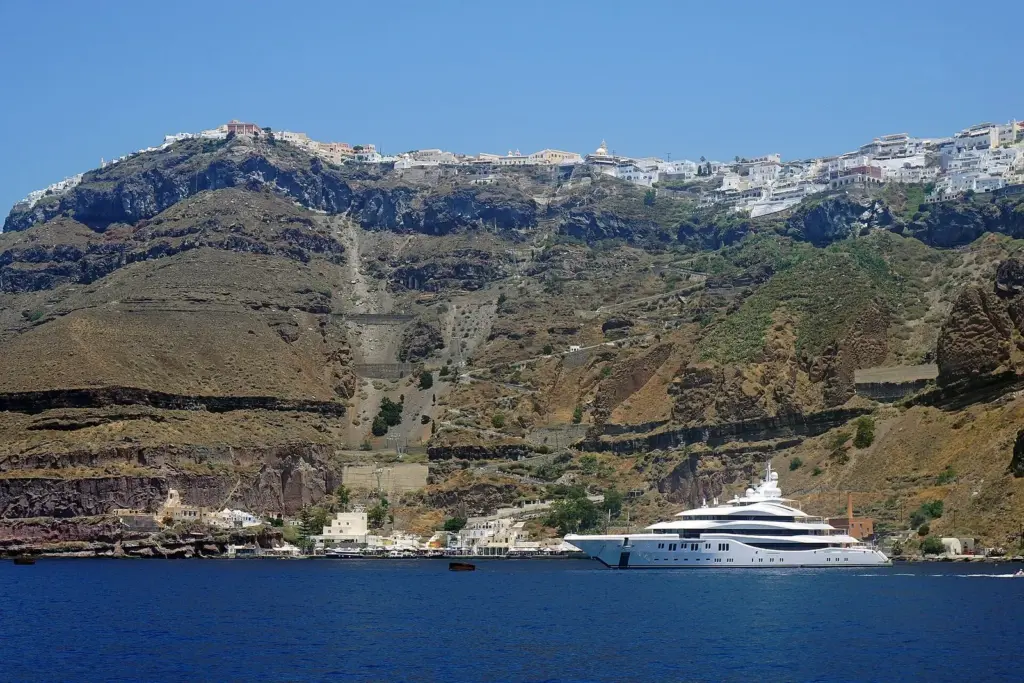
EUR 10 by cable car, free on foot. The cable car drops from the top of the cliff to the Old Port at its foot in a few minutes, and the view on the way down is half the point. The alternative is the Karavolades steps, a zigzag of a few hundred steps (sources give 588 to 650) that the donkeys also use. The steps were closed from July 27 to August 3, 2026 after a retaining-wall collapse and reopened by municipal order.
Plan it: cable car EUR 10 adult, EUR 5 reduced (children 6-12 and some other groups), EUR 5 per piece of luggage, under-6s free; cash or card (2026 price list). Walking down takes 20 to 30 minutes, according to one boat operator, and walking up in the heat is a real workout. Lines for the cable car get long when cruise ships are in. Best for: the views, and anyone catching a volcano boat.
10. Take a Volcano Boat From the Old Port
From EUR 30, the cheapest way onto the caldera. The classic wooden volcano boats still sail from Fira’s Old Port. Dakoutros Bros’ Santorini Excursions lists departures at 11:00 and 14:30 for its three-hour volcano and hot springs trip (EUR 30 without transfer) and 15:30 for its sunset cruise (EUR 45), plus a six-hour three-island trip with time on Thirasia (EUR 35). Add EUR 5 in cash for the Nea Kameni volcano ticket.
Plan it: meet at the operator’s Old Port office 15 minutes before departure, allowing time for the cable car or the steps. The crossing to the volcano takes about 10 minutes. Best for: budget travelers and anyone who wants to walk on the volcano.
11. Watch the Sunset From the Caldera Edge
Free, and calmer than Oia. Fira faces west across the caldera, so every terrace and path on the cliff edge is a sunset seat. The light turns the cliffs orange, the Kameni islands go dark and the boats head home below. The Fira sunset doesn’t have Oia’s famous crowd at the castle, which for many people is exactly the appeal.
Plan it: claim a spot on the caldera path toward Firostefani or a cafe terrace about an hour before sunset; times move by more than two hours between June and December, so check for your dates. Best for: couples, photographers and anyone who’d rather not fight for space in Oia.
12. Browse Fira’s Shops and Galleries
From souvenirs to fine jewelry. The lanes just behind the caldera edge are Santorini’s main shopping streets, packed with jewelers, art galleries, local products such as fava, capers and wine, and plenty of souvenirs. Walk north to Firostefani and you’ll find Atlantis Books, which its own website says has moved from Oia to the cliffside of Firostefani, at the base of the Nomikos Cultural Centre; it sells new, used and rare books in several languages and says it’s open every day.
Plan it: shop in the late afternoon and evening, when the day-trippers have gone and the light is softer; compare prices before buying jewelry, and ask for a receipt. Best for: gift hunters and book lovers.
A Walking Tour of Fira: The Classic Half Day
This route takes about three hours at an easy pace, including a museum, and covers the town from south to north before carrying on to Firostefani. Start at 08:30 to beat the heat and the cruise crowds.
- The Orthodox Metropolitan Cathedral and the Museum of Prehistoric Thera. Start in the southern center, with the cathedral’s courtyard and the museum next door, which opens at 08:30 (closed Tuesdays).
- The caldera edge. Walk out to the cliff behind the cathedral and follow the paths north, with the volcano straight ahead and the Old Port far below.
- The cable car station and the Karavolades steps. Look down the zigzag of the steps and decide whether the Old Port is part of today’s plan.
- The Catholic quarter. Turn inland for the Cathedral of Saint John the Baptist and Megaron Gyzi, in the quietest lanes of central Fira.
- The Three Bells of Fira. Back on the caldera path, continue north to the Catholic church of the Dormition and its famous belfry.
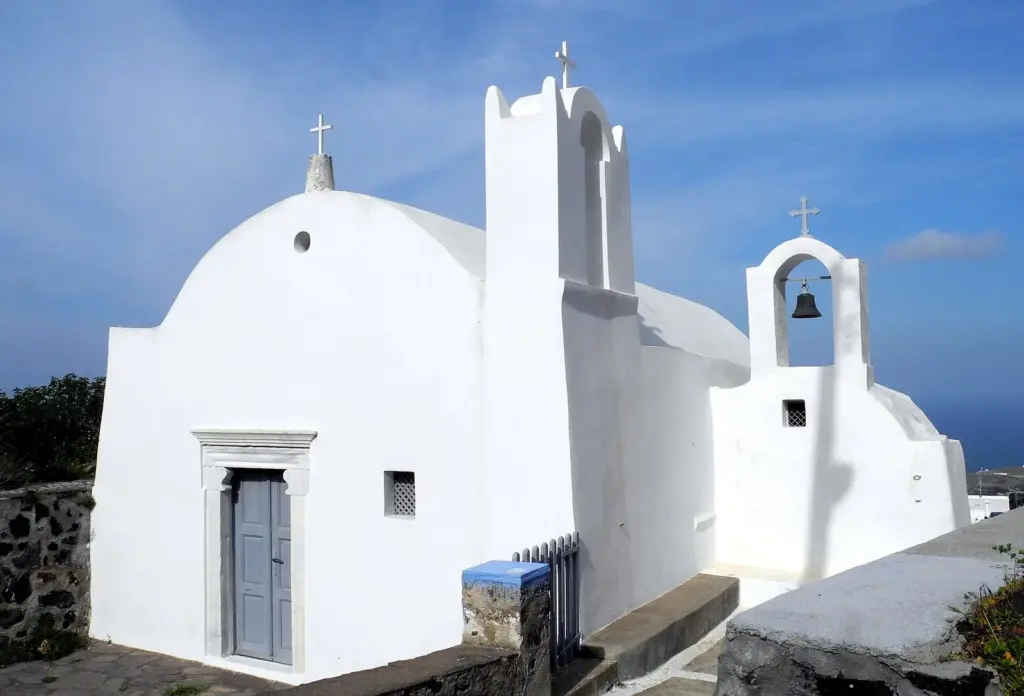
- Firostefani. Fifteen minutes of cliff-top walking brings you to Firostefani, with its church of Agia Sofia, small squares and some of the best views back toward Fira. Stop for lunch, or continue to Imerovigli.
If you have a second half day, flip the order: walk the caldera to Imerovigli in the late afternoon, watch the sunset there, and come back to Fira for dinner and the nightlife.
The Old Port: Getting Down, Getting Back and the 2026 Restrictions
Fira’s Old Port, at the foot of the cliff, was for centuries the island’s harbor. Today it’s where cruise ship tenders land, the volcano boats leave and the cable car and steps meet the sea. It’s also the part of Fira most affected by the 2026 Civil Protection measures.
- The restriction: under the measures in force until March 31, 2027, a restricted zone bars visitors from parts of the Old Port area and the slopes above it. The cable car and the footpath between Fira and the Old Port were not restricted, and volcano boat operators still list Old Port departures.
- Getting down: the cable car (EUR 10 adult, 2026 price list), the Karavolades steps on foot, or a donkey ride. Greek rules are reported to bar riders over about 100 kg from tourist donkeys and mules, but enforcement is reported as inconsistent; many visitors choose the cable car or their own feet for the animals’ sake.
- Getting back: the cable car is the easy way up, but when several cruise ships are in, the line at the bottom can stretch for a long time. Leave a wide margin if you have a boat or a ship to catch.
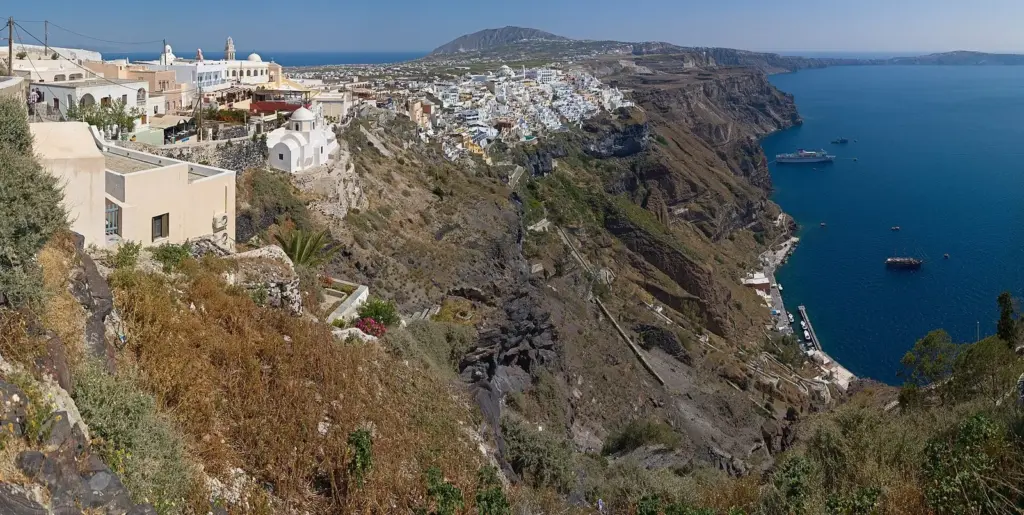
Cruise passengers have more to plan than anyone else here, from tender times to the cable car line. The cruise port, the tenders and the cable car deserve a guide of their own; for most other visitors, the Old Port is a place you pass through on the way to a volcano boat.
Where to Eat, Drink and Go Out in Fira
Fira has more restaurants than any other village on the island, at every budget. On the caldera edge, Naoussa, a family restaurant since 1992, sits next to the Orthodox cathedral, and Selene, led by chef Ettore Botrini, cooks inside the Katikies Garden hotel in central Fira. A short walk north, Aktaion has been a family taverna in Firostefani since 1922. Away from the cliff, the lanes behind the main streets are full of souvlaki counters, bakeries and tavernas where you’ll pay far less for the same fava and moussaka.
After dark, Fira is the island’s nightlife center, with cocktail bars on the caldera edge and clubs and late bars in the streets behind. Things start late, after dinner, and run long in high summer. Santorini nightlife is concentrated here for a reason: it’s the one place you can walk from bar to bar and catch a taxi or a late bus home. Keep in mind that the last scheduled buses leave well before midnight.
Staying in Fira: Pros and Cons
Fira is the best base on Santorini for most first-time visitors without a car, and the noisiest. Here’s the trade-off:
- Pros: buses to everywhere from the station; the widest choice of restaurants, bars and shops; museums and churches on your doorstep; caldera views at lower prices than Oia; easy cable car access to the volcano boats.
- Cons: crowds when cruise ships are in; nightlife noise in the center; steps between the road and many caldera hotels; and traffic around the bus station.
If you like Fira’s convenience but not its noise, look at Firostefani or Imerovigli, a 15- to 45-minute walk along the rim. If you’re choosing between Fira and Oia, the short version is: Fira for convenience, nightlife and value, Oia for romance and the famous sunset. Our guide to where to stay in Santorini compares every village and the hotels in each.
Getting To, From and Around Fira
Fira is Santorini’s transport hub, and almost every bus route starts at its station. On KTEL’s fare table (updated May 19, 2026) and its summer timetable (updated May 18, 2026):
- To Oia: EUR 2.20, every 30 minutes from 08:30 to 21:00, plus a 07:00 bus; the last bus back from Oia leaves at 21:20.
- To Kamari beach: EUR 2.20, about every 30 minutes for most of the day; the last bus back leaves Kamari at 22:15.
- To Perissa and Perivolos: EUR 2.70, hourly from 10:00 to 22:00, plus early buses.
- To Akrotiri: EUR 2.20, hourly from 10:00 to 20:00, plus an 08:30 bus.
- To the airport: EUR 2.20, hourly from 10:00 to 22:00 plus early buses; KTEL advertises the trip as 10 minutes.
- To Athinios ferry port: EUR 2.70, with buses timed around the ferries; allow extra time, because traffic at the port is controlled during ship arrivals under the 2026 measures.
Within Fira you’ll walk everywhere; the center is largely pedestrian, with parking at the edges, and it fills by late morning in summer. Taxis wait at the rank in the center, but there are few of them on the island, so book ahead for ferries, flights and late nights.
Firostefani and Imerovigli: Fira’s Quieter Neighbors
The caldera path doesn’t stop at the edge of Fira, and neither should you. North of town, the cliff-top villages of Firostefani and Imerovigli run on almost without a break, each a little higher, quieter and more expensive than the last.
Firostefani begins about 15 minutes’ walk north of the center, just past the Three Bells. It feels like a neighborhood of Fira rather than a separate village, with a small square, the church of Agia Sofia, and some of the best views back toward the capital. Aktaion, a family taverna since 1922, sits by the church of Saint Gerasimos, and Atlantis Books has moved here, to the cliffside at the base of the Nomikos Cultural Centre. Staying in Firostefani gives you Fira’s restaurants and buses within a short walk, with far less noise at night.
Imerovigli, further along, is the highest of the caldera villages and the most romantic: a strip of cave suites and terraces looking straight down at Skaros rock, where the Venetian capital once stood, and across the whole caldera. It has fewer restaurants and shops than Fira and is mostly hotels, which is precisely why honeymooners like it. Walking from Fira takes a little under an hour at an easy pace, and buses run between Fira and Imerovigli about hourly on the summer timetable if you’d rather ride back.
Together, the three villages make the best short walk on the island: start in Fira in the late afternoon, walk to Imerovigli for the sunset, and take the bus or a taxi back for dinner. For the full stretch to Oia, start early in the morning instead and carry plenty of water.
A Short History of Fira
Fira hasn’t always been the capital. For centuries the island was run from Skaros, the fortified rock below Imerovigli, where the Venetian rulers and leading families lived behind walls for protection from pirates. As the danger faded, people moved out to the open cliff-top villages, and by the 19th century the capital’s role had passed to Fira, close to the old harbor that served the island’s growing merchant fleet.
The town you see today owes much to two events. The first was the Venetian era, which left Fira its Catholic community, its Catholic quarter and the cathedral of Saint John the Baptist, on the site of a 17th-century Jesuit church. The second was the earthquake of July 9, 1956, which wrecked much of Fira, brought down its first archaeological museum and severely damaged both cathedrals. Rebuilding took years, and much of the cliff-top skyline dates from after it.
In between came the island’s shipping boom, when Santorini was Greece’s fifth-ranked naval power by 1850, and World War II, when, on April 24, 1944, a British Special Boat Service raid struck the German and Italian garrison billeted in a former bank building in Fira, according to accounts of the raid. Since the 1970s, tourism has transformed the town again. For the island’s full story, from Bronze Age Akrotiri to the Venetians, see our Santorini history guide.
Fira Through the Year
Fira is the one place on Santorini that feels like a town all year, because people live and work here in winter too. That said, the experience changes a lot with the season.
- June to September: the busiest months, with the longest bus timetables, every restaurant and bar open and the most cruise ships. Book dinners and sunset tables ahead, and walk early.
- April, May and October: the best balance of open businesses, warm weather and smaller crowds. Most seasonal sights and shops are open; Megaron Gyzi runs from May 1 to October 31.
- November to March: quiet, cool and often windy, with fewer buses once KTEL’s winter timetable starts and many seasonal businesses closed, though Fira keeps more open than anywhere else on the island. The Museum of Prehistoric Thera keeps the same hours year-round.
The town’s calendar adds a few highlights. The Megaro Gyzi Festival filled August evenings in 2026, its 40th edition, with free admission to its events. Orthodox Easter, which falls on May 2 in 2027, brings services and processions to the cathedral. Check the organizers’ sites for the 2027 dates of the island’s summer festivals before you plan around them.
Fira for Different Travelers
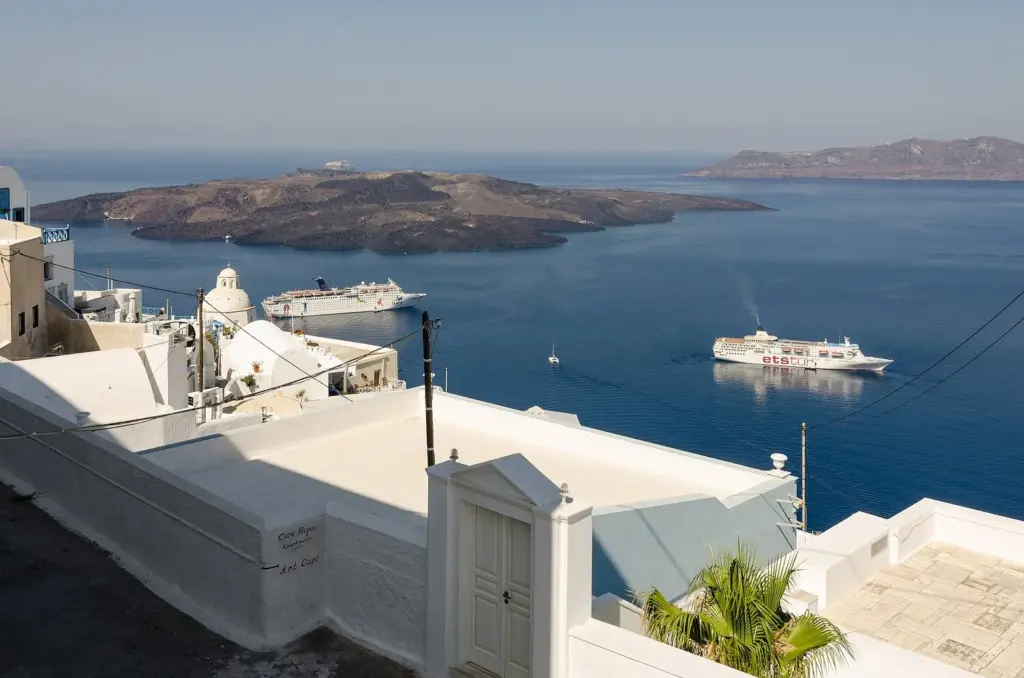
- First-time visitors: Fira is the easiest base on the island. Everything in the first two or three days, from Oia to the beaches to Akrotiri, starts at its bus station, and the caldera path is on your doorstep.
- Couples: stay in Firostefani or Imerovigli and walk into Fira for dinner. You get the views and the quiet, with the restaurants 15 to 45 minutes away on foot.
- Families: Fira works well for families who don’t want to drive, thanks to the buses and the museums, but the caldera edge means steps and low walls everywhere. Choose a hotel with a pool and easy road access rather than a cliff-side suite.
- Budget travelers: Fira has the island’s widest range of rooms and cheap eats, and the bus fares to everywhere (EUR 2.20 to 2.70) make a car unnecessary. Eat in the back streets and save the caldera terraces for one splurge.
- Nightlife fans: this is the place. Fira has the island’s biggest concentration of bars and clubs, all within walking distance; just book the ride home if you’re staying elsewhere.
- Cruise passengers: you’ll arrive by tender at the Old Port and come up by cable car or the steps. With a few hours, walk the caldera path north and see one museum; with a full day, take the bus to Oia, leaving plenty of time to get back down to the port.
Practical Tips for Fira
- Cruise days: ask your hotel how many ships are due. On busy days, see the caldera path before 10:00 and the shops after 17:00.
- Steps and luggage: many caldera hotels sit dozens of steps below the nearest road. Ask before you book, and ask whether someone can meet you with your bags.
- Heat: the caldera edge has little shade. Carry water and a hat, and plan museum visits for the middle of the day.
- Church visits: cover shoulders and knees, keep voices down, and don’t photograph services.
- Getting home at night: the last scheduled buses leave before midnight, and taxis are few. Book a ride home in advance if you’re staying outside Fira.
- Accessibility: the center’s main lanes are walkable but crowded, and the caldera side involves steps almost everywhere. The cable car spares you the steps down to the Old Port.
Is There a Beach in Fira?
No. Fira sits on top of a cliff, and the only water at its feet is the Old Port, which isn’t a swimming beach and is partly inside the 2026 restricted zone. The nearest beach town is Kamari on the east coast, 7.3 km away by road; buses leave Fira for Kamari about every 30 minutes for most of the day for EUR 2.20 (summer timetable, 2026). Perissa and Perivolos, the long black-sand beaches of the south, are EUR 2.70 and an hourly bus away. Plenty of Fira hotels have pools, which is how most people in town cool off.
What to Do in Fira, Santorini for a Day
If you only have a day, here’s how to fit in Fira’s best without rushing:
- Morning: the walking tour above, from the Orthodox cathedral and the Museum of Prehistoric Thera to the Three Bells and Firostefani, finishing with coffee on the caldera.
- Midday: lunch in Firostefani or the lanes behind Fira’s center, then the Archaeological Museum of Thera or Santozeum while the heat and the cruise crowds peak.
- Afternoon: the cable car down to the Old Port for the 14:30 volcano boat, back by early evening, or a lazy afternoon by a hotel pool.
- Evening: sunset from the caldera path, dinner on a cliff terrace or in the back streets, then a drink in town.
Two days lets you add Oia by bus, a beach afternoon in Kamari and the full caldera walk to Imerovigli, still sleeping in the same bed in Fira.
What’s Changed in Fira in 2025 and 2026
| Item | What older guides say | Now (checked September-October 2026) |
|---|---|---|
| Old Port | Open harbor area | Restricted visitor zone in parts of the Old Port and the slopes above it until March 31, 2027; cable car and footpath not restricted |
| Karavolades steps | Open | Closed July 27 to August 3, 2026 after a wall collapse, then reopened by municipal order |
| Cable car fare | EUR 6 | EUR 10 adult, EUR 5 reduced, EUR 5 per bag (2026 price list) |
| Archaeological Museum of Thera | Closed for renovation | Reopened June 13, 2025; closed Mondays |
| Bus fares | EUR 2.00 to 2.50 | EUR 2.20 to Oia, Kamari, Akrotiri and the airport; EUR 2.70 to Perissa and Athinios (May 19, 2026) |
| Argo restaurant | In Fira | Moved to a new venue in Kontochori, about five minutes away |
| Atlantis Books | In Oia | Moved to Firostefani, at the base of the Nomikos Cultural Centre |
What to Skip
- The caldera lanes at midday on a cruise day. Go early or late; see a museum in between.
- A donkey ride up from the Old Port. The cable car or your own feet are kinder choices.
- Buying the first piece of jewelry you see. Compare, ask questions and get a receipt.
- Driving into the center. Parking is at the edges and fills early; walk or take the bus.
- Planning a swim in Fira. There’s no beach; head to Kamari or Perissa.
Fira Santorini FAQ
Is Fira worth visiting?
Yes. Fira is Santorini’s capital and has the caldera path to Firostefani and Imerovigli, the Three Bells of Fira, two cathedrals, the island’s archaeological museums and the most choice of restaurants and nightlife. Avoid the caldera lanes at midday when cruise ships are in, and come back for the sunset.
Is it better to stay in Oia or Fira?
Fira is better for first-timers without a car, nightlife, choice of restaurants and value, because buses to everywhere leave from its station. Oia is quieter at night, more romantic and has the famous sunset, but it’s at the end of the bus line and its hotels cost more. Firostefani and Imerovigli are good middle grounds.
How do you get from Fira to Oia?
The KTEL bus is the easiest way: on the summer timetable, buses leave Fira for Oia every 30 minutes from 08:30 to 21:00 for EUR 2.20, and the last bus back leaves Oia at 21:20. You can also walk the caldera path, roughly 10 km and three to five hours, or book a taxi.
Is there a beach in Fira?
No. Fira sits on top of the caldera cliff. The nearest beach town is Kamari, 7.3 km away, with buses about every 30 minutes for EUR 2.20; Perissa and Perivolos are EUR 2.70 by bus. Many Fira hotels have pools instead.
How do you get from Fira to the Old Port?
By cable car (EUR 10 one way for adults on the 2026 price list), on foot down the Karavolades steps, which takes about 20 to 30 minutes, or by donkey. A 2026 restricted zone covers parts of the Old Port and the slopes above it, but the cable car and the footpath were not restricted.
What is the best time of day to visit Fira?
Early morning and evening. Before 10:00 the caldera path is quiet and cool, and after 17:00 the cruise passengers have mostly gone and the light softens toward sunset. Use the middle of the day for the museums, which are cooler and quieter when the lanes are busiest.
What are the best things to do in Fira, Santorini?
Walk the caldera path to Firostefani and Imerovigli, see the Three Bells of Fira and both cathedrals, visit the Museum of Prehistoric Thera, ride the cable car to the Old Port for a volcano boat, watch the sunset from the cliff, and spend an evening in the town’s restaurants and bars.
How far is Fira from the ferry port?
Athinios port is 18 km from Fira by road. The KTEL bus costs EUR 2.70 and runs around ferry times, and taxis and transfers are the other options. Traffic at Athinios is controlled during ship arrivals and departures under the 2026 measures, so leave extra time for the trip.
Related Santorini Guides
- Where to stay in Santorini: Fira, Oia, Imerovigli and the beach towns compared
- Santorini history: Akrotiri, Ancient Thera and the island’s museums
Sources and How We Checked
We checked museum hours, fares, timetables and the 2026 restrictions against official sources and operators’ own sites between September 24 and October 1, 2026. Church histories and Santozeum’s hours come from secondary sources.
- Hellenic Ministry of Culture: Museum of Prehistoric Thera
- Hellenic Ministry of Culture: Archaeological Museum of Thera
- KTEL Santorini: routes and timetables and fare table
- Santorini Cable Car (2026 price list)
- Megaron Gyzi
- Santorini Excursions (Dakoutros Bros): Old Port access and volcano boats
- Euronews: the 2026 Civil Protection measures
Santorini Tourism Guide is an independent publication. We are not affiliated with the Municipality of Thira, the Greek National Tourism Organisation, the Santorini Cable Car, KTEL Santorini, the churches and museums named here or any business listed here, and no one paid to be included.
Photo Credits
- Fira panorama: photo by Taxiarchos228, via Wikimedia Commons (FAL)
- Caldera rim villages from the sea: photo by Norbert Nagel, via Wikimedia Commons (CC BY-SA 3.0)
- Three Bells of Fira: photo by Dietmar Rabich, via Wikimedia Commons (CC BY-SA 4.0)
- Fira cable car and steps: photo by Mariordo (Mario Roberto Durán Ortiz), via Wikimedia Commons (CC BY-SA 4.0)
- Agia Sofia, Firostefani: photo by LBM1948, via Wikimedia Commons (CC BY-SA 4.0)
- Fira and the Old Port: photo by Christian Mehlführer, User:Chmehl, via Wikimedia Commons (CC BY 2.5)
- Fira caldera alley: photo by Norbert Nagel, via Wikimedia Commons (CC BY-SA 3.0)