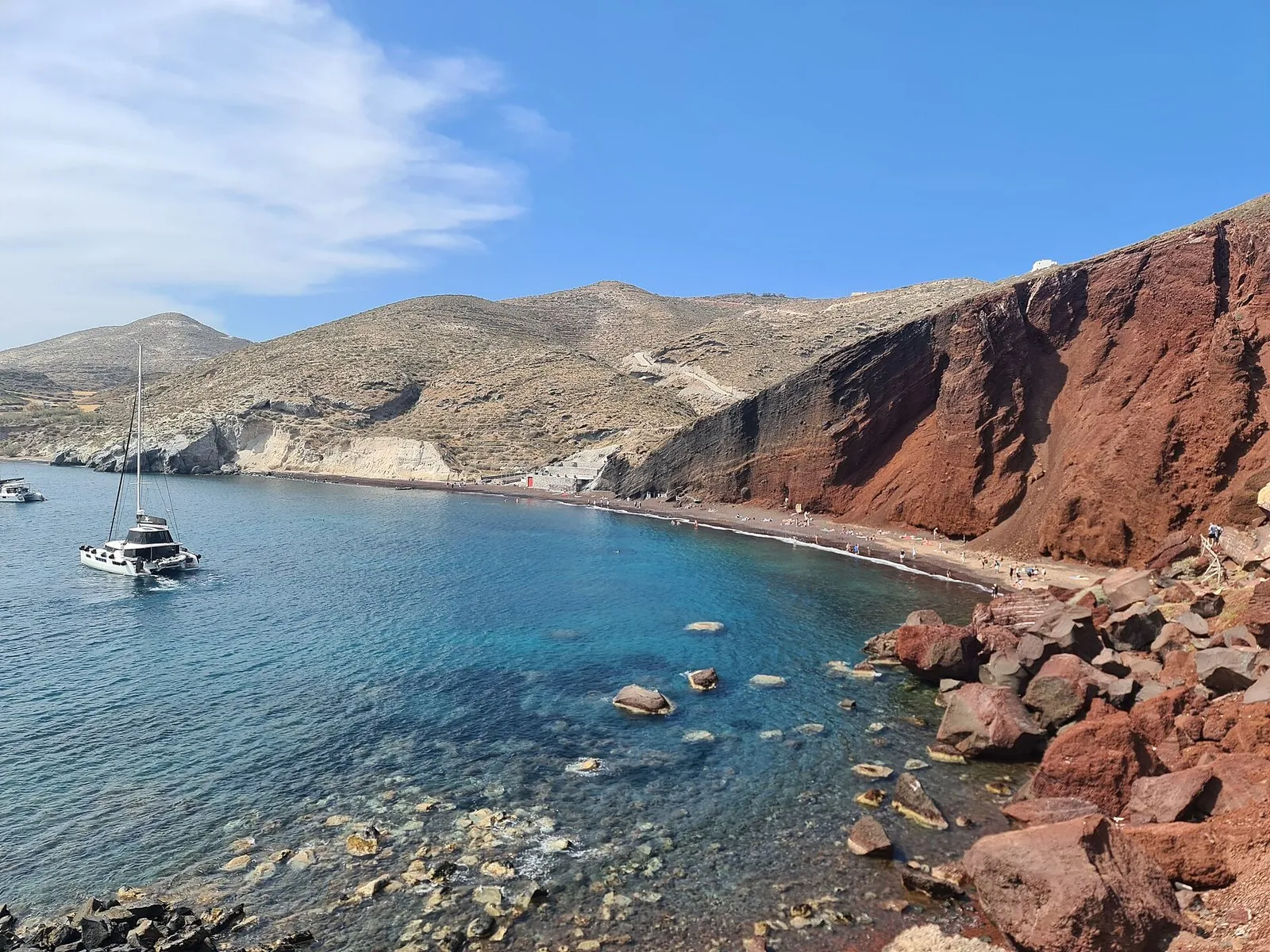
The first thing to know about Santorini beaches is that they look nothing like the beaches in travel ads. The island is a volcano, so the sand is black, the pebbles are dark and polished, and the cliffs behind the beaches come in red, white and every shade of rust. There’s no powder-white sand anywhere. What you get instead are long, organized black-sand beaches on the east and south coasts, dramatic cliff-backed coves you reach by boat, and a handful of wild, windy stretches in the north. Almost none of them is on the caldera side, where the famous villages sit on cliffs that drop straight into deep water.
Quick answer: For a full beach day, go to Perissa or Perivolos: long black sand, sunbeds, tavernas and easy buses. Kamari is the best-organized beach with a promenade; Red Beach is the most photographed, but only by boat; Vlychada and Monolithos are the calmest. Seven Santorini beaches hold a 2026 Blue Flag for water quality and management.
Last updated September 29, 2026. We checked the 2026 Blue Flag list, the KTEL bus fares to the beaches, and the Red Beach and Ammoudi restrictions against official and mainstream news sources in September 2026. Beach facilities are seasonal and set by private operators, so ask about sunbed prices on the beach before you settle in.
- Seven Blue Flags in 2026: Agios Georgios, Vlychada, Kamari (two sections), Monolithos, Perivolos and Perissa, on the official Blue Flag list announced May 14, 2026.
- Red Beach is boat-only: the cliff path has been officially closed since 2013 because of rockfalls, and the February 2025 earthquakes triggered more. Small boats from Akrotiri harbor charge roughly EUR 5-8 for the short ride.
- The 2026 trap at Oia: Civil Protection measures until March 31, 2027 close the Ammoudi road to general traffic and the shoreline path from Ammoudi to Agios Nikolaos, the rocks where people used to swim below Oia.
- By bus: from Fira, Kamari costs EUR 2.20, Perissa and Perivolos EUR 2.70 and Red Beach (Akrotiri) EUR 2.20 on the KTEL table updated May 19, 2026.
- Black sand burns: by midday in summer the dark sand is too hot for bare feet. Bring beach shoes.
Planning a beach-focused trip? Our guide to where to stay in Santorini compares Kamari, Perissa and Perivolos as bases.
On this page: Every beach rated | Is Santorini good for beaches? | The best beaches | Which beach for you | Beaches and sights | Beach map | Beach clubs and sunbeds | Sea temperature | Wind and safety | Getting there | From a caldera base | What to skip | FAQ
Santorini Beaches at a Glance: Every Beach Rated
Our ratings for each beach on the things that decide a beach day. “Facilities” means sunbeds, umbrellas, tavernas and showers in summer; “wind” is exposure to the strong north wind, the meltemi, that blows on many summer days.
| Beach | Sand | Swimming | Facilities | Crowds | Wind | Access | Blue Flag 2026 |
|---|---|---|---|---|---|---|---|
| Perissa | Black sand | Good | Full | Busy | Fairly sheltered | Bus, car | Yes |
| Perivolos | Black sand | Good | Full, beach clubs | Busy | Fairly sheltered | Bus, car | Yes |
| Agios Georgios | Black sand | Good | Good | Moderate | Fairly sheltered | Car, bus to Perivolos | Yes |
| Kamari | Black pebbles and sand | Good, deepens quickly | Full, promenade | Busy | Moderate | Bus, car | Yes (two sections) |
| Red Beach | Red and black pebbles | Good | Minimal | Busy by boat | Sheltered | Boat only | No |
| Vlychada | Dark sand | Good | Some | Quiet | Fairly sheltered | Car | Yes |
| Monolithos | Dark sand | Shallow, calm | Some | Quiet | Moderate | Bus, car | Yes |
| White Beach | Dark pebbles under white cliffs | Good | None | Quiet | Sheltered | Boat only | No |
| Kambia | Pebbles | Good | Basic | Quiet | Sheltered | Car | No |
| Eros | Dark sand and pebbles | Good | Basic | Quiet | Sheltered | Car, dirt road | No |
| Mesa Pigadia | Black pebbles | Good | Basic | Quiet | Sheltered | Car, boat | No |
| Koloumbos | Dark sand and rocks | Variable | None | Very quiet | Exposed | Car, path | No |
| Baxedes | Dark sand | Variable | Basic | Quiet | Exposed | Car | No |
| Katharos | Rocks and pebbles | Variable | Minimal | Quiet | Variable | Car, dirt road | No |
| Ammoudi and Armeni (Oia) | Rocks, no beach | Deep water | Tavernas | Busy | Variable | Restricted in 2026 | No |
| Pori | Pebbles and rocks | Variable | Minimal | Very quiet | Variable | Car | No |
Is Santorini Good for Beaches?
Yes, if you like interesting beaches; no, if you want soft white sand and palm trees. Santorini’s beaches are volcanic, and that’s both their appeal and their catch. Does Santorini have sandy beaches? It does, but the sand is black or dark gray, made of volcanic rock and glass, and it heats up fast in the sun. The famous colored beaches get their looks from the rock around them: Red Beach from iron-rich lava that has oxidized to a rust red, White Beach from pale volcanic ash cliffs.
Where the beaches are matters as much as what they’re made of. The caldera side, with Oia, Fira and Imerovigli, is a wall of cliffs dropping into deep water, so there are no Fira beaches as such: the nearest sand to the capital is at Kamari or Monolithos, a short drive or bus ride east. The long, organized beaches are all on the gently sloping east and south coasts, where the land runs down to the sea. The north coast has a few wild stretches, and the south side of the Akrotiri peninsula hides coves you can reach only by boat.
So is Santorini a beach destination? Not in the way Mykonos or Naxos are. Most visitors come for the caldera and spend one or two days at the beach, and that’s the right balance. But if you stay on the east or south coast, you can have a genuinely good beach holiday with the caldera a short trip away.
If beaches are the main reason for your trip, it’s worth knowing how Santorini compares with its neighbors. Naxos and Paros, a couple of hours north by ferry, have long beaches of pale sand and shallow turquoise water, and Milos to the west is famous for its white rock coves. Many travelers pair Santorini’s caldera with a few days on one of those islands for the classic Greek beach experience, and use Santorini’s own beaches as a bonus rather than the main event.
The Best Beaches in Santorini
These are the best beaches in Santorini, in the order we’d recommend them for a first visit. Each entry says what the beach is like, how to get there and who it suits.
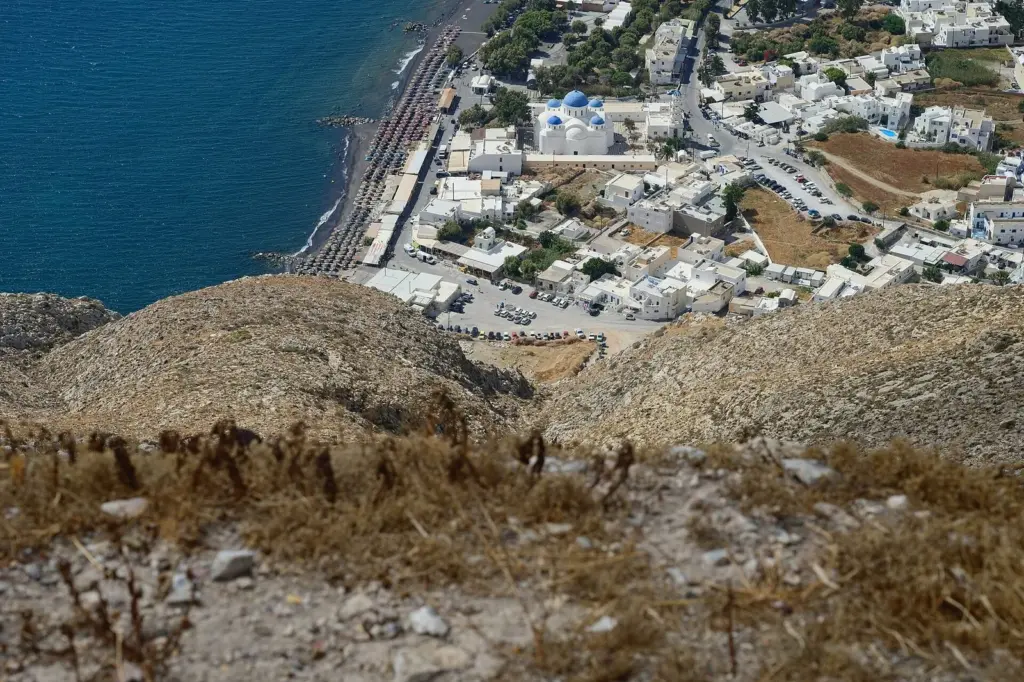
1. Perissa
The classic black-sand beach, with everything nearby. Perissa beach, at the northern end of the long stretch of dark sand on the southeast coast, sits right under the cliffs of Mesa Vouno, with the village’s shops, tavernas and budget hotels a few steps behind the beach. The sand shelves gently into clear water, there are rows of sunbeds and umbrellas in summer, and beach bars run the length of the shore. It holds a 2026 Blue Flag.
Plan it: buses from Fira cost EUR 2.70 (May 2026 table); summer is busiest from late morning to late afternoon. The path up to Ancient Thera starts nearby, so a morning climb and an afternoon swim make a good day. Best for: families, budget travelers and anyone without a car.
2. Perivolos
Beach clubs on a long black strand. Perivolos beach continues south from Perissa along the same dark sand, which Istoria, a hotel on the seafront, describes as a 3 km stretch. This is where the island’s beach clubs are, with designer sunbeds, music and cocktails, alongside plainer stretches of free sand. Several resorts front the beach and give their guests sunbeds on their own stretch. It holds a 2026 Blue Flag.
Plan it: buses on the Perissa route cost EUR 2.70 from Fira; parking behind the beach fills up in August. Expect beach-club prices on the organized stretches and bring your own towel for the free ones. Best for: couples, groups of friends and anyone who wants a beach club day.
3. Agios Georgios
The quieter southern end. Agios Georgios, at the southern end of the Perissa-Perivolos stretch, has the same dark sand and clear water with fewer people and a calmer feel, plus a few tavernas and small hotels. It holds its own 2026 Blue Flag, and it’s a good compromise between Perivolos’s clubs and the south coast’s empty coves.
Plan it: easiest by car; the Perivolos bus stops a walk away. Best for: couples and families who want organized facilities without the crowd.
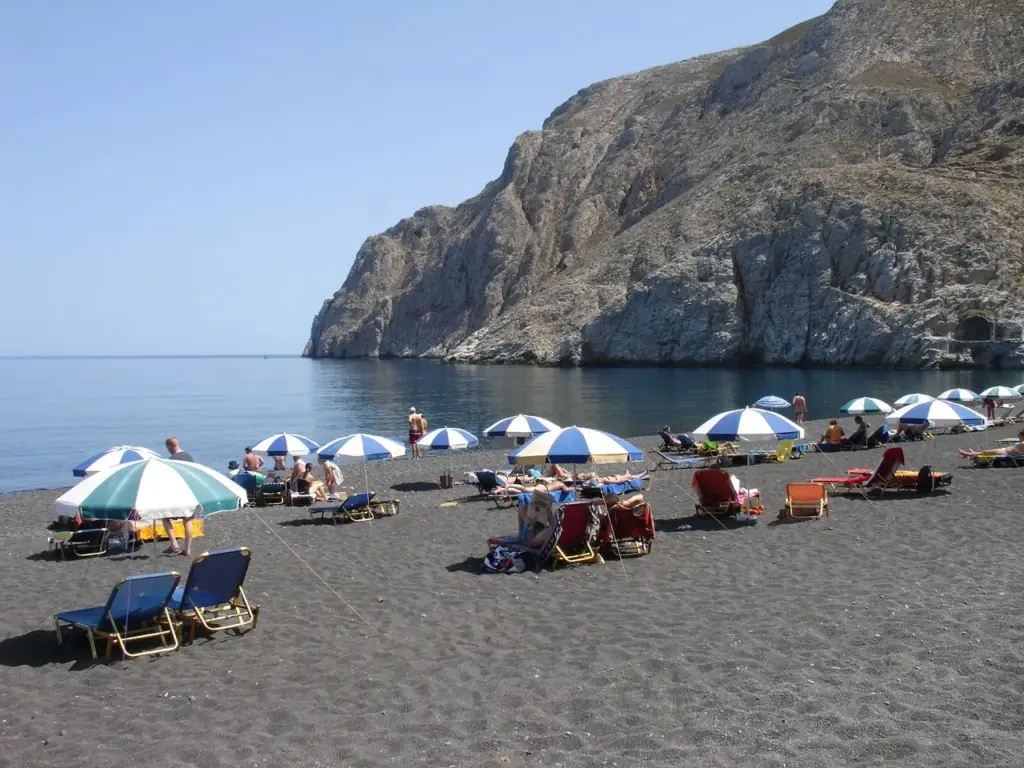
4. Kamari
The best-organized beach, with a promenade. Kamari beach, on the east coast near the airport, is a long stretch of black pebbles and sand backed by a car-free promenade of tavernas, cafes and bars, with the Mesa Vouno cliffs rising at the southern end. The water deepens quickly and is usually clear. The beach is split into two sections, both holding 2026 Blue Flags, and it’s the easiest beach day on the island: sunbeds, showers, lunch and a bus stop all within a few steps.
Plan it: buses from Fira cost EUR 2.20 (7.3 km); pebbles make water shoes useful. Stay for dinner on the promenade and, in summer, a film at the open-air cinema. Best for: families, older travelers and anyone who wants everything organized.
5. Red Beach
The famous one, by boat only. Red Beach Santorini’s most photographed stretch of coast is a small bay of red and black pebbles under towering rust-colored lava cliffs near Akrotiri. The cliff path has been officially closed since 2013 because of rockfall danger, and the February 2025 earthquake swarm set off more rockfalls, so the only legal way onto the beach is by boat. Small boats from Akrotiri harbor charge roughly EUR 5-8 for the ride of about 10 minutes, and south-coast cruises stop offshore.
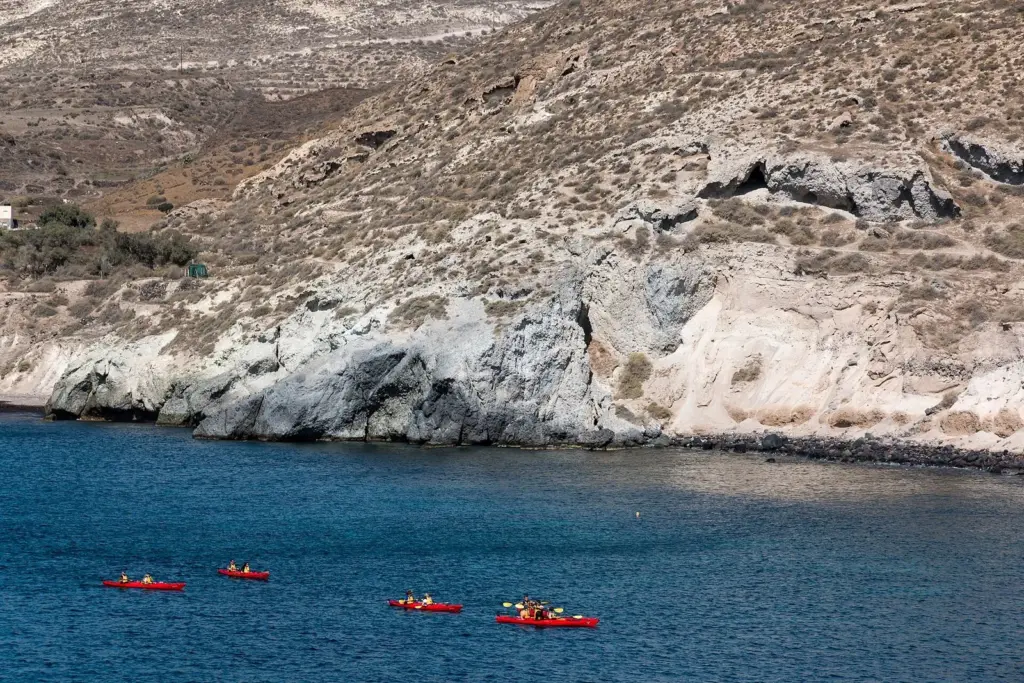
Plan it: buses from Fira to the Akrotiri beach stop cost EUR 2.20 (16.5 km). Go early, before the boats bring the crowds, and stay well away from the base of the cliff; it’s still unstable. Best for: photographers and anyone combining the beach with the archaeological site next door.
6. Vlychada
Wind-carved cliffs and a quiet stretch of sand. Vlychada beach, on the south coast next to the marina, is backed by pale cliffs of compressed volcanic ash that the wind has carved into ripples, hollows and pillars. The sand is dark, the water clear, and even in summer it feels far quieter than Perivolos. Fish tavernas sit by the marina, and the Tomato Industrial Museum is nearby. It holds a 2026 Blue Flag.
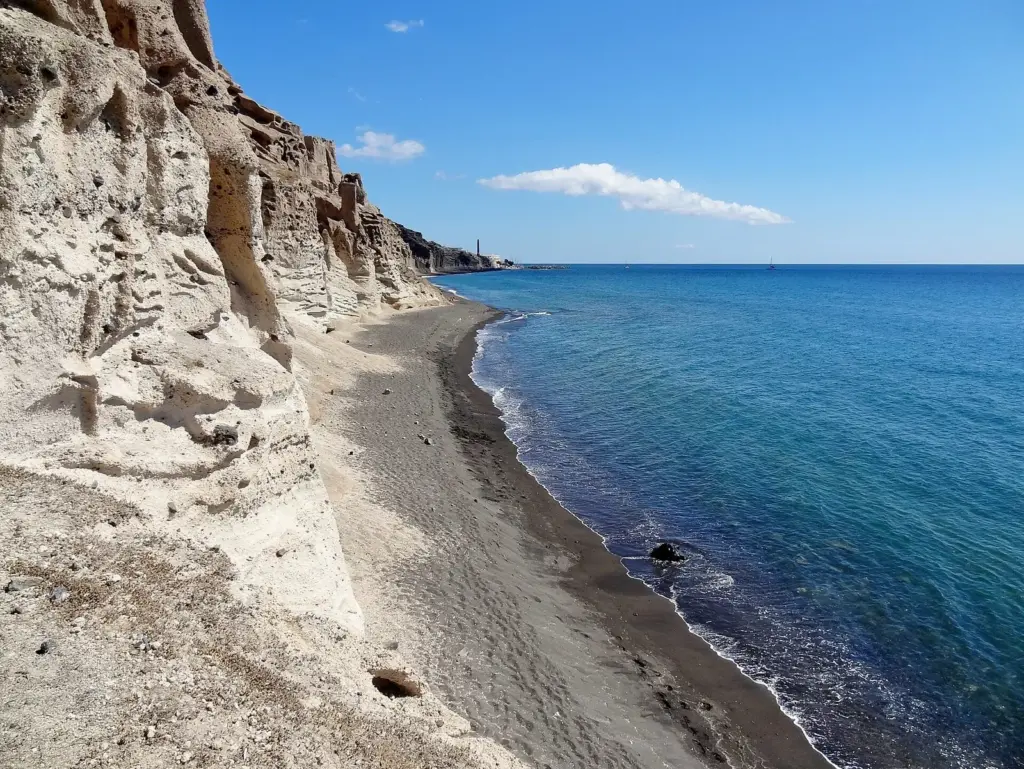
Plan it: easiest by car; bring shade, as facilities cover only part of the beach. Late afternoon, when the cliffs glow, is the best time for photos. Best for: couples, photographers and anyone escaping the crowds.
7. Monolithos
Shallow, calm and good for kids. Monolithos beach, on the east coast next to the airport, has dark sand, shallow water and a relaxed local feel, with a few tavernas and some sunbeds. It’s one of the best beaches for small children because the water stays shallow for a long way. It holds a 2026 Blue Flag. Planes landing next door are part of the scenery.
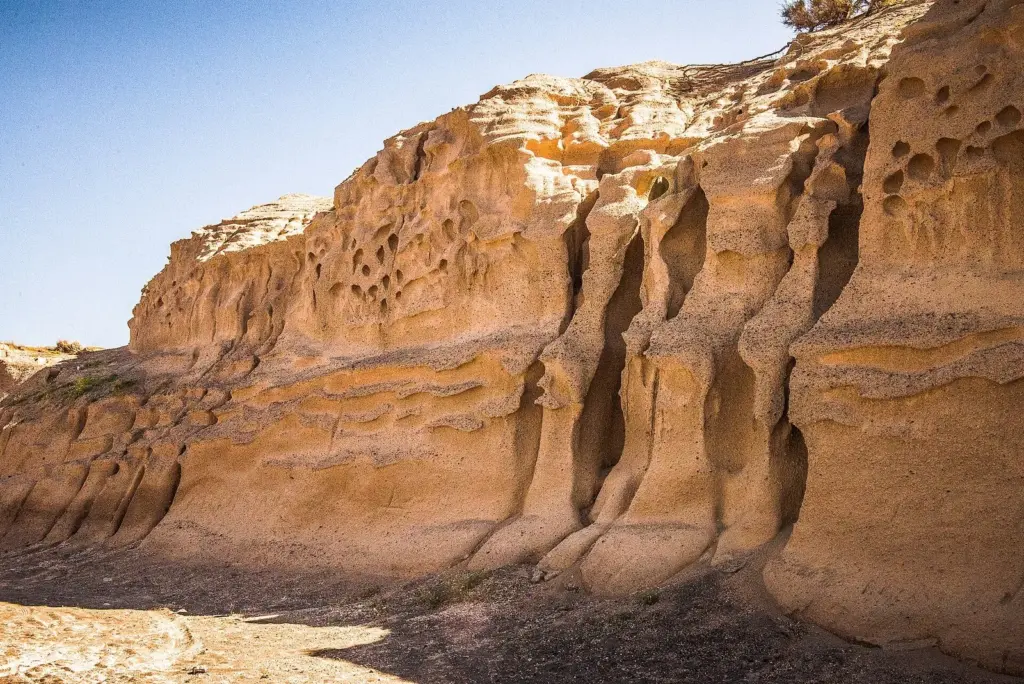
Plan it: the Kamari bus continues to Monolithos and the airport for EUR 2.20 from Fira. Best for: families with young children and anyone staying near the airport.
8. White Beach
A small cove under pale cliffs. White Beach, next to Red Beach on the south side of the Akrotiri peninsula, is a narrow strip of dark pebbles under tall white cliffs. It’s a boat-access beach too, reached by the small boats from Akrotiri harbor or on south-coast cruises. Photos of White Beach Santorini tend to be taken from the water, and that’s the best way to see it.
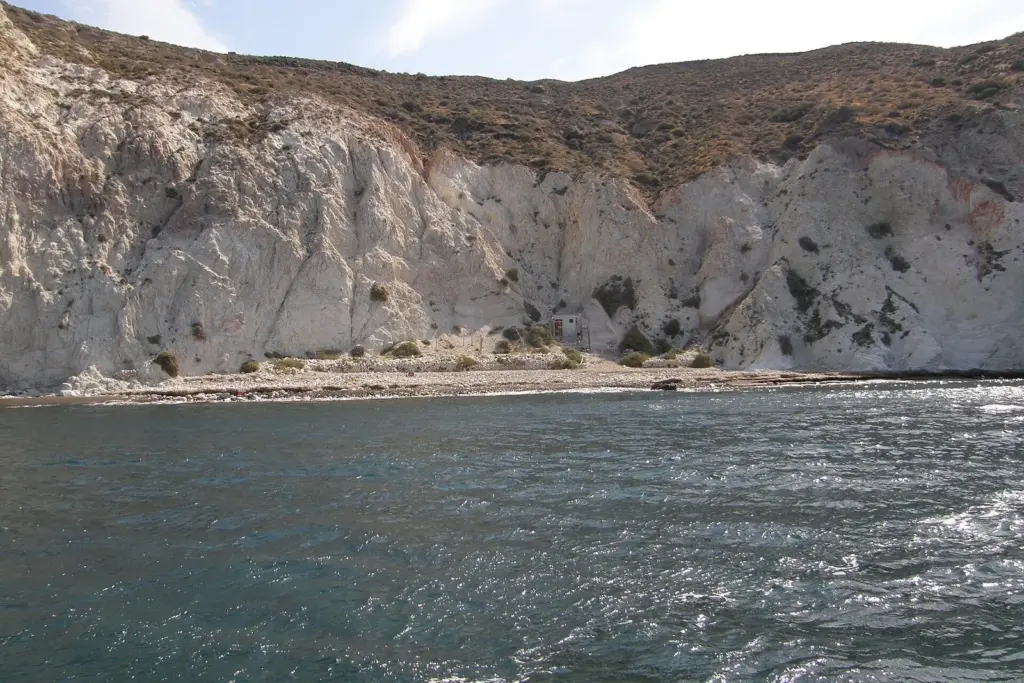
Plan it: no facilities; bring water, food and shade. Snorkeling around the rocks is good. Best for: swimmers and snorkelers on a boat day.
9. Kambia
A pebbly south-coast cove with a taverna feel. Kambia beach sits on the south coast of the Akrotiri peninsula, a quiet bay of pebbles and clear water that feels much farther from the crowds than it is. Facilities are simple and seasonal, and the water is good for swimming and snorkeling on calm days. It’s the kind of place locals go when Perivolos is too busy.
Plan it: by car or scooter; limited parking. Bring water shoes for the pebbles. Best for: travelers with a car who want a low-key swim near Akrotiri.
10. Eros Beach
A dirt road to a quieter strand. Eros beach Santorini visitors find at the end of a dirt road on the south coast is a stretch of dark sand and pebbles with more space and fewer people than the big east-coast beaches. What facilities there are come and go with the season, so check before you rely on lunch. The drive down is part of the adventure; go slowly.
Plan it: by car or ATV; no bus. Bring shade, water and food. Best for: couples and anyone who wants space to spread out.
11. Mesa Pigadia
Black pebbles below the Akrotiri cliffs. Mesa Pigadia, on the south coast of the Akrotiri peninsula, is a small beach of black pebbles under dramatic cliffs, and it’s what many people mean by “Black Beach”. The name is confusing, because “black beach Santorini” searches also bring up Kamari and Perissa, which are black too. Mesa Pigadia is the quieter, more secluded version, with basic facilities in summer and a few boats stopping by.
Plan it: by car on a steep road, or by boat on some south-coast trips; keep away from the base of the cliffs. Best for: travelers looking for a smaller beach with a view.
12. Koloumbos
Wild, windy and clothing-optional. Koloumbos, on the north-east coast below the road between Oia and Finikia, is a long, unorganized beach of dark sand and rocks under layered volcanic cliffs. It’s named after Kolumbo, the underwater volcano offshore, and it’s known as the island’s unofficial clothing-optional beach. There are no facilities, the path down is rough, and the north wind can make the sea choppy.
Plan it: by car, then on foot down a steep path; bring everything you need. Swim only on calm days. Best for: adventurous swimmers and naturists who value solitude.
13. Baxedes
The north coast’s open beach. Baxedes, on the north coast near Oia, is a long stretch of dark sand with a few simple facilities in summer and a view along the coast. It catches the north wind, so on meltemi days the water can be rough and the sand blows, but on still days it’s one of the least crowded beaches near Oia.
Plan it: by car; check the wind before you go. Best for: travelers staying in Oia who want a quick beach.
14. Katharos
Rocks and clear water below Oia. Katharos, west of Oia at the end of a dirt road, is more rocky shore than beach, with clear water for swimming and snorkeling and views of the cliffs. It’s small and simple, which is its charm. Of the Oia beaches, it’s the one most people reach by car, on its own dirt road rather than the restricted road down to Ammoudi.
Plan it: by car or scooter on a dirt road; bring water shoes. Best for: snorkelers and anyone staying in Oia.
15. Ammoudi and Armeni
Oia’s harbors, not beaches, and restricted in 2026. Ammoudi, the little fishing harbor below Oia, is famous for its fish tavernas and for swimmers jumping into deep water from the rocks near the islet of Agios Nikolaos. In 2026, though, the Civil Protection measures close the road down to general traffic (municipal shuttles excepted) and close the path from Ammoudi to Agios Nikolaos until March 31, 2027, which takes the famous swimming rocks off the table. Armeni, the neighboring harbor, has no real beach either.
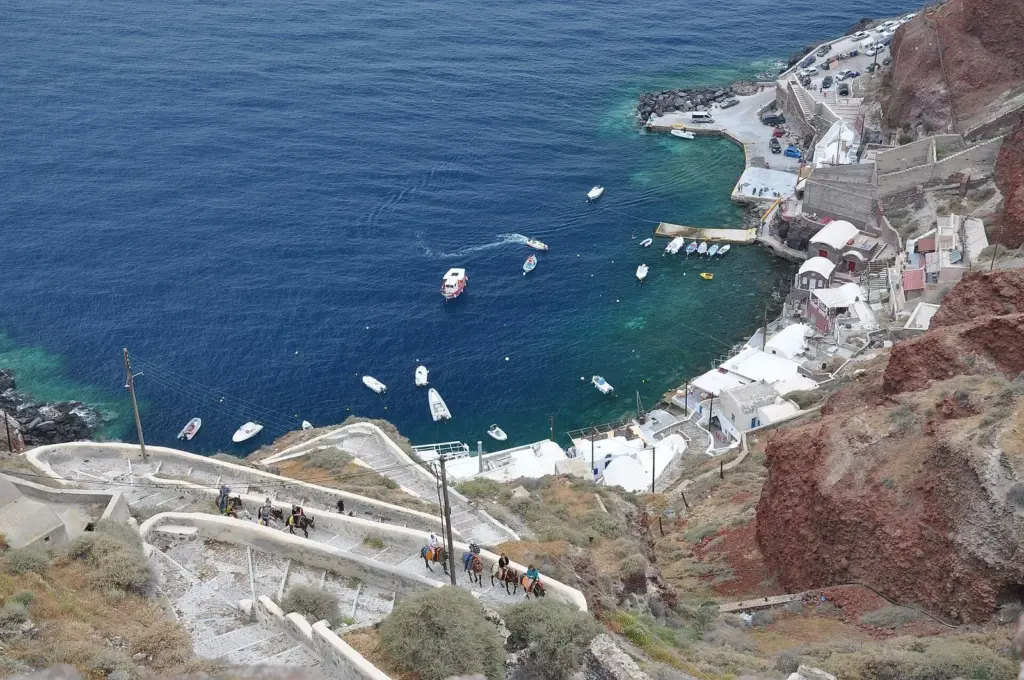
Plan it: check the current access rules locally before you go down; don’t cross closures. Best for: a seafood lunch when access allows, not a beach day.
16. Pori
A tiny fishing cove on the north-east coast. Pori is a small bay with a few fishing boats, rocks and pebbles, far from the tourist circuit. It’s the kind of place worth knowing if you’re driving the north-east coast and want a quiet dip, not a destination for a whole day.
Plan it: by car; no facilities to speak of. Best for: explorers ticking off Santorini hidden beaches with a map and a full tank.
Which Beach Is Best for You?
The best beach in Santorini depends on what you want from the day. Here’s our shortlist by type of trip.
| If you want… | Go to | Why |
|---|---|---|
| A full, easy beach day | Perissa or Kamari | Sunbeds, tavernas, showers and buses |
| Beach clubs and music | Perivolos | The island’s beach-club strip |
| Small children | Monolithos or Kamari | Shallow water at Monolithos, everything on hand at Kamari |
| The famous photo | Red Beach, by boat | The red cliffs are unlike anywhere else |
| Quiet and space | Vlychada, Agios Georgios or Eros | Fewer people, more room |
| Snorkeling | White Beach, Kambia or Katharos | Rocks and clear water |
| No car | Perissa, Perivolos, Kamari or Monolithos | Direct buses from Fira |
| Shelter on a windy day | The south coast: Perivolos, Vlychada, the Akrotiri coves | Tucked away from the north wind |
| Clothing-optional | Koloumbos | Remote, and known for it |
Traveling with young children narrows the list quickly. Monolithos is the gentlest, with shallow water that stays shallow; Kamari and Perissa have everything within a few steps, from showers to ice cream, but the water deepens faster at Kamari. The boat-only beaches and the wild northern stretches are better left for older kids who swim well.
Beach Days With a Sight Attached
The easiest way to enjoy Santorini’s beaches is to pair each one with something nearby, so a swim becomes part of a full day rather than the whole of it. These combinations work well:
- Kamari and Ancient Thera. Climb or drive up to Ancient Thera on Mesa Vouno in the morning (EUR 10 on the Ministry of Culture’s 2026 list; closed Wednesdays in summer), then come down for a swim at Kamari and dinner on the promenade. In summer, finish with a film at Cine Kamari, where screenings start at 21:30.
- Perissa, Emporio and the old path. Walk the old path from Perissa up toward Ancient Thera early, before the heat, then spend the afternoon on the sand. Emporio’s fortified old quarter is a few minutes inland for a late-afternoon wander.
- Red Beach, Akrotiri and the lighthouse. Visit the prehistoric town at Akrotiri when it opens (EUR 20 in 2026), take the short boat to Red Beach and White Beach, then drive to the lighthouse at the island’s western tip for sunset.
- Vlychada, the tomato museum and the marina. Spend the morning under Vlychada’s sculpted cliffs, visit the Tomato Industrial Museum nearby (EUR 12, Tuesday to Sunday, April to November), and have a fish lunch by the marina.
- Monolithos on arrival or departure day. It’s next to the airport, so a swim at Monolithos fills a gap before an evening flight better than an afternoon in the terminal.
Santorini Beach Names, Decoded
Santorini beaches’ names can be confusing, because each one tends to have a Greek name, an English nickname and sometimes a village name too. A few words of Greek help: paralia means beach, ammos sand, votsala pebbles and limani harbor.
- Kokkini Paralia is Red Beach; Aspri Paralia is White Beach; Mavri Paralia, “black beach”, is used loosely for several dark beaches, most often Mesa Pigadia near Akrotiri, but also for Kamari and Perissa.
- Perissa, Perivolos and Agios Georgios are three sections of one continuous beach, named after the villages and the church behind them.
- Kamari appears on the Blue Flag list as two beaches, Kamari 1 and Kamari 2, because the long beach is managed in sections.
- Ammoudi and Armeni are harbors below Oia, not beaches, even though you’ll see them on lists of “Oia beaches”.
- Koloumbos is spelled several ways, including Kolumbo, which is also the name of the underwater volcano offshore.
Santorini Beach Map: The Coasts Explained
The map above shows the pattern, and it’s simple once you see it. On a Santorini beach map, the organized beaches form one long line on the flat east and south coasts: Monolithos and Kamari near the airport, then, past the Mesa Vouno headland, Perissa, Perivolos and Agios Georgios, and finally Vlychada at the southern marina. The Akrotiri peninsula in the southwest hides Red Beach, White Beach, Mesa Pigadia and Kambia along its southern shore, mostly best by boat or car. The north coast, below Oia and Finikia, has the wild beaches: Baxedes, Koloumbos and the coves around Pori. The caldera side, from Oia around to Akrotiri, has harbors and swimming rocks but no real beaches.
In practice that means a Kamari-based stay puts you on the beach every morning, a Perissa or Perivolos base gives you the longest sand, and a caldera base means a 20- to 40-minute trip for a swim. Many visitors combine a beach day with nearby sights: Kamari with Ancient Thera, Perissa with Emporio, Red Beach with the prehistoric site at Akrotiri.
Beach Clubs, Sunbeds and What They Cost
Most of the organized beaches are lined with sunbeds and umbrellas run by the tavernas, bars and hotels behind them. On some stretches you pay per set; on others the price is a minimum spend on food and drinks. Santorini beach clubs, concentrated on Perivolos, add music, table service and a higher price. As one example, Istoria’s beach club on Perivolos sold a set for two non-guests at EUR 100 in September 2026, including two sunbeds, an umbrella, towels, water, a fruit platter and two cocktails, from 11 a.m. to 6 p.m.
Several beachfront hotels give their own guests free sunbeds on their stretch of sand: Santo Miramare on Perivolos and Costa Grand on Kamari both mention it. And every organized beach also has free public stretches where you can lay down a towel, usually at the ends. If you want to spend nothing, bring a beach umbrella; shade is what you’re really paying for.
Are the beaches free? The sand itself is, and by Greek custom the shoreline is public, so you can always walk along it or put down a towel, even in front of a beach club. What you pay for is the sunbed, the umbrella and the service. On busy summer days the best-positioned sets on Perivolos and Kamari go early, so if the beach club experience matters to you, arrive in the morning or book where the operator allows it.
When the Sea Is Warm Enough to Swim
The swimming season on Santorini runs roughly from June to October for most people, with the sea at its warmest in August and September, after a summer of sun. May and late October are fine for the brave and for anyone from a northern climate, but many find the water bracing. From November to April, only the hardy swim. The Santorini water temperature also varies around the island: shallow, sheltered bays such as Monolithos warm up faster than exposed, deep spots on the north coast.
The wind matters as much as the thermometer. On meltemi days in July and August, the north coast can be rough and chilly while the south coast stays calm, so if one beach feels cold and choppy, try one on the other side of the island.
Santorini Beaches Through the Year
- May and early June: the beaches are quiet, beach bars and sunbed operators are opening, and the sea is fresh. Good for walks and sunbathing; swimming is for the brave.
- Late June to August: peak season. Every organized beach is fully set up and busy, beach clubs are at their liveliest, and the sand is at its hottest. The north wind blows on many days in July and August, so keep the south coast in mind.
- September and October: the best time for a beach holiday here. The sea is at its warmest after the summer, the crowds thin out, and most facilities stay open into October. Late in the month, some beach bars close for the season.
- November to April: the beaches are empty and most facilities are closed. Walks along Perissa or Kamari are still lovely, and the promenade in Kamari keeps a few places open, but it’s not swimming weather for most.
Wind, Rockfalls and Other Safety Notes
- Stay away from the cliffs. Santorini’s cliffs are made of soft volcanic rock and ash, and they fall. Red Beach’s official closure is the best-known case, but the same rule applies anywhere with a cliff behind the beach: don’t sit or set up an umbrella at the base, and respect any signs or barriers.
- Watch the wind. The north wind can make the northern beaches rough in summer. If the sea looks wild, pick a sheltered south-coast beach.
- Protect your feet. Black sand and pebbles get extremely hot by midday. Beach shoes help, and they also help on the rocky entries at many beaches.
- Mind the drop-offs. Kamari and several rocky spots get deep quickly. Children should stay close, and non-swimmers should stick to shallow beaches such as Monolithos.
- Respect the sun. The Cycladic sun is fierce from June to September, and there is little natural shade on any beach. Plan the middle of the day under an umbrella or indoors, and reapply sunscreen after every swim.
- Look out for boats. At the busier beaches, water-sports boats and jet skis work close to the swimming areas, and small boats come and go at Red Beach and the Akrotiri coves. Swim inside marked areas where there are any, and stay visible.
- Cover up away from the sand. Walking through villages or into tavernas in swimwear is frowned upon; bring a cover-up.
Nude Beaches
There’s no officially designated Santorini nude beach, but by long custom Koloumbos on the north coast is known as the island’s clothing-optional beach, and some visitors go nude at remote ends of the south-coast beaches. Topless sunbathing is common and generally accepted on the big beaches. Everywhere else, and anywhere families are around, the rule is simple: keep your swimsuit on.
Getting to the Beaches
You don’t need a car for the main beaches. The KTEL buses from Fira, on the price table updated May 19, 2026, run to:
- Kamari: EUR 2.20 (7.3 km), with the same line continuing to Monolithos and the airport at the same fare.
- Perissa and Perivolos: EUR 2.70 (20.4 km).
- Akrotiri beach, for Red Beach boats: EUR 2.20 (16.5 km).
Fira is the hub, so from most villages you change there. For Vlychada, the Akrotiri coves, Eros and the northern beaches, you’ll want a car, scooter or ATV, and some access roads are rough dirt tracks. Red Beach and White Beach need a boat, either the small shuttles from Akrotiri harbor (ask there for the current fare) or a south-coast or caldera cruise; a Santorini boat tour is also the easiest way to see several of the southern coves in one day. Several Santorini villages near the beaches make good stops on the way, such as Emporio above Perissa and Akrotiri village above Red Beach; our guide to Santorini villages covers them all.
Planning a Beach Day From a Caldera Base
Most visitors stay on the caldera, in Oia, Imerovigli, Firostefani or Fira, and treat the beach as a day out. That works well with a little planning. Take a morning bus from Fira to Perissa or Kamari, which gets you to the sand before the midday crowds and the hottest sun, and plan to be back on the caldera by late afternoon for the sunset. If you’re staying in Oia, remember that most bus trips change in Fira, so allow extra time, or rent a car for the day and combine two or three beaches.
From Oia, the northern beaches are closest: Baxedes and Katharos are short drives, and Koloumbos is just beyond Finikia, though all three depend on the wind. From Fira and Firostefani, Kamari and Monolithos are the quickest, about 7 km away. From anywhere on the caldera, the south coast beaches and the Akrotiri coves make a full day, best done by car or on a boat trip.
If you’re staying four nights or more, consider spending the last night or two on the beach side. It turns the beach from an expedition into a morning habit, and beach-side hotels are usually cheaper than those on the rim.
What to Bring to a Santorini Beach
- Beach or water shoes. For hot black sand and pebbly entries, they’re the single most useful thing you can pack.
- Your own shade. A small umbrella or beach tent saves the cost of a sunbed and makes the unorganized beaches comfortable.
- Snorkel and mask. The rocky coves at White Beach, Kambia and Katharos are good for snorkeling, and rentals aren’t everywhere.
- Water and snacks for the remote beaches. Koloumbos, White Beach and the northern coves have little or nothing to buy.
- Some cash. Small boats, beach canteens and sunbed attendants don’t always take cards.
- A cover-up. For the walk to lunch or the bus back.
What’s Changed for 2026
| What | Now | Source and date |
|---|---|---|
| Blue Flag beaches | Seven: Agios Georgios, Vlychada, Kamari (two sections), Monolithos, Perivolos, Perissa | Official Blue Flag list, May 14, 2026 |
| Red Beach | Boat access only; more rockfalls after the February 2025 earthquakes | Closed by land since 2013 |
| Ammoudi below Oia | Road closed to general traffic; Ammoudi-Agios Nikolaos path closed | Civil Protection measures to March 31, 2027 |
| Bus fares | Kamari EUR 2.20, Perissa EUR 2.70, Red Beach EUR 2.20 | KTEL table updated May 19, 2026 |
What to Skip
- Walking to Red Beach. The path is officially closed for rockfalls. Take the boat.
- Expecting white sand. You won’t find it here. Enjoy the black sand for what it is.
- Setting up under a cliff. Anywhere on the island.
- Barefoot walks at noon. The sand will teach you this lesson once.
- The northern beaches on a windy day. Go south instead.
- Swimming at Ammoudi in 2026. The path to the rocks is closed until March 31, 2027.
Santorini Beaches FAQ
Is Santorini good for beaches?
Yes, for unusual volcanic beaches; no, if you want white sand. Santorini’s beaches are black sand and pebbles, with famous red and white cliffs at Red and White beaches. Perissa, Perivolos and Kamari are long, organized and easy to reach by bus, and seven beaches hold 2026 Blue Flags for water quality.
Does Santorini have sandy beaches?
Yes, but the sand is black or dark gray, made of volcanic rock and glass. Perissa and Perivolos have the longest stretch of dark sand, and Monolithos and Vlychada are sandy too. Kamari is a mix of black pebbles and sand. There’s no white sand on the island, and the dark sand gets very hot in the midday sun.
What is the best beach in Santorini?
For a full beach day, Perissa or Perivolos: long black sand, sunbeds, tavernas and direct buses from Fira. Kamari is the best-organized, with a promenade behind it. Red Beach is the most striking, but reachable only by boat. For families with small children, Monolithos has the shallowest water.
Why is Red Beach red?
Its cliffs are made of iron-rich volcanic rock that has oxidized to a deep rust red, and the pebbles and sand below come from the same rock. The contrast with the black sand and blue water is what makes it so photogenic. The cliffs are also unstable, which is why land access has been closed since 2013.
Can you walk to Red Beach?
No. The cliff path has been officially closed since 2013 because of rockfall danger, and the February 2025 earthquakes caused more rockfalls. Small boats from Akrotiri harbor charge roughly EUR 5-8 for the ride of about 10 minutes, and south-coast cruises stop offshore. Don’t climb the barriers.
Is there a beach in Fira?
No. Fira sits on top of the caldera cliffs, and the Old Port below it is a harbor, not a beach. The nearest beaches to Fira are Kamari (7.3 km, EUR 2.20 by bus) and Monolithos on the east coast, and the long black-sand beaches at Perissa and Perivolos are 20.4 km away (EUR 2.70).
Which Santorini beaches have Blue Flags?
Seven in 2026: Agios Georgios, Vlychada, Kamari (two sections), Monolithos, Perivolos and Perissa, all on the official list announced on May 14, 2026. The Blue Flag is awarded each year for water quality, safety, services and environmental management, so the list can change from one summer to the next.
Are Santorini beaches free?
Yes, the beaches themselves are free and open to everyone; what costs money is a sunbed and umbrella, either as a set price or through a minimum spend on food and drinks. Every organized beach also has free stretches for towels, usually at the ends. Boat-access beaches such as Red Beach cost the boat fare.
Sources and How We Checked
We checked the pages below between September 24 and 29, 2026, and dated each rule and fare; we did not visit these beaches for this guide.
- Blue Flag Greece: 2026 awarded beaches (Hellenic Society for the Protection of Nature)
- KTEL Santorini price table (updated May 19, 2026): fares and distances to the beaches
- To Vima: Red Beach closure and Protothema: 2025 rockfalls
- Euronews: the 2026 Civil Protection measures (April 28, 2026)
- Istoria, Santo Miramare and Costa Grand: beach club and sunbed details
Santorini Tourism Guide is an independent publication. We are not affiliated with the Municipality of Thira, the Greek National Tourism Organisation, the Blue Flag programme, KTEL Santorini or any business listed here, and no one paid to be included.
Photo Credits
- Red Beach near Akrotiri: photo by Anthony Baratier, via Wikimedia Commons (CC BY-SA 4.0)
- Perissa from Ancient Thera: photo by Zde, via Wikimedia Commons (CC BY-SA 4.0)
- Kamari black beach: photo by Stan Zurek, via Wikimedia Commons (CC BY-SA 3.0)
- Bay near Red Beach: photo by Dietmar Rabich, via Wikimedia Commons (CC BY-SA 4.0)
- Vlychada beach: photo by Olaf Tausch, via Wikimedia Commons (CC BY 3.0)
- Cliffs near Monolithos: photo by Winniepix, via Wikimedia Commons (CC BY 2.0)
- White Beach from the water: photo by originaly owned and uploaded by Κλέαρχος Π. Καπούτσης, transfered to commons by Μυρμηγκάκι, via Wikimedia Commons (Attribution)
- Ammoudi harbor: photo by Moonik, via Wikimedia Commons (CC BY-SA 3.0)