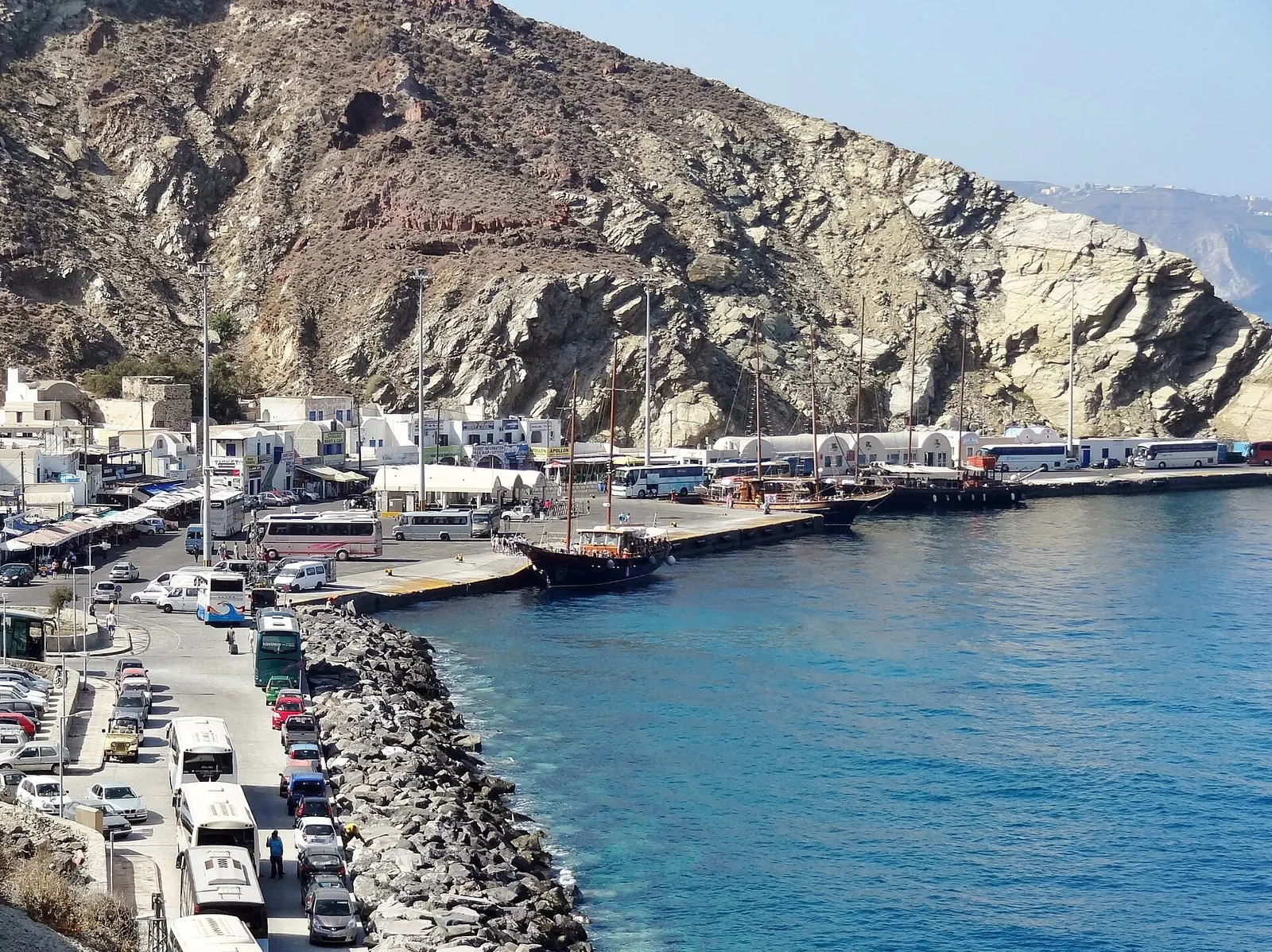
Every Santorini ferry ties up at the same narrow quay: Athinios, at the foot of the caldera cliffs south of Fira. Getting there is where the choices are. From Athens you pick between Piraeus and Rafina, and between the big conventional ships of Blue Star Ferries and the high-speed craft that race through the Cyclades. From the other islands you pick by season, because the web of routes linking Santorini to Naxos, Paros, Ios, Mykonos, Milos and Crete in July shrinks to a few threads by January.
Quick answer: For the cheapest, steadiest crossing from Athens, take a Blue Star ferry from Piraeus; the line’s own page gives the journey as “from 6 hours 6 minutes”. For speed, take a high-speed boat, which saves time but moves more in the wind. Book on the operator’s site, keep a spare day before any flight home, and know how you’re getting up the cliff from Athinios before the ramp comes down.
Last updated September 26, 2026. We checked Blue Star Ferries’ route, fare-offer, discount and e-ticket pages, its 2026 itinerary notices, the EU’s rules on sea passenger rights and the KTEL Santorini price table in September 2026. Timetables are set season by season: confirm yours with the operator.
- One ferry port: passenger ferries use Athinios, about 10 km from Fira. Fira’s Old Port handles cruise tenders and excursion boats, not ferries.
- From Athens: Blue Star’s Santorini ferries leave Piraeus from gates E6 and E7. Rafina adds fast boats, mainly in the warmer months.
- Cheapest tickets: Blue Star’s Super Economy fare is EUR 20 on Cyclades routes from Piraeus, but seats are limited, can’t be changed or refunded, and aren’t sold online. Children under 5 travel free in Economy.
- E-tickets: Blue Star issues them by web check-in from 48 hours up to 2 hours before departure. Show the e-ticket with your passport or ID card when you board.
- Weather is real, even in summer: Blue Star posted bad-weather itinerary changes for eight separate spells in 2026, including July 28-August 2 and August 9-11.
- The 2026 trap: Civil Protection measures have put traffic control on Athinios port until March 31, 2027. Leave extra time for the one road down.
Still deciding whether to sail at all? Our guide to how to get to Santorini compares the ferry with the Athens flight, door to door. This page is for when you’ve chosen the sea.
On this page: Routes at a glance | Route by route | Conventional or fast? | The crossing | Operators | Prices | Booking | Schedules | Weather and cancellations | Arriving at Athinios | Leaving by ferry | Which ferry for which trip | What to skip | FAQ
Santorini Ferry Routes at a Glance
These are the Santorini ferry connections most visitors use, Times marked “roughly” are planning figures: check the actual sailing.
| Route | Who sails it | Typical time | Season | Good to know |
|---|---|---|---|---|
| Piraeus (Athens) | Blue Star; high-speed boats | From 6h 6m on Blue Star; roughly 4.5-5.5h by fast boat | All year | Gates E6 and E7; some sailings arrive after midnight |
| Rafina (Athens) | High-speed boats | Roughly 5.5-6h | Mainly spring to fall | The port nearest Athens airport |
| Naxos | Blue Star; high-speed boats | Roughly 1-3h | All year, busiest in summer | The most reliable island link in winter |
| Paros | Blue Star; high-speed boats | About 2h on average | All year, busiest in summer | Frequent in season |
| Ios | Blue Star; high-speed boats | A short hop | All year, busiest in summer | Often the last stop before Santorini on the line from Piraeus |
| Mykonos | High-speed boats | Roughly 2h 50m | Mainly spring to fall | Not on Blue Star’s list of direct links from Santorini |
| Crete (Heraklion, Sitia) | Seajets; Blue Star | Under 2h to Heraklion by fast boat | Fast boats seasonal | Blue Star links run on its long Dodecanese line |
| Milos | High-speed boats | Roughly 2-5h | Mainly summer | Times vary with the stops |
| Rhodes and the Dodecanese | Blue Star | Long, many stops | All year | Irregular hours, including night calls |
| Anafi | Blue Star | About 1h 20m | All year | Santorini’s quiet neighbor to the east |
Santorini Ferry Routes, One by One
Ferry routes from Santorini run both ways, and each has its own rhythm. We’ve ordered them by how many visitors use them, starting with the mainline from Athens.
1. Piraeus (Athens)
The year-round mainline, and the cheapest way across. The Athens to Santorini ferry from Piraeus is the backbone of the whole network. Blue Star’s conventional ships run it all year, and high-speed boats join in the warmer months. Blue Star’s Santorini page gives the journey as from 6 hours 6 minutes, with calls at islands such as Paros, Naxos or Ios on the way, so a sailing with more stops takes longer. Not every departure is a daytime one, either. On July 30, 2026, Blue Star 1 left Piraeus at 17:30 and was due into Santorini at 02:00, which is a very different arrival from a morning boat that docks in daylight.
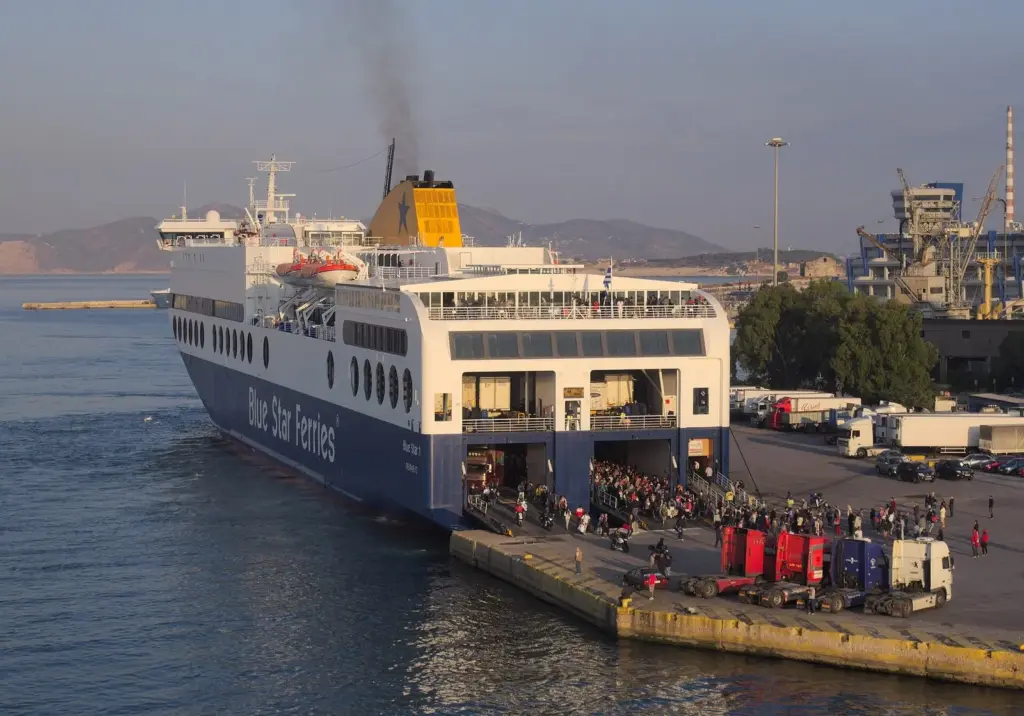
Plan it: Blue Star’s Santorini ferries leave from gates E6 and E7 at Piraeus. From Athens airport, the X96 bus takes an estimated 90 minutes (EUR 5.50) and Metro Line 3 about an hour (EUR 9 airport ticket) to reach the port; add walking time from the metro to the gate. Check the arrival time before you pay: a 02:00 arrival needs a pre-booked transfer at the other end. Best for: travelers already in Athens, budget trips, and anyone bringing a car.
2. Rafina (Athens)
The fast-boat port closest to Athens airport. Rafina sits on the east coast of Attica, and in the warmer months high-speed boats run from there down through the Cyclades to Santorini, roughly five and a half to six hours with several island calls. The KTEL bus to Rafina leaves from Athens airport’s Arrivals level between Exits 2 and 3, in the outer lane opposite the Sofitel. If you land in Athens and want to reach the islands without crossing the city, this is your port.
Plan it: the route is seasonal and thinner than Piraeus, so confirm your date has a sailing before you build a day around it. Boats that stop at five or six islands tend to lose time as the day goes on, so a Santorini arrival late in the afternoon can slip. Best for: travelers coming straight off a flight into Athens in summer.
3. Naxos
The easiest island pairing, and the one that works in winter. Naxos, the largest of the Cyclades, is a regular stop for both the Blue Star ships and the fast boats, which makes Santorini to Naxos one of the most frequent connections in the network. Crossings run roughly one to three hours depending on the vessel and the stops. When most island-to-island links disappear in winter, this one keeps going because the Blue Star line keeps calling.
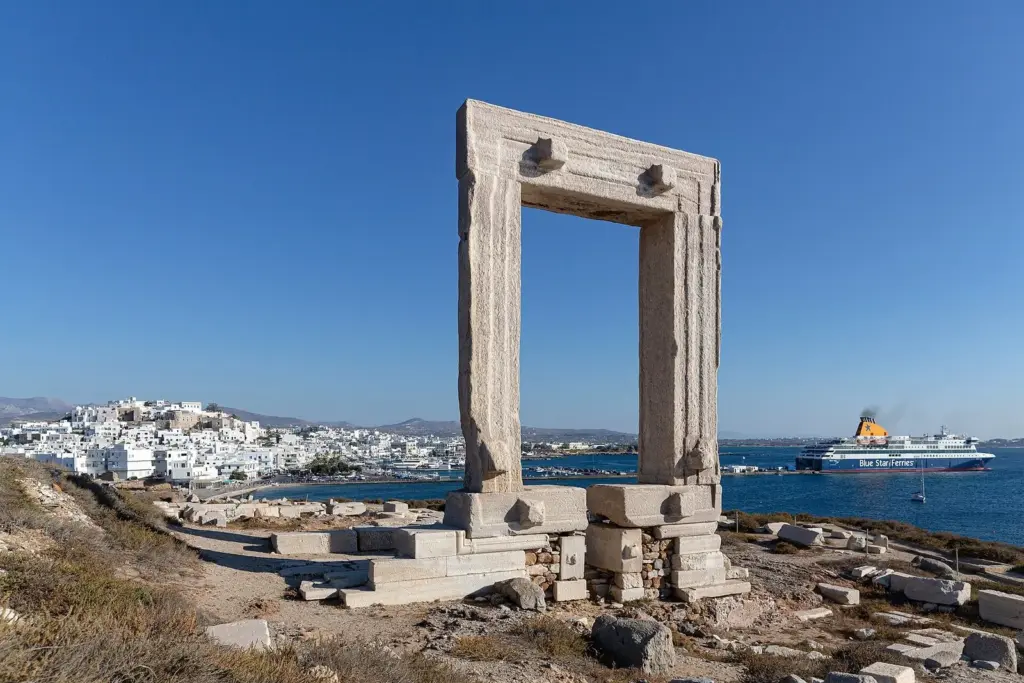
Plan it: the Naxos port is right at the edge of the main town, so you can walk to many hotels from the ramp. In summer, fast boats give you a choice of times; out of season, plan around the Blue Star timetable. Best for: pairing Santorini with a bigger, greener island with long sandy beaches and a lower price level.
4. Paros
A frequent, mid-length hop. Paros is on Blue Star’s Piraeus-Santorini line and on the fast-boat routes. Booking sites listed about four sailings a day in season, averaging just under two hours. Santorini to Paros suits travelers who want an island with a real town life, easy beaches and plenty of onward connections, because Paros is a hub for the central Cyclades.
Plan it: boats dock at Parikia, the main town, so arrival is simple. Because Paros sits in the middle of the network, it’s also a useful place to wait out a cancellation: there are usually more ways out of Paros than out of smaller islands. Best for: a two- or three-island trip with Naxos or Antiparos nearby.
5. Ios
The short hop north. Ios is often the last stop before Santorini on the line from Piraeus, and Blue Star’s Santorini page lists it among its direct connections. Santorini to Ios is the shortest crossing most visitors make, which is why people pair the two for a few nights of beaches and, in high summer, a much louder nightlife than Santorini’s.
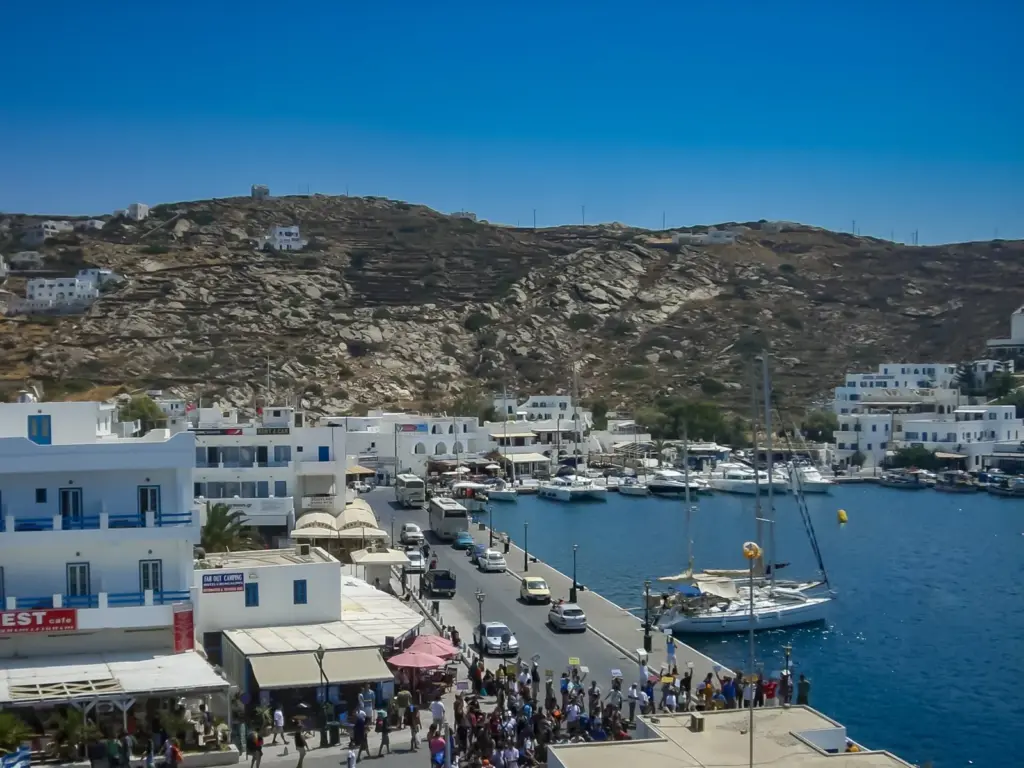
Plan it: the Ios harbor sits below the island’s hilltop village, a steep walk or a short bus ride up. In June, July and August, fast boats give you several options a day; in winter, you’re back to the Blue Star timetable. Best for: younger travelers, beach days and a short add-on to a Santorini stay.
6. Mykonos
A summer fast-boat route only. The Mykonos to Santorini ferry is the busiest island pairing in the peak months, but Blue Star’s Santorini page doesn’t list Mykonos among its direct connections: this is high-speed boat territory. Booking sites listed about four sailings a day in season at roughly 2 hours 50 minutes. Outside the warmer months, direct boats thin out or stop altogether, and the fallback is a sailing via Piraeus or a flight via Athens.
Plan it: check which of Mykonos’s two ports your boat uses, since the new port is outside town and the timing of your transfer depends on it. On windy summer days, this route is one of the first to feel it; if you’re prone to seasickness, a morning departure is usually calmer than an afternoon one. Best for: the classic two-island summer trip, with Santorini’s caldera and Mykonos’s beaches and nightlife.
7. Crete (Heraklion and Sitia)
Closer than most people think. Santorini to Crete is a realistic pairing, not an expedition. Seajets sells day trips to Santorini from Heraklion and Rethymno with crossings of under two hours, and Blue Star’s Santorini page lists direct links to Heraklion and to Sitia on Crete’s eastern end. The Blue Star connections run on its long Dodecanese line, which in January 2026 called at Santorini at hours such as 03:05 and 23:10, so read the times closely before you book.
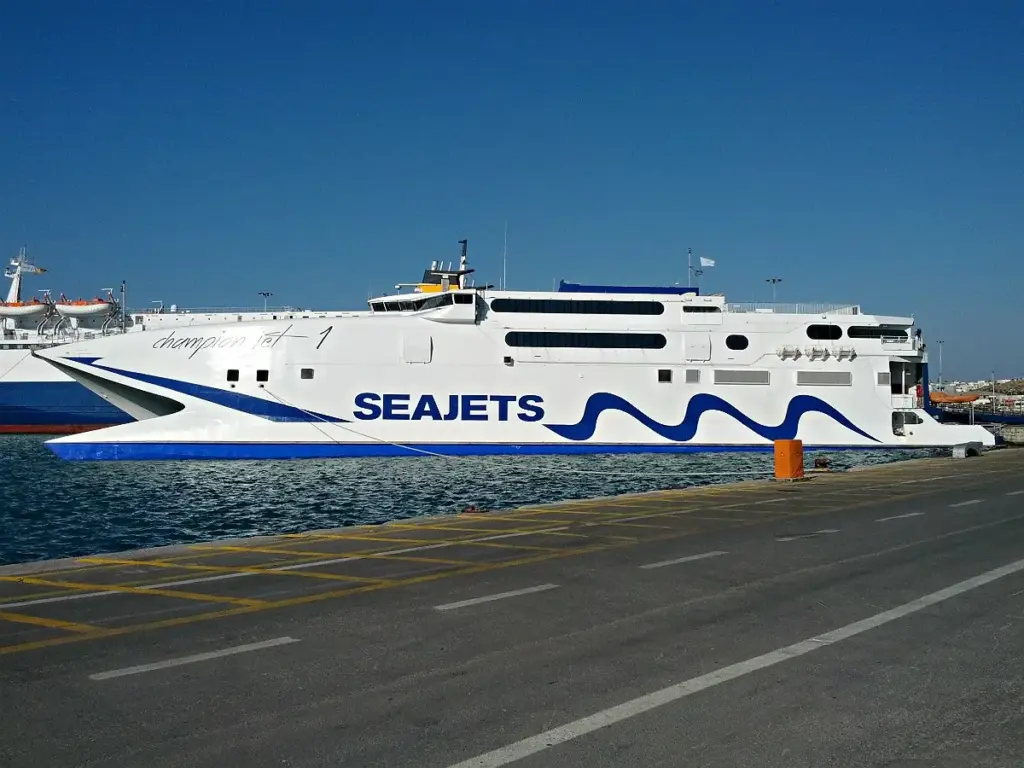
Plan it: Heraklion is the port for Knossos and central Crete; Sitia suits a trip to the island’s quieter east. In summer the fast boats are the practical choice; outside it, check whether the Blue Star line’s timing works or fly via Athens. Best for: combining Santorini with Crete’s beaches, food and archaeology.
8. Milos
A summer link to the western Cyclades. Milos lies west of Santorini, and Santorini to Milos runs mainly in summer on high-speed boats. Planning figures from booking sites put the crossing at roughly two to five hours, depending on how many islands the boat calls at; it isn’t on Blue Star’s list of direct connections from Santorini. Outside summer, the realistic route is back through Piraeus.
Plan it: book early for July and August, because Milos has become popular and the direct boats are few. Check whether your sailing stops at Folegandros or other small islands on the way, which explains the wide range in journey times. Best for: travelers who want Santorini’s drama followed by Milos’s coastline and boat trips.
9. Rhodes and the Dodecanese
A long, slow, useful line. Santorini to Rhodes is possible without going back to Athens. In January 2026, Blue Star Chios ran the Dodecanese line from Piraeus, calling at Santorini, Anafi, Kasos, Karpathos (Pigadia and Diafani), Chalki and Rhodes, with Heraklion also on its circuit. It’s a working ferry route, not a tourist shuttle: hours are irregular, stops are many, and some calls come in the middle of the night.
Plan it: look at the exact call times on Blue Star’s site, book a cabin if the trip runs through the night, and allow a buffer at the far end. Best for: island-hoppers with time who want to move on to Rhodes, Karpathos or the smaller Dodecanese islands.
10. Anafi
Santorini’s quiet neighbor to the east. Anafi is a small, rugged island a short sail east of Santorini, and Blue Star lists it as a direct connection. On July 30, 2026, Blue Star 1 left Santorini at 02:20 and was due in Anafi at 03:40, which tells you both how close it is and how inconvenient the hours can be. It’s the opposite of Santorini in almost every way: few visitors, simple rooms and long, empty walks.
Plan it: check the timetable carefully, since the Anafi calls can come at unsociable hours and outside summer there may be only a few a week. Book your room before you sail; there isn’t much of it. Best for: travelers who want a few days of real quiet after Santorini.
Conventional Ferry or High-Speed Boat?
Every ferry to Santorini, Greece falls into one of two families, and they feel nothing alike. The conventional ships are big roll-on, roll-off ferries with several decks, cafeterias, outside decks and cabins, carrying cars and trucks as well as passengers. The high-speed craft are sleeker catamarans and monohulls with airline-style lounges. One is a slow, steady day at sea; the other is a fast ride you mostly spend indoors.
| Conventional ferry (such as Blue Star) | High-speed boat | |
|---|---|---|
| Piraeus to Santorini | From 6h 6m on Blue Star’s page; longer with more stops | Roughly 4.5-5.5 hours |
| Classes | Economy, numbered aircraft-type seats, cabins including LUX cabins | Economy, Business and VIP seats |
| Outside space | Open decks for the caldera arrival | Limited or none while under way |
| In the wind | Steadier, and less likely to be canceled | Pitches more; first to be delayed or canceled |
| Cars | Yes | Depends on the vessel |
| Price | The cheapest fares, including Blue Star’s EUR 20 Super Economy offer | Usually higher |
| Best for | Budgets, families, anyone prone to seasickness, and the view | Short island hops and tight schedules on calm days |
Our rule of thumb: for the long Piraeus run, take the conventional ferry unless you’re genuinely short on time, because the steadier ride and the open decks are worth the extra hours. For hops under three hours between islands, the fast boats make sense on a calm day. If the forecast shows strong north winds and you’re sensitive to motion, reverse that advice.
What the Crossing Is Actually Like
If you’ve only taken short car ferries before, a Greek island crossing takes a little getting used to. On the big conventional ships you usually walk aboard up the vehicle ramp, past the trucks, and leave large bags in the racks near the car deck before climbing to the passenger decks. Economy lets you sit in the lounges or outside; numbered seats and cabins are reserved. Blue Star even runs onboard meal offers, which tells you how long some of these legs are. On the fast boats you board quickly, drop big bags at the entrance and find an assigned seat, and that seat is where you’ll spend most of the trip.
Bring what you’d bring on a long train ride: water, snacks you like, a sweater for the air-conditioned lounges, a charged phone and something to read. In summer, the outside decks of a conventional ferry are the best seats on the ship until early afternoon, when the sun makes shade the most valuable thing on board.
If you’re prone to seasickness, choose the bigger ship, sit low and toward the middle, keep your eyes on the horizon and skip the heavy lunch. On a fast boat in a north wind, a window seat near the back usually feels calmer than one at the bow.
Then there’s the arrival, which is the whole reason some people choose the sea. The last stretch runs inside the caldera, with the cliffs rising hundreds of feet above the ship and the white villages strung along the rim. Get on deck when the announcements start, with your bags already sorted, and you’ll see it properly instead of from the luggage line.
Santorini Ferry Operators
Two names carry most passengers to and from Santorini, and a handful of smaller lines appear on particular routes in particular seasons. Your ticket tells you who runs your boat, and the vessel name matters more than the brand: the same company can run a fast modern ship on one route and an older, slower one on another.
Blue Star Ferries
Blue Star, part of Greece’s Attica Group, runs the big conventional ships. Its own Santorini page gives the Piraeus-Santorini journey as from 6 hours 6 minutes, says the ferries leave Piraeus from gates E6 and E7, and lists direct onward links from Santorini to Heraklion, Anafi, Ios, Naxos, Paros and Sitia. In 2026 its notices showed Blue Star 1 on the Piraeus-Cyclades line and Blue Star Chios on the long Dodecanese line that also calls at Santorini.
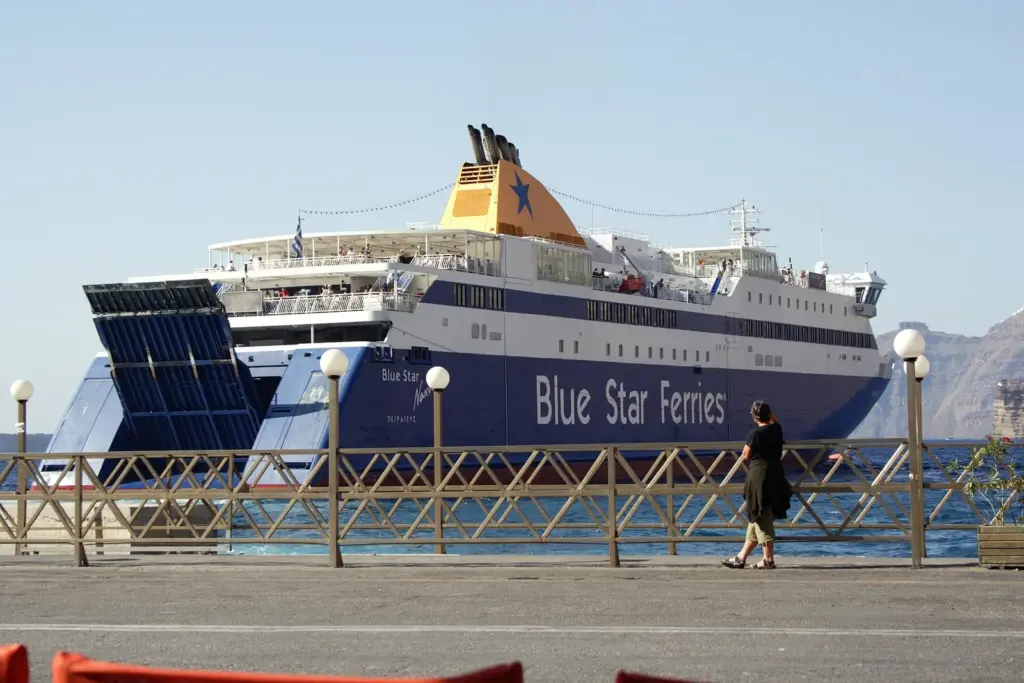
Blue Star is also where the bargains are: a limited Super Economy fare of EUR 20, a Special Economy discount of 20%, free Economy travel for children under 5 and half fares for children aged 5 to 10 and for ISIC student card holders. Its e-tickets arrive through web check-in, from 48 hours up to 2 hours before departure.
Seajets
Seajets runs high-speed craft through the Cyclades and to Crete, including day trips to Santorini from Heraklion and Rethymno that it advertises with crossings of under two hours. For Seajets Santorini sailings, check the vessel name and the stops: a direct fast boat and one that calls at four islands on the way can differ by hours.
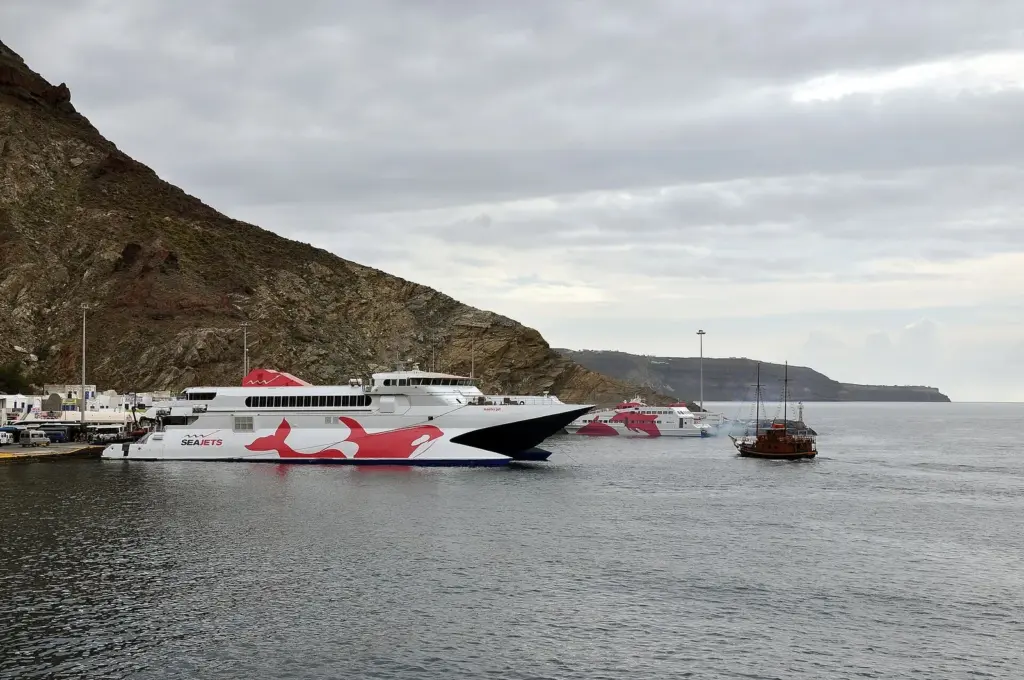
One practical note: Check Seajets’ current Santorini timetables and fares on its own site. Book there or through an agent, and read the schedule for your exact date rather than trusting a general figure, including ours.
Other lines and agents
Smaller operators appear on individual routes, especially in summer, and ferry booking sites list them alongside the big two. Travel agencies in Fira and at Athinios sell tickets for most lines and can print paper tickets, which is useful for fares that can’t be bought online, such as Blue Star’s Super Economy.
Ferry to Santorini Price: What You’ll Pay
Ferry fares in Greece move with the operator, the vessel, the class, the season and how early you book, so any single “price of the ferry to Santorini” is a snapshot. Here are the fares from the operators’ own pages in September 2026, plus rougher booking-site figures.
| Ticket or rule | What it means | Source and date |
|---|---|---|
| Super Economy | EUR 20 Economy tickets on Cyclades routes from or to Piraeus (EUR 25 Piraeus-Heraklion); limited seats; no changes or refunds; not sold through the online booking system | Blue Star, September 2026 |
| Special Economy | 20% off a limited number of Economy tickets on routes from or to Piraeus; can be changed or made open-date under the company’s policy | Blue Star, September 2026 |
| Children under 5 | Free in Economy, with a zero-fare ticket | Blue Star discounts page |
| Children 5 to 10 | 50% off | Blue Star discounts page |
| Students with ISIC | 50% off (on conventional ships, all fares except LUX cabins and VIP seats) | Blue Star discounts page |
| Regular Piraeus-Santorini fares | Booking sites listed conventional tickets from about EUR 46.50 and fast boats from about EUR 79.70 | Booking sites, September 2026; check with the operator |
So what’s the real cost of a ferry to Santorini? For one adult from Piraeus, expect to pay the least for an Economy seat on a conventional ship, noticeably more for a fast boat, and considerably more for a cabin. Outside the peak months, compare against the flight: on September 24, 2026, Aegean and SKY express were selling Athens-Santorini seats from EUR 49-50, which can undercut a high-speed ticket once you add the metro to Piraeus.
A few money points people miss. Cabins are worth the extra on night sailings, when a seat for eight hours is miserable. Cars cost extra, and most rental contracts restrict taking the car on a ferry, so check before you book a vehicle ticket. And “cheap” promotional fares only help if your plans are fixed: a non-refundable EUR 20 ticket that you can’t use is the most expensive ticket on the ship.
How to Book Santorini Ferry Tickets
Booking is simple once you know the order. Here’s how we’d do it:
- Pick the sailing, not just the route. Look at the vessel, the stops and the arrival time at Athinios. A cheaper ticket that lands at 02:00 is only cheaper if you’ve planned the night.
- Book on the operator’s site or through a travel agent. Booking platforms show several lines at once, which is useful for comparing, but check the final price and the change rules before you pay.
- Use names exactly as they appear on passports or ID cards. You’ll show ID at boarding.
- Get your e-ticket. On Blue Star, web check-in issues it from 48 hours up to 2 hours before departure, to your email or phone. If you need a paper ticket, collect it from a Greek port agent at least 2 hours before departure.
- Arrive early. Our advice is 45 to 60 minutes before departure at Piraeus, where finding the gate takes time, and at least an hour at Athinios in summer, where the road is the bottleneck.
When should you book? For July and August, Greek Easter weekend and the days around August 15, when half of Greece seems to be heading to the islands, book as soon as your dates are fixed, and certainly before you arrive in Greece. For cabins and car spaces, book earlier still. In late fall, winter and early spring, a few days ahead is usually enough, but the timetable is thinner, so there’s less to choose from.
Santorini Ferry Schedule: How the Timetables Work
A Santorini ferry schedule is really several overlapping timetables: Blue Star’s year-round lines, the fast boats that run mainly in the warmer months, and the long Dodecanese line with its odd hours. Operators publish them season by season, and they change at short notice when the weather turns. Blue Star posts every change as an itinerary notice on its site; in 2026 there were notices for eight bad-weather spells between January and mid-August.
| Season | What runs | What to watch in 2026-style conditions |
|---|---|---|
| Winter (November-March) | Blue Star from Piraeus via Paros and Naxos; the Dodecanese line; few fast boats | Storm changes, as in Blue Star’s notices for January 10-18, January 19-February 4 and February 5-8, 2026 |
| Spring (April-May) | Fast boats and Rafina sailings return; Blue Star continues | Spring wind, as in the March 24-April 1, April 1-7 and May 1-9, 2026 changes |
| Summer (June-August) | The full network, including Mykonos and Milos | Meltemi gales, as in the July 28-August 2 and August 9-11, 2026 changes; heavy demand |
| Fall (September-October) | Most routes continue, thinning as October ends | Calmer seas as a rule, but check for early storms; fewer fast boats by late October |
Night sailings deserve a special mention. The Blue Star 1 sailing on July 30, 2026, left Piraeus at 17:30 and was due in Santorini at 02:00, and the Dodecanese line called at Santorini at 03:05 and 23:10 on different days in January 2026. These sailings are real options, often cheaper and less crowded, but only if a transfer is waiting for you at the other end.
Weather, Delays and Cancellations
The Aegean is not a lake. In summer the meltemi, a strong, dry north wind, can blow for days at a time, and it hits the fast boats first. In winter, storms come through from other directions. When winds get strong enough, Greek port authorities can ban departures outright, and even when boats sail, schedules slip and some calls get skipped: on July 30, 2026, Blue Star 1 missed its Syros call because of the weather.
If your ferry is canceled or delayed, EU Regulation 1177/2010 gives you rights:
- Cancellation or a departure delay over 90 minutes: you choose between a refund within 7 days (with a free return journey where needed) and re-routing to your destination at the earliest opportunity at no extra cost.
- Late arrival: compensation of 25% of the ticket price, or 50% at double the delay. For trips up to 4 hours, that’s after 1 hour (2 hours for 50%); for trips of 4 to 8 hours, after 2 hours (4); for 8 to 24 hours, after 3 hours (6). It isn’t owed when severe weather or extraordinary circumstances caused the delay.
- Stranded overnight: the operator must offer accommodation up to EUR 80 a night for up to 3 nights, plus meals in proportion to the wait, except when severe weather caused the cancellation.
Read that last line twice. Because weather causes most cancellations in the Cyclades, the rules that matter most in practice are the refund and re-routing ones. The real protection is your own planning: a spare day before any international flight, a morning sailing rather than the last boat of the day, a flexible ticket when the forecast looks bad, and travel insurance that covers missed connections. When the sea is closed, the Athens flight is the escape hatch.
Arriving at Athinios, the Santorini Ferry Port
The Santorini ferry port at Athinios is a narrow quay at the foot of the caldera wall, about 10 km from Fira by road. There’s a strip of cafes, ticket agencies and car-rental offices, a waiting area, and one road: a series of hairpin bends that climbs the cliff to the villages above. When a big ferry arrives, hundreds of passengers and a line of vehicles try to leave at the same moment, and under the 2026 Civil Protection measures, traffic at the port is controlled until March 31, 2027.
Your ways up the cliff:
- KTEL bus: EUR 2.70 to Fira on the official price table updated May 19, 2026. Fira is the hub, so for most other villages you change there.
- Pre-booked transfer: the calm option, especially with luggage, children or a late arrival. Hotels arrange pickups at extra cost; one apartment property in our hotel research listed EUR 27 for two by shared minibus from the port in September 2026.
- Taxi: possible, but a ferry-load of people competing for the island’s small taxi fleet makes it the least predictable choice.
- Rental car: some rental firms meet ferries at the port. Pick-up at Athinios saves the transfer, but you’ll be driving the hairpins straight away, in traffic.
Distance matters here. Fira and the villages just south of it are a short ride; Santorini port to Oia is the longest transfer on the island, across to the northern tip, and by bus it means a change in Fira. If you’re staying in Oia and arriving on a busy afternoon, the transfer is money well spent. The same goes for any arrival after dark, when the buses may have stopped for the night.
Three habits make arrival easier. Go to your luggage early: big bags usually sit in racks near the car deck, and when the crew announces Santorini, the ramp comes down fast. Walk off briskly and find your driver or bus before the crowd forms. And don’t linger on the quay deciding what to do; five minutes of hesitation can mean the last seat on the bus goes to someone else.
Leaving Santorini by Ferry
The road down to Athinios is the bottleneck, not the ferry. In summer, plan to be at the port at least an hour before departure, more if you’re driving a rental car back or if a cruise ship and two ferries are due around the same time. The KTEL bus from Fira costs EUR 2.70; check its timetable for a departure that gets you there with that hour to spare, not one that arrives as your ferry’s ramp is going up.
At the port, find out which berth your ship uses, keep your e-ticket and passport or ID card handy, and stay near the quay. Ferries in the Cyclades turn around quickly, and boarding a big ship with cars and passengers can take only a few minutes. If you’re on a fast boat, big bags go in the luggage area as you board, so pack a small bag with water, a layer for the air conditioning and anything you need for the trip.
Island-hoppers should build the route around the ferry, not the other way around. Naxos, Paros and Ios link to Santorini all year; Mykonos and Milos mainly in the warmer months; Crete by fast boat in season or on Blue Star’s slower line. As for day trips from Santorini, the public ferries rarely suit them. The popular sea outings are organized boat trips around the caldera, a different business from the ferries altogether.
Which Ferry for Which Trip?
The right boat depends on the rest of your trip. These are the combinations we see most often, and what we’d book for each.
- A few nights on Santorini after flying into Athens. If you want the sea, spend a night in Athens and take a morning Blue Star from Piraeus, so you arrive in daylight with the afternoon ahead of you. If you’re connecting straight off a long-haul flight, fly the last leg instead and save the ferry for later in the trip.
- Santorini and Mykonos in summer. Take a high-speed boat between them, pick a morning departure, and book as soon as your hotels are confirmed. Put Santorini second if your international flight leaves from Athens, and leave a spare day between the last crossing and the flight.
- Santorini and Naxos or Paros in spring or fall. The easiest pairing in the network. The Blue Star line connects them all year, and the fast boats add choice in season.
- Santorini and Crete. Sail between Santorini and Heraklion by fast boat in season, then fly home from Crete rather than doubling back to Athens. Out of season, check the Blue Star timing or fly.
- A winter visit. Use the Blue Star line from Piraeus, check the forecast for the days around your crossing, and keep the Athens flight as your backup. Winter storms are the main reason sailings change between November and March.
- Traveling with a car. Take a conventional ferry from Piraeus, book the vehicle space early in summer, and confirm your rental company allows ferry crossings before you pay.
- On a tight budget. Travel Economy on a conventional ship, and if your dates are fixed, ask an agent about Blue Star’s EUR 20 Super Economy seats. Bring your own food: the ferry cafeteria is priced for a captive audience.
What to Skip
- A ferry on the day of your international flight. One meltemi afternoon is all it takes. Sail at least a day ahead.
- Super Economy tickets if your plans might move. The EUR 20 fare can’t be changed or refunded.
- A fast boat into a strong north wind if you get seasick. Take the conventional ferry or a morning sailing.
- Buying tickets at the port in August. Popular sailings sell out; buy when you book your hotel.
- A 02:00 arrival with no plan. Night sailings are fine with a pre-booked transfer and miserable without one.
- Assuming the Mykonos boat runs in winter. The direct link is essentially a warm-season route.
Santorini Ferry FAQ
Where is the Santorini ferry port?
At Athinios, on the caldera side of the island about 10 km south of Fira. Almost every passenger ferry and fast boat uses it. Fira’s Old Port, directly below the town, is a different place: it serves cruise-ship tenders and excursion boats. From Athinios, KTEL buses run to Fira for EUR 2.70 (May 2026 table).
Where do Santorini ferries leave from in Athens?
Mostly from Piraeus, Athens’s main port, where Blue Star’s Santorini ferries use gates E6 and E7. In the warmer months, high-speed boats also sail from Rafina on the east coast, the port closest to Athens airport. Check your ticket for the port and the gate, and allow time to walk to it.
How much is the ferry to Santorini?
It depends on the boat and the class. Blue Star’s Super Economy offer is EUR 20 on Cyclades routes from Piraeus, though seats are limited and non-refundable. Booking sites listed regular conventional fares from about EUR 46.50 and fast boats from about EUR 79.70 in September 2026. Cabins, cars and peak dates cost more.
Do I need to print my ferry ticket?
Not usually. Blue Star issues e-tickets through web check-in from 48 hours up to 2 hours before departure, and you show the e-ticket on your phone with your passport or ID card when boarding. If you prefer paper, collect the ticket from a Greek port agent at least 2 hours before departure.
What happens if my ferry is canceled?
Under EU rules, if a sailing is canceled or leaves more than 90 minutes late, you choose between a refund within 7 days and re-routing at no extra cost. Late-arrival compensation and hotel costs aren’t owed when severe weather caused the problem, which is the usual reason in the Aegean, so keep a spare day.
Are there night ferries to Santorini?
Yes, on some days. On July 30, 2026, Blue Star 1 left Piraeus at 17:30 and was due in Santorini at 02:00, and Blue Star’s Dodecanese line called at Santorini at hours like 03:05 and 23:10 in January 2026. Book a cabin for long night legs and a transfer for the arrival.
Do children travel free on Greek ferries?
On Blue Star’s Cyclades routes, children under 5 travel free in Economy but still need a zero-fare ticket, and children aged 5 to 10 pay half fare. Discounts differ by class and vessel type, and other operators set their own rules, so check the discount page of the line you’re booking.
Sources and How We Checked
We checked the operator and official pages below on September 25 and 26, 2026, and dated every fare, rule and sailing to its source; we did not take these ferries for this guide.
- Blue Star Ferries: Santorini page (journey time, Piraeus gates, connections), offers and discounts and online booking and web check-in
- Blue Star itinerary notices for 2026, including July 28-August 2
- Seajets day trips to Santorini from Heraklion and Rethymno
- Your Europe: ship passenger rights (EU Regulation 1177/2010)
- KTEL Santorini price table (updated May 19, 2026)
- Athens International Airport and OASA: buses and metro to Piraeus and Rafina
Santorini Tourism Guide is an independent publication. We are not affiliated with the Municipality of Thira, the Greek National Tourism Organisation, Blue Star Ferries, Attica Group, Seajets, KTEL Santorini or any business listed here, and no one paid to be included.
Photo Credits
- Athinios port from the cliff road: photo by Olaf Tausch, via Wikimedia Commons (CC BY 3.0)
- Blue Star 1 at Piraeus: photo by C messier, via Wikimedia Commons (CC BY-SA 4.0)
- The Portara and a ferry, Naxos: photo by Manfred Werner (Tsui), via Wikimedia Commons (CC BY-SA 4.0)
- Ios harbor: photo by dronepicr, via Wikimedia Commons (CC BY 2.0)
- Seajets catamaran at Heraklion: photo by Lourakis, via Wikimedia Commons (CC BY-SA 4.0)
- Blue Star Naxos at Athinios: photo by Zde, via Wikimedia Commons (CC BY-SA 4.0)
- Fast boats at Athinios: photo by Moonik, via Wikimedia Commons (CC BY-SA 3.0)