Most visitors see two Santorini villages, Oia and Fira, and leave thinking they’ve seen the island. They’ve seen its postcard. Santorini has around a dozen other villages, and they’re where the island still lives its own life: medieval castle villages built against pirates, wine villages with bell towers over the lanes, cave houses dug into a ravine, beach villages on black sand and quiet caldera villages with the best views of all. The choice isn’t which one is “best” but which kind of village you want: the caldera rim for views, the inland villages for history and wine, or the coast for beaches.
Quick answer: For views without Oia’s crowds, walk to Imerovigli and Firostefani. For the best traditional villages, go to Pyrgos, Megalochori and Emporio in the south and center. For beaches, Kamari and Perissa. For something almost nobody sees, Vothonas, Episkopi Gonia and Vourvoulos. Most villages are a EUR 2.20 bus ride from Fira on the 2026 table.
Last updated October 1, 2026. We checked bus fares and distances on the KTEL Santorini price table, the current locations of cultural venues that have moved, and village details against official sources and the venues’ own sites in September 2026.
- Buses: from Fira, most village routes cost a flat EUR 2.20, including Imerovigli, Karterados, Messaria, Vourvoulos, Megalochori, Emporio, Pyrgos and Akrotiri village; Perissa costs EUR 2.70 (KTEL table updated May 19, 2026). Fira is the hub, so village-to-village trips usually change there.
- Five castle villages: in the Middle Ages the islanders lived in five fortified kastelia: Skaros (near Imerovigli), Oia, Pyrgos, Emporio and Akrotiri. Pyrgos and Emporio preserve theirs best.
- Two famous venues have moved: Atlantis Books has left Oia for Firostefani, and the tsabouna (island bagpipe) exhibition that used to fill Akrotiri’s La Ponta tower moved to the Symposion Cultural Center in Megalochori in 2018.
- 2026 measures: the Civil Protection restrictions until March 31, 2027 affect the Ammoudi road below Oia, Fira’s Old Port and Athinios port, not the villages themselves.
On this page: Villages at a glance | Three kinds of village | Every village | Oia and Fira | Which village for you | Getting around | Village-hopping routes | A village day | The five castles | Easter and festivals | Through the year | What to skip | FAQ
Santorini Villages at a Glance
| Village | Type | Known for | Best for | From Fira by bus |
|---|---|---|---|---|
| Imerovigli | Caldera rim | The widest caldera views, Skaros Rock | Couples, quiet | EUR 2.20 |
| Firostefani | Caldera rim | Views a short walk from Fira | First-timers | Walk (10 minutes) |
| Pyrgos | Inland castle village | Its Kasteli and hilltop panorama | History, dinner, Easter | EUR 2.20 |
| Megalochori | Inland wine village | Bell towers, old wineries | Wine lovers, photographers | EUR 2.20 (10.7 km) |
| Emporio | Inland castle village | A fortified medieval maze | History lovers | EUR 2.20 |
| Finikia | Near the rim | Pastel lanes next to Oia | Quiet mornings | Oia bus, EUR 2.20 |
| Akrotiri village | Southwest castle village | Castle ruins, near the prehistoric site | History, sunsets | EUR 2.20 (15.1 km) |
| Kamari | Beach village | Promenade and black beach | Families, beach days | EUR 2.20 (7.3 km) |
| Perissa | Beach village | Long black-sand beach | Budget travelers | EUR 2.70 (20.4 km) |
| Karterados | Inland, near Fira | Windmill square, value | No car, budget | EUR 2.20 |
| Messaria | Inland crossroads | Neoclassical mansions | Architecture | EUR 2.20 |
| Vothonas | Inland ravine village | Cave houses | Curious travelers | Pyrgos bus, EUR 2.20 |
| Exo Gonia and Episkopi Gonia | Inland hillside | A hilltop church, a Byzantine church | Churches, quiet | EUR 2.20 |
| Vourvoulos | Northeast coast | A tiny fishing harbor | Escaping everyone | EUR 2.20 |
The Three Kinds of Santorini Village
Caldera villages. Oia, Imerovigli, Firostefani and Fira sit along the western rim of the caldera, with houses and hotels stepping down the cliff. They have the views and the sunsets, and they’re where most visitors stay. Beyond Oia and Fira, they’re quieter and mostly given over to hotels.
Inland and castle villages. Pyrgos, Megalochori, Emporio, Akrotiri, Messaria, Vothonas and the Gonia villages grew up away from the cliff, many of them around the medieval kastelia, fortified clusters of houses whose outer walls doubled as defenses. Among these traditional villages, Santorini feels least like a resort: lanes too narrow for cars, churches on every corner, vineyards on the edges and tavernas where locals eat.
Coastal villages. Kamari and Perissa on the east and south coasts are beach villages, flat and relaxed, with promenades, hotels and tavernas along black-sand beaches. Vourvoulos, in the northeast, is a tiny fishing harbor rather than a resort.
There’s another difference worth knowing: where people live. The caldera villages are now mostly hotels, restaurants and shops, while most islanders live inland and on the coast, in places like Karterados, Messaria, Pyrgos and Emporio. That’s why the inland villages still have bakeries, schools and kafeneia, and why they feel alive in winter when the rim goes quiet.
A good trip mixes all three. Sleep on the caldera for the views, spend an afternoon and an evening in the inland villages, and give the coast a beach day.
Every Santorini Village, One by One
This is our village guide to Santorini beyond Oia and Fira, starting with the caldera villages and moving inland and down to the coast. For each village: what it’s like, what to see, who it suits and how to get there.
1. Imerovigli
The balcony of the caldera. Imerovigli sits at the highest point of the caldera rim, about 4 km beyond Fira, and its views take in the whole curve of the caldera, with Oia to the north, Fira to the south and the volcanic islands in the middle. The village is small, quiet and mostly hotels, strung along a path above the cliff with a few restaurants and a main square. Its signature is Skaros Rock, the headland just below the village where a medieval castle once stood; check locally on the path around it before you go.
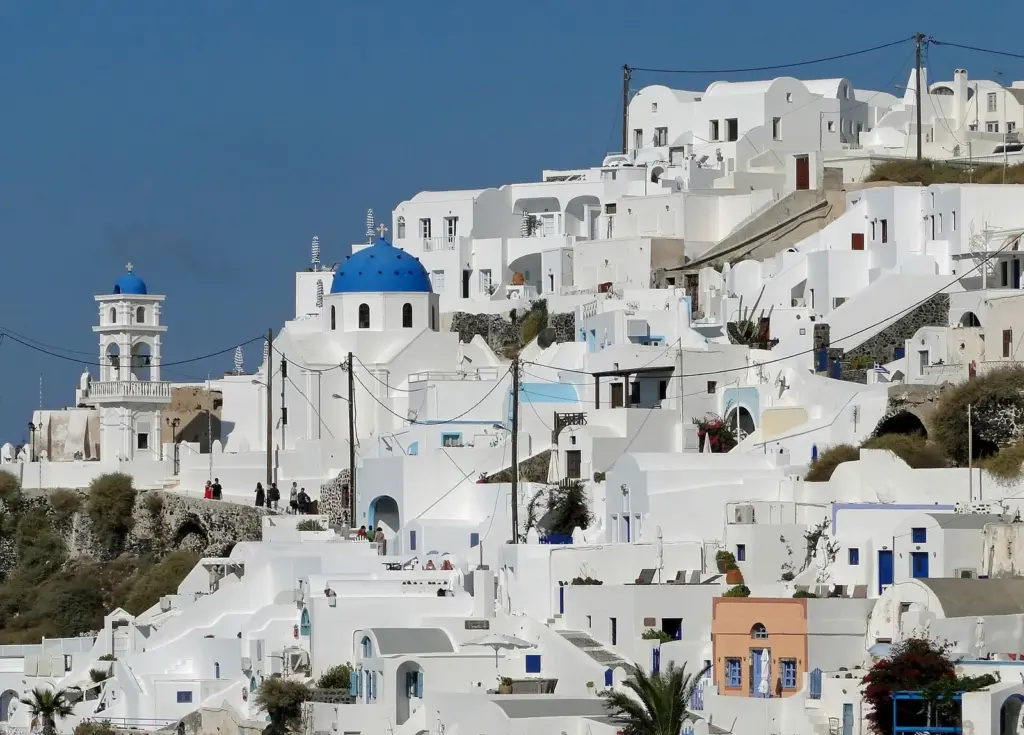
Come for the sunset, which you watch across the caldera with Skaros in the foreground and a fraction of Oia’s crowd, and for the caldera path, which passes right through the village on its way from Fira to Oia. There’s little to “do” beyond walking, looking and eating, which is exactly the appeal.
Walking from Fira takes about an hour at a strolling pace along the rim, passing through Firostefani, and the path continues north toward Oia as a proper hike. Most of the village’s hotels step down the cliff below the path, among them Grace, which says it sits 300 meters above the caldera, and Katikies Chromata, 20 meters from the main square. Expect stairs, and check minimum ages if you’re traveling with children: several Imerovigli hotels don’t accept young kids.
Plan it: the bus on the Fira-Oia road costs EUR 2.20, or walk from Fira along the rim. Many of the island’s most romantic cliff hotels are here, and most involve steps. Best for: couples, sunset lovers and anyone who wants the view without the noise.
2. Firostefani
Fira’s quieter twin. Firostefani begins where Fira ends, about a 10-minute walk north along the caldera path, and it has the same sweeping views with a fraction of the noise. There’s a small square, a couple of blue-domed churches and some good tavernas, and the village feels residential in a way Fira no longer does. It’s also the new home of Atlantis Books, the bookshop that made Oia famous among readers, which now sits on the cliffside at the base of the Nomikos Cultural Centre.
Firostefani is the best base on the island for a first visit: caldera views from your terrace, dinner in Fira on foot, and the bus hub ten minutes away. It’s also a good stop on the walk from Fira to Imerovigli.
In the evening, Firostefani’s own tavernas are calmer than Fira’s, and the bars of the capital are ten minutes away on foot, which makes it the best of both worlds. The walk on to Imerovigli, along the most spectacular stretch of the rim path, takes about half an hour.
Plan it: walk from Fira along the rim, or take any northbound bus. Hotels here include the Tsitouras Collection, in a 1780 mansion. Best for: first-time visitors and couples.
3. Pyrgos
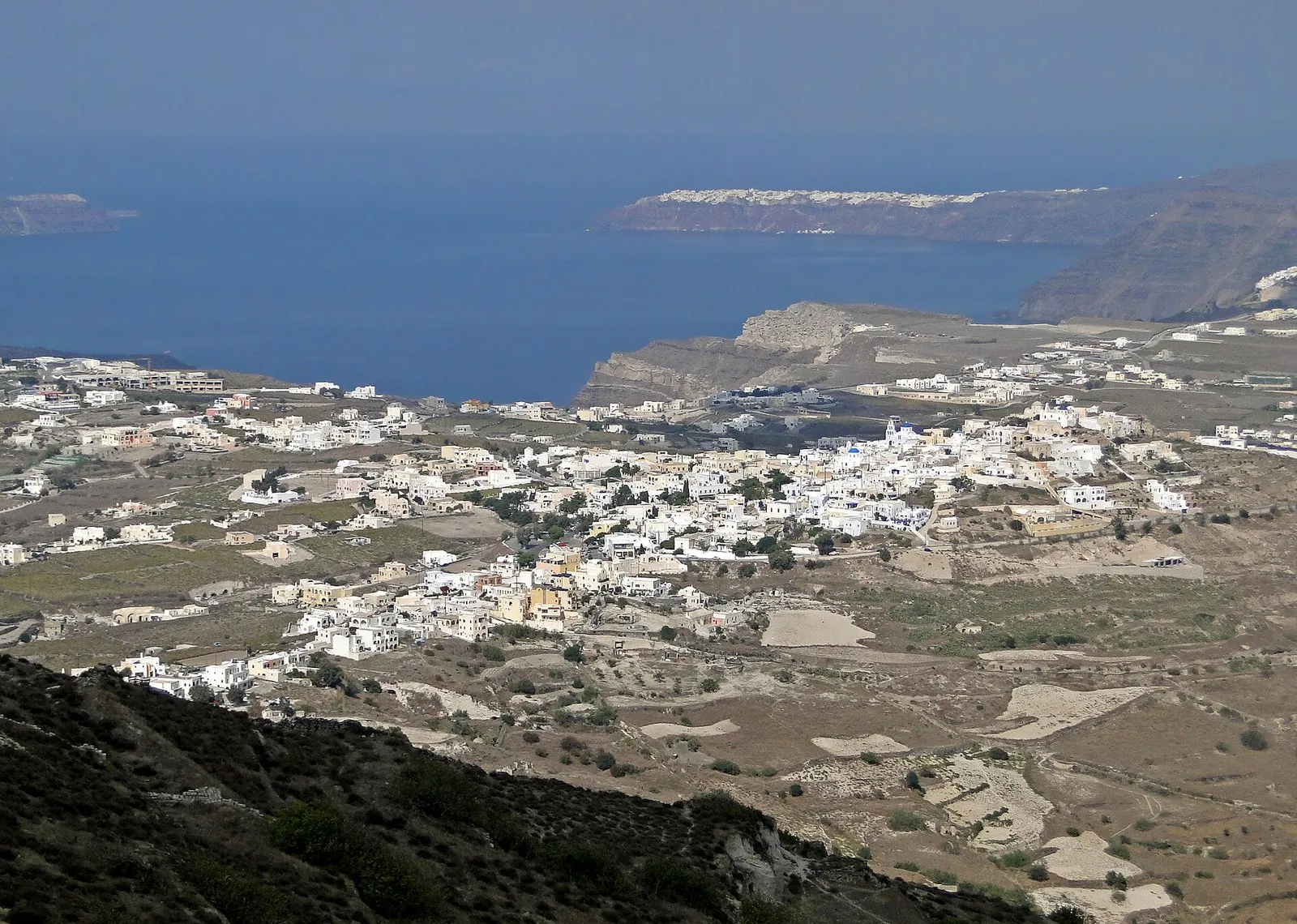
The hilltop castle village. Pyrgos Santorini’s best-preserved castle village climbs a hill in the middle of the island in tight rings of lanes that end at its Venetian castle, the Kasteli. From the top you see almost the whole island: the caldera on one side and the vineyards running down to the east coast on the other. The village is a maze of arches, stairways, chapels and small squares, and it rewards aimless wandering more than any other village on the island. Above it rises Profitis Ilias, Santorini’s highest point.
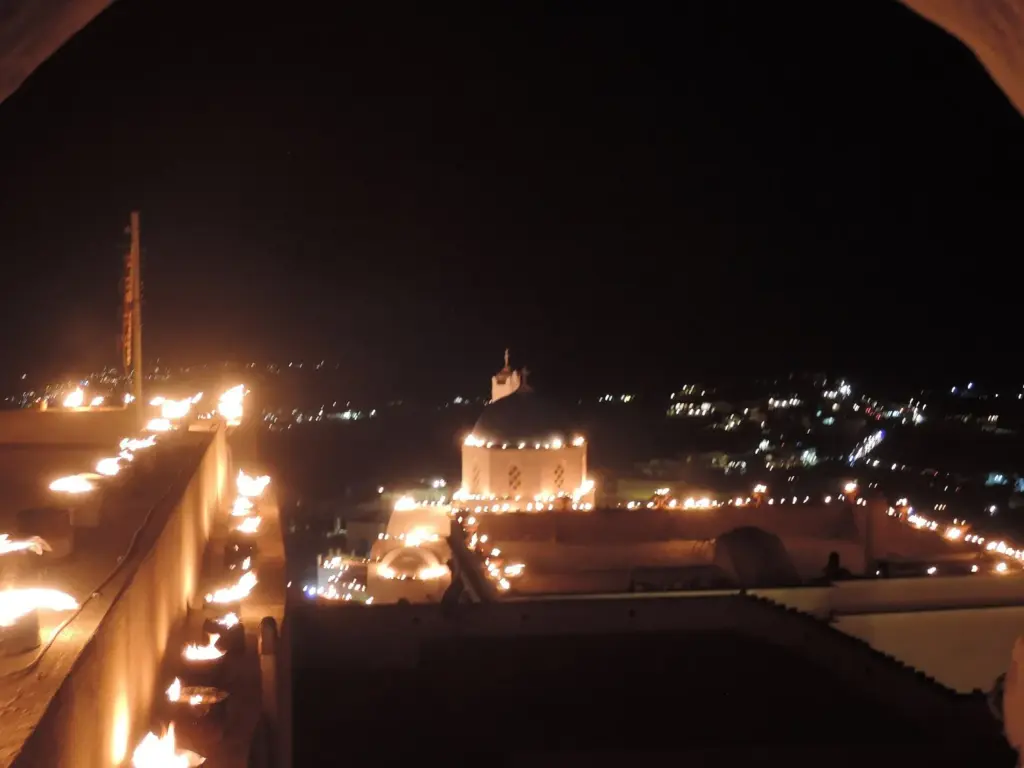
Pyrgos is at its best in the late afternoon and evening, when the light softens and the tavernas below the castle fill with people who came for dinner and stayed for the view. On Good Friday of Greek Orthodox Easter, the village is lit with thousands of small flames along its walls and roofs, one of the island’s great sights.
Park at the edge of the village and walk in; the lanes are too narrow for cars. The road on up to the summit of Profitis Ilias starts nearby, and the island’s cooperative winery, Santo Wines, is on the road near the village; it hosted the 2026 Vedema harvest festival on August 2, with free admission. Pyrgos is also one of the best places on the island for a village dinner after a winery visit.
Plan it: free; 1-2 hours; buses from Fira via Vothonas cost EUR 2.20. Zannos Melathron, a restored 19th-century mansion, stands at the castle entrance. Best for: history lovers, photographers and anyone who wants a village dinner.
4. Megalochori
The wine village. Megalochori, in the south of the island about 10.7 km from Fira by the bus route, is a medieval village of whitewashed alleys, old mansions and bell towers that arch over the lanes. Wine made its fortune: the Vedema resort grew out of a 400-year-old winery here, and the Symposion Cultural Center, which moved from Akrotiri’s La Ponta tower in 2018, occupies a turn-of-the-century winery that had stood empty for fifty years, with exhibitions, performances, workshops and a wine cafe. The village’s western edge reaches the caldera cliffs.
Come in the morning for empty lanes and soft light, or at dusk when the small square fills up. Several wineries are nearby, which makes Megalochori a natural base for a wine afternoon.
Walk out of the village to the west and you reach the caldera rim, with the small chapel of Saint Marina between the cliff edge and the village; it’s a quiet place for sunset. Two very different hotels show the village’s range: Vedema, a large resort woven into the old lanes, whose spa sits in a 100-year-old wine cellar, and Alti Santorini Suites, a handful of adults-only suites carved into the caldera cliffs.
Plan it: free; about an hour; buses from Fira cost EUR 2.20. Best for: wine lovers, photographers and anyone who wants a quiet base.
5. Emporio
A medieval maze built against pirates. Emporio, in the south near Perissa, has one of the island’s best-preserved fortified quarters: houses packed together to form an outer wall, with narrow passages, blind corners and low arches meant to confuse raiders. Emporio Santorini visitors tend to skip entirely, which is why on a weekday morning you may have its lanes to yourself. Windmills stand on the ridge above the village, and the long beach at Perissa is a few minutes away.
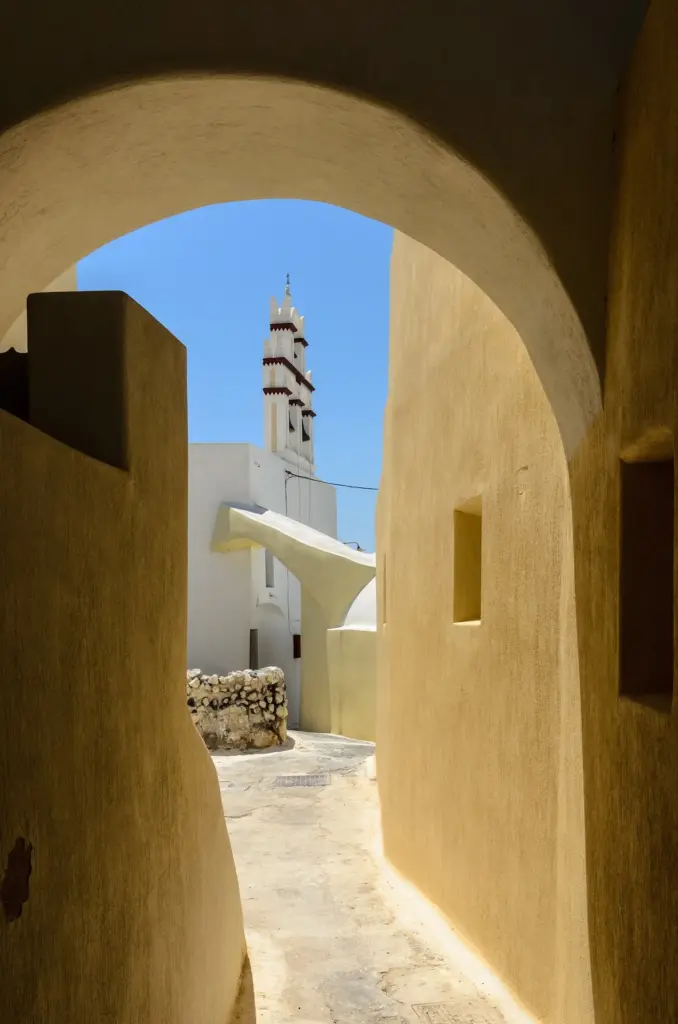
Look for Agios Nikolaos Marmaritis on the edge of the village, an ancient marble temple later turned into a chapel, and for the old tower houses inside the fortified core. The walk up to the windmills on the ridge gives views over the south coast and the long black beach below.
Plan it: free; about an hour; buses from Fira cost EUR 2.20. Combine it with a swim at Perissa. Best for: history lovers and anyone tired of caldera crowds.
6. Finikia
Oia’s quiet neighbor. Finikia sits just inland from Oia, a small village of pastel houses, cave homes and chapels where daily life carries on largely untouched by the sunset crowds a few minutes’ walk to the west. It’s the perfect start to an Oia morning: wander Finikia’s back lanes, then walk into Oia through the side streets before the day-trippers arrive.
It’s also a good place to look for a cheaper room or meal within walking distance of Oia, and its lanes are pleasant at any time of day, not just at dawn.
Plan it: free; under an hour; take the Oia bus from Fira (EUR 2.20). Best for: anyone visiting or staying in Oia.
7. Akrotiri Village
The southwest’s castle village. Akrotiri village sits on a hill in the southwest, above the prehistoric town of the same name, and grew around one of the island’s five medieval castles, whose ruins still crown the top. Its tower, La Ponta, housed a well-known exhibition of the tsabouna, the island bagpipe, until 2017, when that exhibition moved to Megalochori. The village is quiet and residential, with views over the south coast, and it pairs neatly with the archaeological site below, the boats to Red Beach and the lighthouse at the island’s western tip.
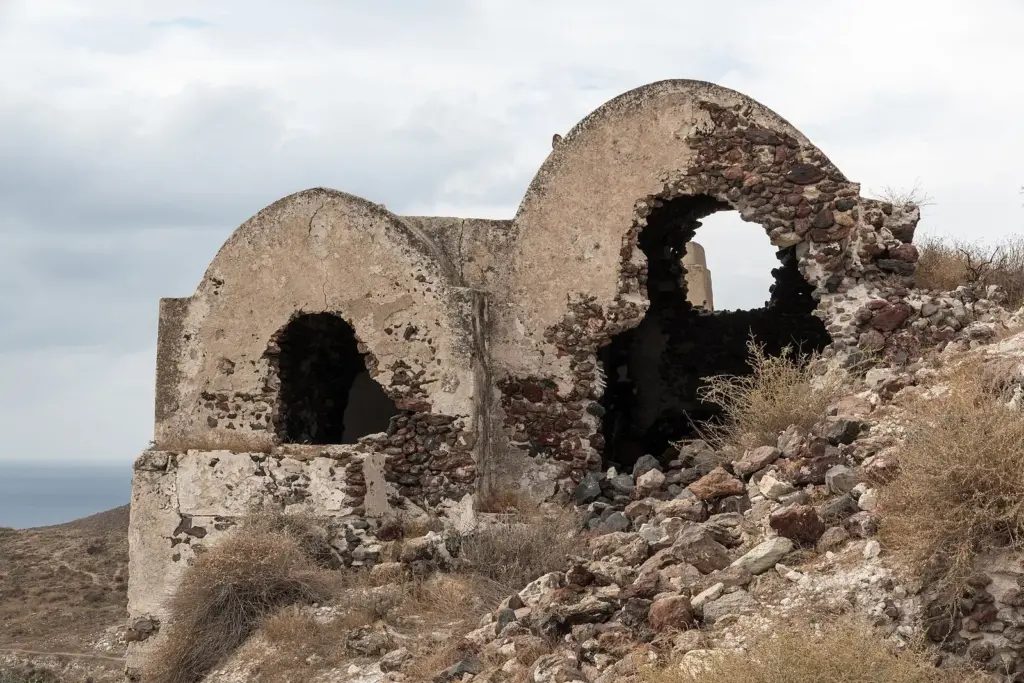
The prehistoric town below costs EUR 20 on the Ministry of Culture’s 2026 list and is open 08:00-19:00 on most days in the second half of September 2026, with shorter hours on Mondays and Thursdays. Small boats from the harbor to Red Beach cost roughly EUR 5-8, since the cliff path has been closed since 2013, and the lighthouse at the western tip is the area’s classic sunset spot.
Plan it: free; 45 minutes; buses from Fira cost EUR 2.20 (15.1 km). Visit the prehistoric site when it opens, then climb to the village. Best for: history lovers and travelers heading to the lighthouse for sunset.
8. Kamari
The beach village with a promenade. Kamari Santorini’s main beach resort stretches along a black-pebble beach on the east coast, backed by a car-free promenade of tavernas, cafes and bars, with the cliffs of Mesa Vouno and Ancient Thera rising at the southern end. It’s close to the airport and 7.3 km from Fira, and its beach holds two 2026 Blue Flags. In summer the open-air cinema screens films nightly, with the film at 21:30.
Ancient Thera, on the mountain above, costs EUR 10 and closes on Wednesdays in summer; you can drive or take a shuttle up the hairpin road from Kamari. Cine Kamari shows films in English with Greek subtitles and doesn’t take reservations, so arrive when the doors open at 20:30. Among the hotels, Costa Grand says it’s the only resort right on Kamari’s beach.
Plan it: buses from Fira cost EUR 2.20. Pair a swim with the climb to Ancient Thera, and stay for dinner on the promenade. Best for: families and beach lovers.
9. Perissa
The long black beach. Perissa Santorini’s southern beach village sits under the cliffs of Mesa Vouno at the start of the island’s longest stretch of black sand, which runs on through Perivolos to Agios Georgios. The village is relaxed, young and the cheapest base on the island, with family-run hotels, hostels, beach bars and tavernas. The old path up to Ancient Thera starts nearby, and Emporio is a few minutes inland.
Perissa is where you’ll find the island’s cheapest beds: on September 24, 2026, one family-run hotel two minutes from the beach listed rooms for two at EUR 50-55 for early October, and a hostel near the sand takes guests aged 18 to 40. Sunbeds and umbrellas line most of the beach in summer, with free stretches at the ends.
Plan it: buses from Fira cost EUR 2.70 (20.4 km); one Perissa hotel says they run every 20-30 minutes in high season. Its beach holds a 2026 Blue Flag. Best for: budget travelers and beach-focused trips.
10. Karterados
Village life a walk from Fira. Karterados sits just southeast of Fira on flat ground, a village of older houses, small churches and a main square with a round stone windmill. There’s no caldera view and no beach, but it’s on the bus routes into Fira, about a 25-minute walk or a five-minute drive away, and its guesthouses and apartments cost far less than the rim. Karterados Santorini’s best-known address is Caveland, a hostel in an 18th-century wine estate with rooms in caves once used for wine storage.
Karterados is also a sensible base for travelers without a car who don’t need a view: you can walk into Fira for dinner and catch any bus from the hub the next morning, for a fraction of the price of a caldera room.
Plan it: buses from Fira cost EUR 2.20. Best for: budget travelers and anyone without a car who wants to be near Fira.
11. Messaria
The crossroads village with mansions. Messaria, in the center of the island, is where several main roads meet, and many visitors pass through without stopping. They miss its neoclassical mansions, built by wine merchants in the 19th century, and its churches, including the domed church of Saint Demetrius. The best known mansion, the Argyros Mansion of 1888, is shown to visitors as a museum on its first floor.
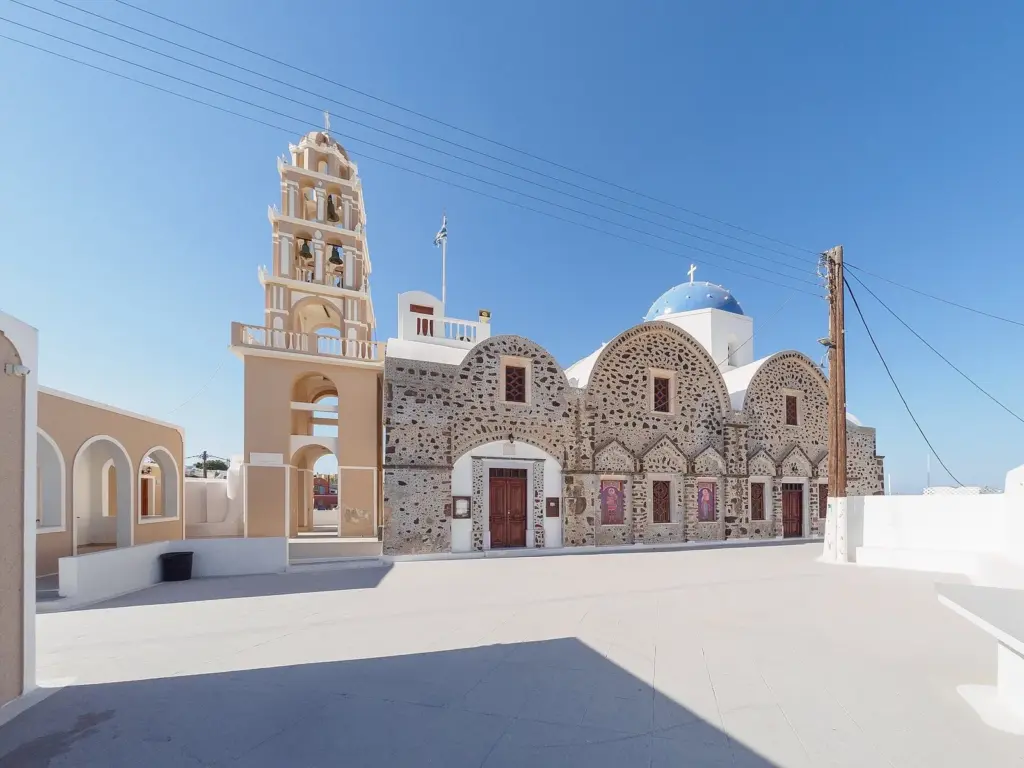
Listings for the Argyros Mansion give hours of May 1 to October 31, daily except Mondays and Thursdays, 10:00-14:00 and 17:00-19:00, with guided tours in Greek and English. Check the hours for this year before you go. The rest of the village is worth a slow loop on foot, looking up at the mansion facades and into the church courtyards.
Plan it: buses from Fira cost EUR 2.20; allow an hour. Best for: architecture lovers and anyone with a car exploring the center.
12. Vothonas
Houses dug into a ravine. Vothonas, between Fira and Pyrgos, is built into the sides of a ravine, with cave houses cut into the soft volcanic rock and churches set into the gully. It’s one of the clearest places on the island to see how Santorini’s people built before concrete, using the ground itself for insulation against the summer heat and the winter wind. Almost nobody stops here, which makes it all the more rewarding.
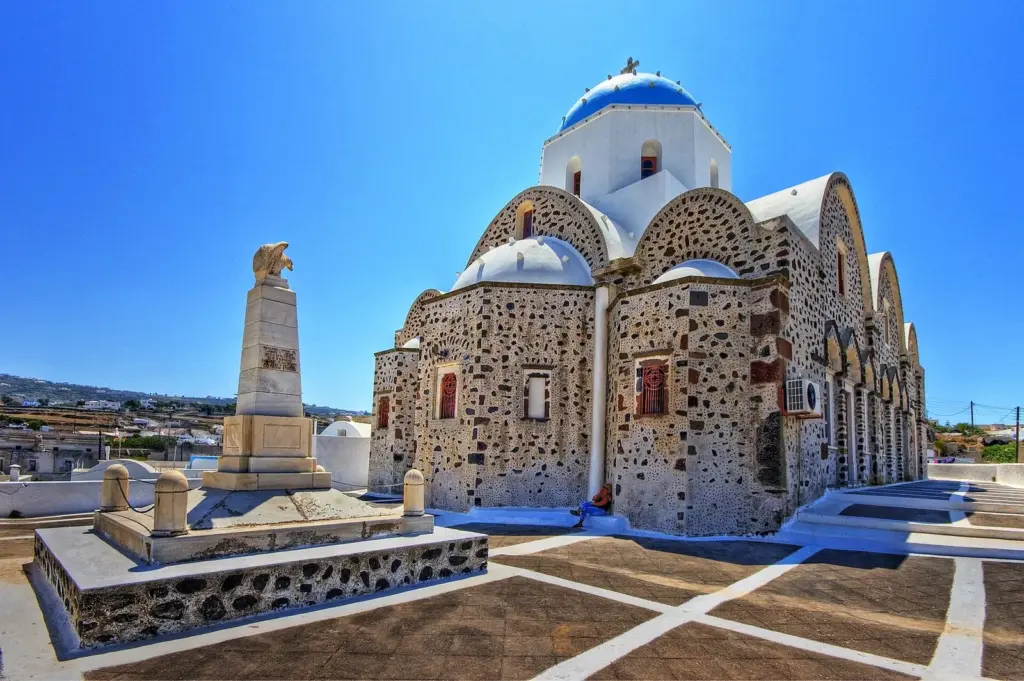
Look for the facades cut straight into the rock walls of the ravine, with a door and a window or two and the whole house hidden behind. It’s a short stop, best combined with a drive to Pyrgos.
Plan it: free; 30-45 minutes; it’s on the Fira-Pyrgos bus route (EUR 2.20). Best for: curious travelers with a car or scooter.
13. Exo Gonia and Episkopi Gonia
Two faces of one hillside. Exo Gonia climbs a hillside below Pyrgos, crowned by a large church that dominates the village and looks out over the vineyards to the east coast. Below it, Episkopi Gonia, also called Mesa Gonia, is a half-abandoned village whose houses were emptied by the 1956 earthquake, and it holds the Byzantine church of Panagia Episkopi, one of the oldest on the island. Together they make a quiet, slightly haunting detour on the road down to Kamari.
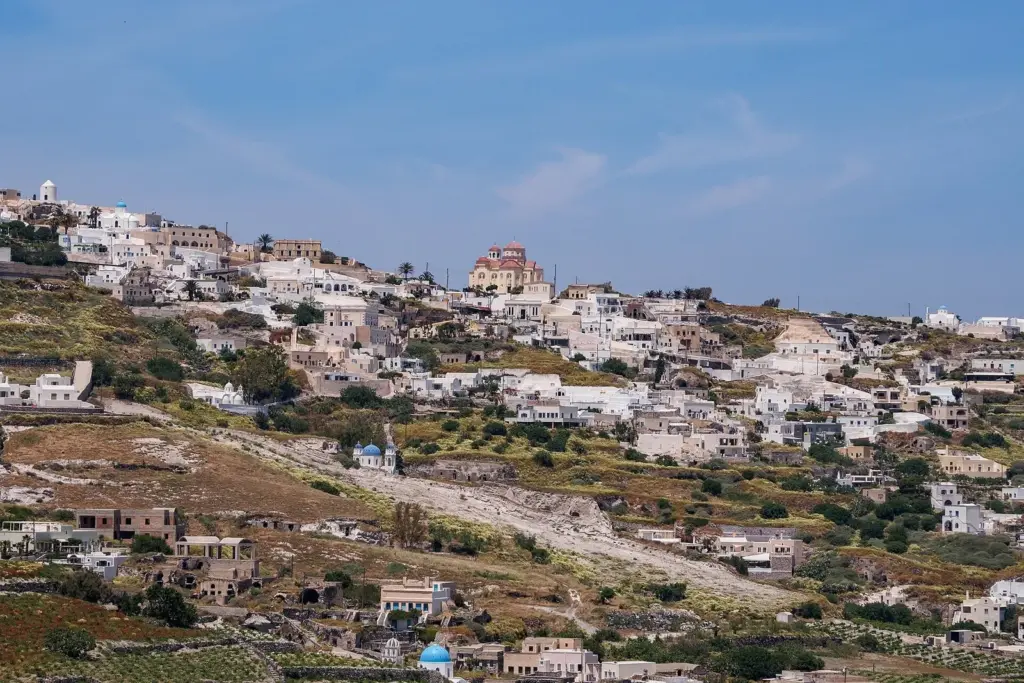
Panagia Episkopi is said to date to the 11th century, which makes it one of the oldest churches on the island; opening depends on the parish, so treat the interior as a bonus. Several wineries sit in the surrounding countryside, which makes this hillside a natural stop on a wine loop.
Plan it: free; about an hour for both; buses from Fira cost EUR 2.20; church opening hours vary. Best for: church lovers and anyone driving between Pyrgos and Kamari.
14. Vourvoulos
A fishing harbor at the end of the road. Vourvoulos, on the northeast side of the island, is a small village with a tiny harbor of painted fishing boats, cliffs of layered volcanic rock and vineyards behind. There are no sights as such, just a glimpse of a Santorini that still works for a living, and a quiet place for a coffee or a fish lunch far from the caldera traffic.
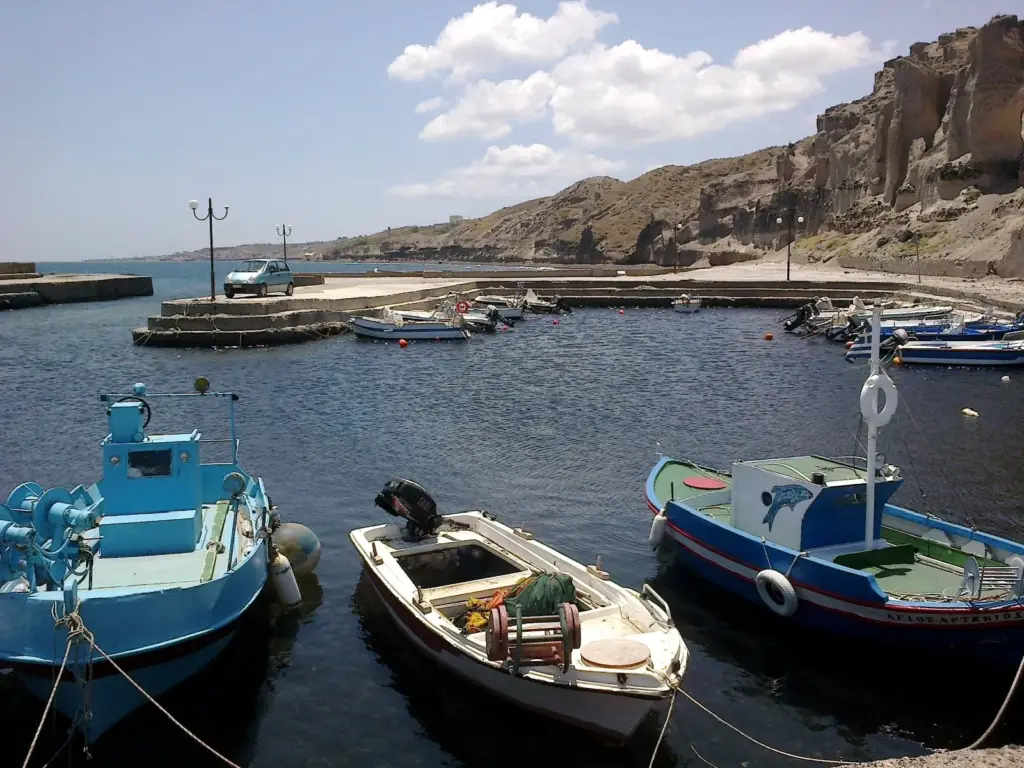
Below the village, a beach of dark sand stretches along the coast; it catches the north wind, so it’s best on calm days. The drive out along the northeast side of the island passes vineyards and very few other cars.
Plan it: buses from Fira cost EUR 2.20; a car is easier. Best for: travelers who want to escape everyone.
What About Oia and Fira?
Oia and Fira are the two best-known villages on the island, and each has its own guide on this site. Oia, at the northern tip, is the famous sunset village of cave houses, windmills and blue domes; our Oia Santorini guide covers the lanes, the castle, Ammoudi Bay and the sunset in detail. Fira is the capital and the island’s hub, with the museums, the cable car, the most restaurants and bars, and the bus station. The Fira Santorini visitors pass through first is its busy caldera edge, but the town’s quieter northern lanes and Catholic quarter reward a slower look.
Which Santorini Village Is Best for You?
| If you want… | Choose |
|---|---|
| The best caldera view without the crowd | Imerovigli |
| A first-time base with views and easy transport | Firostefani |
| The most traditional village | Pyrgos or Emporio |
| Wine and quiet lanes | Megalochori |
| A beach on your doorstep | Kamari or Perissa |
| Value near Fira | Karterados |
| Somewhere almost nobody goes | Vothonas, Episkopi Gonia or Vourvoulos |
| History and a sunset | Akrotiri village, with the lighthouse |
For choosing a base, as opposed to a village to visit, our guide to where to stay in Santorini compares the villages as places to sleep, with hotels, prices and age rules. And if beaches are the priority, our guide to Santorini beaches rates every one.
Getting Around the Villages
- By bus: most villages are EUR 2.20 from Fira on the 2026 KTEL table, but routes radiate from Fira, so you’ll change there to go from one village to another.
- By car: the easiest way to string several villages together. Park at the edge of the old quarters, which are for walking.
- By scooter or ATV: popular, but the roads are narrow and busy in summer; wear a helmet, and check your rental company’s license rules.
- On foot: the caldera path links Fira, Firostefani, Imerovigli and Oia, and old paths link some inland villages, but distances and summer heat make walking between most villages impractical.
- By taxi: a taxi for the day, agreed in advance, is a good option for a village tour without driving.
Village-Hopping Routes
Santorini’s buses run hub-and-spoke from Fira, so hopping between villages by bus means changing in Fira. With a car, scooter or a taxi for the day, these loops link the best villages without backtracking.
- The castle villages: Pyrgos in the late morning, then south to Megalochori for lunch, and on to Emporio for the afternoon. Finish with a swim at Perissa.
- The wine loop: Megalochori, the wineries between it and Pyrgos, Pyrgos for the view, and Exo Gonia and Episkopi Gonia on the way down toward Kamari.
- The southwest: the prehistoric site at Akrotiri when it opens, Akrotiri village and its castle, a boat to Red Beach, and the lighthouse for sunset.
- The north: Finikia and Oia early in the morning, the caldera path south to Imerovigli, and Vourvoulos for a quiet lunch on the way back.
- The rim on foot: Fira to Firostefani and Imerovigli along the caldera path, an easy walk with the best views on the island.
A Day in the Inland Villages
If you give the villages one full day, this is the order we’d follow, by car or with a taxi for the day.
- Morning: start in Pyrgos before 10:00, when the lanes are empty and the light is soft. Climb to the Kasteli for the view, then drive up to Profitis Ilias for the panorama over the whole island.
- Late morning: stop in Vothonas on the way south to see the cave houses in the ravine, then continue to Megalochori.
- Lunch: eat on or near Megalochori’s square, then walk out to the caldera rim by the chapel of Saint Marina.
- Afternoon: visit a winery nearby for a tasting, then head south to Emporio to explore its fortified quarter as the heat eases.
- Evening: swim at Perissa as the sun drops, then drive back to Pyrgos for dinner below the castle.
The Five Castles of Santorini
For centuries, pirate raids shaped where Santorini’s people lived. Under Venetian rule, which began in the early 13th century, the islanders gathered in five fortified settlements called kastelia: Skaros, on the rock below Imerovigli, which was the main settlement; Oia, at the northern tip; Pyrgos, in the center; Emporio, in the south; and Akrotiri, in the southwest. Each was a tight cluster of houses whose outer walls formed the defenses, with narrow gates, a tower or two and a church at the heart.
What’s left varies. Skaros is a bare rock with almost nothing standing. Oia’s castle is a ruin that serves as the island’s favorite sunset spot. Akrotiri keeps its tower and some walls. Pyrgos and Emporio preserve the most, with their fortified cores still lived in, and they’re the best places to feel what life inside a kasteli was like.
Eating in the Villages
The inland villages are where Santorini eats. Village tavernas around the squares of Pyrgos and Megalochori, and along the lanes of Emporio, serve local dishes at prices well below the caldera: fava with capers and onions, tomato fritters made with the island’s small tomatoes, white eggplant and grilled meat, with wine from the surrounding vineyards. For fish, head to the coast, to the promenade at Kamari, the harbor at Vourvoulos or the beachfront at Perissa. Dinner is late in Greece, often from 21:00, and in summer booking ahead helps at the popular village places, especially in Pyrgos.
Easter and Village Festivals
The villages come alive on their saints’ days, when each parish holds a panigyri, a feast with food, wine, music and dancing that often runs late into the night. Most take place in summer, and visitors are welcome; ask at your hotel or look for posters in the village.
Greek Orthodox Easter is the biggest event of the year. On Good Friday, Pyrgos is lit with thousands of small flames along its walls, rooftops and lanes, and people come from all over the island to see it. Easter dates follow the Orthodox calendar and change each year, so check the date if you want to be there.
Santorini Villages Through the Year
- Spring (April and May): the best time for village walks. The countryside is at its greenest, the vines are leafing out, and the lanes are cool enough to wander at midday. Greek Orthodox Easter usually falls in April or early May, when Pyrgos lights up on Good Friday.
- Summer (June to August): the villages are hot and bright at midday, with little shade. Go early or late, and save the middle of the day for a long lunch or a museum. Summer is also the season of village feasts.
- Fall (September and October): harvest time in the wine villages, warm evenings and far fewer visitors. Our favorite season for Pyrgos and Megalochori.
- Winter (November to March): the caldera villages, which are mostly hotels, go very quiet, and many businesses close. The inland villages, where islanders actually live, carry on: bakeries, kafeneia and churches stay open, and you see the island’s everyday life.
Village Etiquette
- People live here. Keep your voice down in the lanes, especially in the early afternoon and late at night, and don’t walk into courtyards or onto terraces uninvited.
- Ask before photographing people. Doorways and churches are fair game; residents are not.
- Dress for churches. Cover shoulders and knees if you step inside.
- Leave the car outside. The old quarters were built for people and donkeys, not rental cars.
What’s Changed Recently
| What | Now |
|---|---|
| Atlantis Books | Moved from Oia to the cliffside of Firostefani, at the base of the Nomikos Cultural Centre (per its own website) |
| La Ponta tsabouna exhibition, Akrotiri | Moved in 2018 to the Symposion Cultural Center in Megalochori |
| Bus fares from Fira | EUR 2.20 to most villages, EUR 2.70 to Perissa (KTEL table updated May 19, 2026) |
| Civil Protection measures | Affect the Ammoudi road, Fira’s Old Port and Athinios until March 31, 2027, not the villages |
What to Skip
- Seeing only Oia and Fira. The inland villages are the island’s other half.
- Village-hopping by bus in one day. Every change goes through Fira; rent a car or take a taxi for a village day.
- Midday visits in summer. The lanes are hot and shadeless at noon. Go in the morning or late afternoon.
- Looking for La Ponta’s bagpipes in Akrotiri. The exhibition moved to Megalochori in 2018.
- Driving into the old quarters. Park at the edge of Pyrgos, Emporio and Megalochori; the lanes are for walking.
Santorini Villages FAQ
What are the best villages in Santorini?
Beyond Oia and Fira, the best villages are Imerovigli and Firostefani for caldera views, Pyrgos and Emporio for medieval lanes and castles, and Megalochori for wine and bell towers. Kamari and Perissa are the best beach villages, and Vothonas and Episkopi Gonia are the quiet surprises few visitors find.
How many villages are there in Santorini?
Santorini has around a dozen main villages and settlements, from Oia in the north to Akrotiri in the southwest, plus smaller hamlets. The main ones are Oia, Finikia, Imerovigli, Firostefani, Fira, Karterados, Messaria, Vothonas, Pyrgos, Exo Gonia and Episkopi Gonia, Megalochori, Emporio, Akrotiri, Kamari, Perissa and Vourvoulos.
What is the most traditional village in Santorini?
Pyrgos and Emporio are the most traditional, with fortified medieval cores still lived in, narrow lanes, arches and churches. Megalochori, with its bell towers and old wineries, is a close third. All three are inland, quieter than the caldera villages and at their best in the morning or late afternoon.
Which village in Santorini has the best view?
Imerovigli, at the highest point of the caldera rim, has the widest views, taking in the whole curve of the caldera with Skaros Rock in the foreground. Oia has the most famous sunset view, and Pyrgos, inland on its hill, gives a panorama over almost the whole island.
How do you get between villages in Santorini?
By bus, most villages are a EUR 2.20 ride from Fira on the 2026 KTEL table, but routes run through Fira, so village-to-village trips usually mean a change. A rental car, scooter or taxi is much easier for a day of village-hopping. Along the caldera rim, you can walk between Fira, Firostefani, Imerovigli and Oia.
Is Pyrgos worth visiting?
Yes. Pyrgos is one of the best-preserved villages on the island, with lanes winding up to its Venetian castle and views over almost all of Santorini. It’s quieter than Oia and at its best in the late afternoon and evening. On Good Friday of Orthodox Easter, it’s lit with thousands of small flames.
Which Santorini village is best for families?
Kamari and Perissa, on the coast, are the easiest for families: flat streets, beaches, tavernas and hotels that accept children. Megalochori and Pyrgos are good for a family afternoon. The caldera villages involve many steps, and several cliff hotels there don’t accept young children.
Which Santorini village is best for couples?
Imerovigli, for its quiet lanes, caldera views and sunsets with Skaros Rock in the foreground, and Oia if you want the famous sunset on your doorstep and don’t mind the crowd. Firostefani is a good middle ground, with views and Fira’s restaurants a short walk away. Pyrgos and Megalochori suit couples who prefer village life and wine.
Sources and How We Checked
We checked the pages below in September 2026 and dated each fare and fact; we did not visit the villages for this guide.
- KTEL Santorini price table (updated May 19, 2026): fares and distances from Fira
- Symposion Cultural Center: the move from Akrotiri’s La Ponta tower to Megalochori
- Atlantis Books: its new location in Firostefani
- Blue Flag Greece: 2026 awards for Kamari and Perissa
- Cine Kamari: screening times
Santorini Tourism Guide is an independent publication. We are not affiliated with the Municipality of Thira, the Greek National Tourism Organisation, KTEL Santorini or any business listed here, and no one paid to be included.
Photo Credits
- Pyrgos from Profitis Ilias: photo by Bernard Gagnon, via Wikimedia Commons (CC BY-SA 3.0)
- Imerovigli: photo by Berard Gagnon, via Wikimedia Commons (CC BY-SA 3.0)
- Pyrgos at Easter: photo by Georgios Michos, via Wikimedia Commons (CC BY-SA 4.0)
- Emporio old quarter: photo by Norbert Nagel, via Wikimedia Commons (CC BY-SA 3.0)
- Ruins in Akrotiri village: photo by Dietmar Rabich, via Wikimedia Commons (CC BY-SA 4.0)
- Saint Demetrius, Messaria: photo by C messier, via Wikimedia Commons (CC BY-SA 4.0)
- Church in Vothonas: photo by Wolfgang Staudt from Saarbruecken, Germany, via Wikimedia Commons (CC BY 2.0)
- Exo Gonia: photo by C messier, via Wikimedia Commons (CC BY-SA 4.0)
- Vourvoulos harbor: photo by rene boulay, via Wikimedia Commons (CC BY-SA 3.0)